












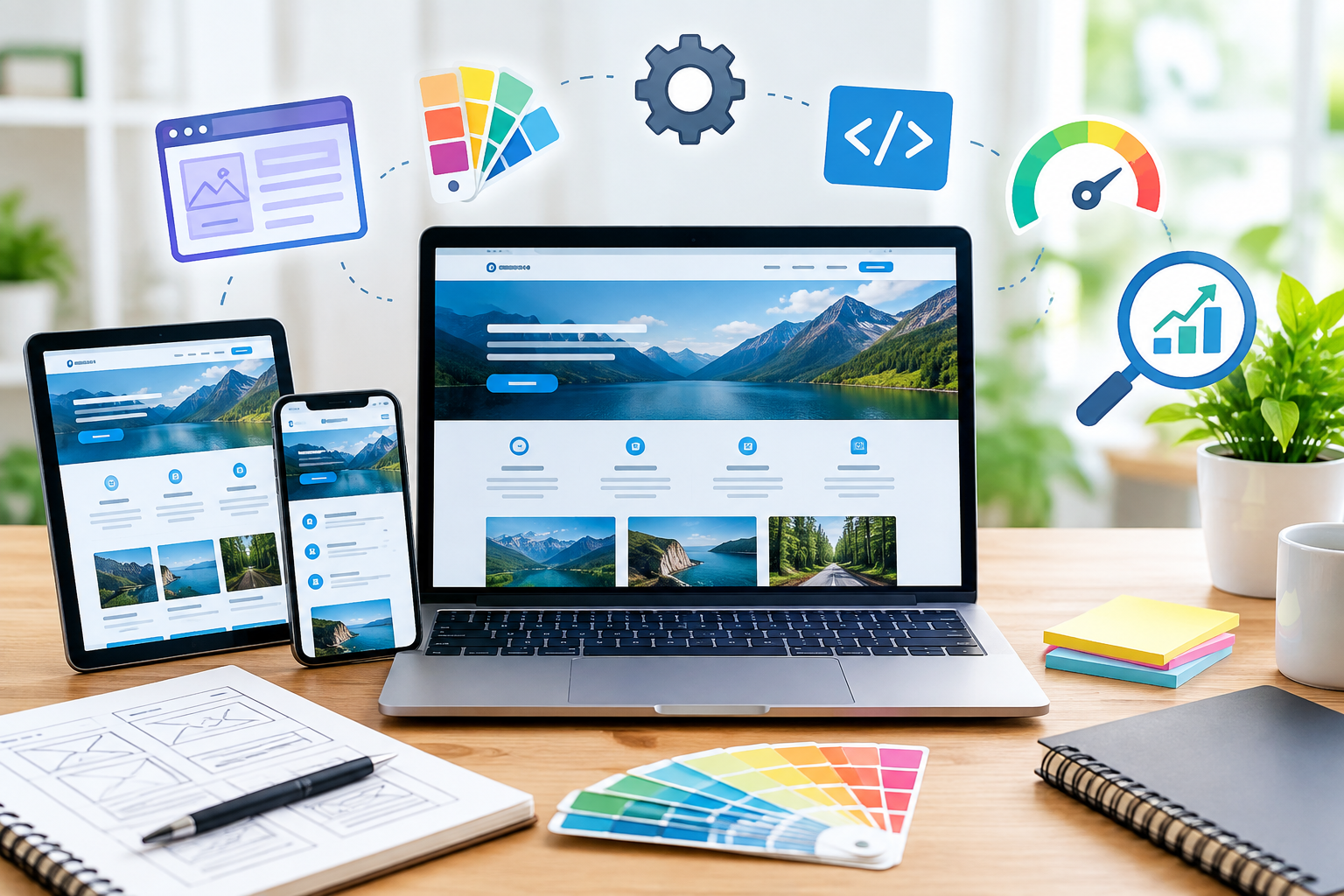


Discover how professional website design creates a visually appealing, user-friendly, mobile-responsive, secure, and high-performing website that strengthens brand credibility, improves user experience, increases organic visibility, and generates more business opportunities.
Introduction
Website design is one of the most important investments a business can make when establishing a strong and sustainable online presence. In today’s digital environment, a website is much more than an online brochure. It is a central business platform where potential customers discover services, evaluate products, compare alternatives, build trust, and decide whether to contact a company or make a purchase. A professionally designed website helps businesses communicate their value, establish credibility, and create meaningful interactions with their target audience.
An effective website combines visual design, user experience, content organisation, technical performance, accessibility, security, and search engine optimisation. Every element should work together to make information easy to find and actions easy to complete. Attractive colours and modern layouts can create a positive first impression, but successful website design requires much more than appearance. Navigation must be intuitive, pages must load efficiently, content must answer visitors’ questions, and the entire experience must work consistently across desktop computers, tablets, and smartphones. Businesses that overlook these foundations can lose valuable visitors even when their products or services are excellent.
For businesses seeking sustainable digital growth, website design should be approached as a strategic process rather than a one-time creative exercise. This involves understanding customer expectations, defining clear objectives, planning the website structure, selecting appropriate technologies, developing useful content, and continuously evaluating performance. A well-planned website can support marketing campaigns, generate qualified leads, improve customer relationships, and provide a foundation for future expansion.
At MyBlogPoster, the importance of a strategically developed online presence is closely connected to the wider goal of helping businesses communicate effectively and grow through digital channels. This comprehensive guide explores the essential principles of website design, from initial planning and visual identity to responsive development, technical optimisation, security, accessibility, and ongoing improvement.
Whether you are creating your first business website, redesigning an outdated platform, or improving an existing digital presence, understanding these principles will help you make better decisions and build a website that delivers lasting value.
Understanding Website Design and Its Importance for Business Growth
Website design is the process of planning, creating, and improving the visual appearance, structure, functionality, and overall experience of a website. It combines creative decisions with technical implementation to produce an online platform that communicates information effectively and helps visitors complete meaningful actions. These actions may include learning about a company, exploring services, purchasing products, requesting a quotation, subscribing to a newsletter, or contacting a support team. A successful website should make these activities straightforward while maintaining a consistent and professional brand experience.
Modern website design involves several connected disciplines. Visual design determines how colours, typography, images, spacing, and layouts work together. User experience design focuses on how easily visitors can understand and interact with the website. User interface design addresses the individual elements people use, including buttons, forms, menus, navigation panels, and interactive components. Web development transforms these design decisions into a functioning website using appropriate technologies. Search engine optimisation, performance optimisation, accessibility, and security also contribute to the overall quality of the finished platform. These areas should not be treated as isolated tasks because weaknesses in one area can negatively affect the entire experience. For example, an attractive homepage cannot compensate for confusing navigation, while technically advanced development cannot deliver strong results if visitors cannot understand the content.
The business value of professional website design extends beyond appearance. A clear, trustworthy website helps establish confidence before a potential customer makes direct contact. Visitors often use a company’s website to evaluate whether its services appear credible, relevant, and suitable for their requirements. Consistent branding, transparent business information, useful content, accessible contact details, and professional presentation can strengthen that impression. A strategically designed website can also support lead generation by placing relevant calls to action in appropriate locations and reducing unnecessary steps in conversion journeys. For e-commerce businesses, thoughtful product presentation, clear pricing, straightforward checkout processes, and reliable payment experiences can influence purchasing decisions. For service providers, informative service pages, case studies, testimonials, and enquiry forms can help convert interest into qualified enquiries.
Another important advantage is the ability to support long-term digital marketing activities. Search engine optimisation, content marketing, email campaigns, paid advertising, and social media promotion all benefit from having a well-organised destination where visitors can obtain further information. A website provides greater control over content, navigation, customer journeys, and brand presentation than many third-party platforms. It also creates opportunities to measure meaningful outcomes through analytics and conversion tracking. Businesses should therefore view website design as a long-term business asset that requires planning, investment, maintenance, and continuous improvement. The strongest websites are not necessarily the most complicated; they are the ones that understand their audiences, communicate clearly, perform reliably, and make it easy for visitors to take the next appropriate step.
Defining Website Goals, Target Audiences, and Business Requirements
Before designing individual pages or choosing a development platform, businesses should establish what their website needs to achieve. Without clear objectives, design decisions can become based on personal preferences rather than measurable business requirements. A company might want to generate service enquiries, increase online sales, improve brand awareness, publish educational resources, provide customer support, or attract potential partners. Each objective influences the website’s structure, content, functionality, and conversion strategy. A lead-generation website, for example, may prioritise service information, credibility indicators, enquiry forms, and consultation requests. An online store requires product categories, search and filtering options, product information, shopping cart functionality, payment integration, and order management. Defining these objectives early helps prevent unnecessary features and keeps the project focused on delivering practical value.
Understanding the target audience is equally important. Businesses should investigate who their potential visitors are, what problems they want to solve, what information they need, and what obstacles might prevent them from taking action. Audience research can include customer interviews, existing website analytics, sales-team feedback, customer support enquiries, market research, and competitor analysis. Useful questions include whether visitors are familiar with the products or services, whether they are comparing different providers, and whether they need detailed technical explanations before making a decision. Their expectations may also differ depending on their experience, location, industry, purchasing authority, and preferred device. A business serving professional organisations may need detailed service specifications and evidence of expertise, whereas a consumer-focused business might benefit from simpler explanations, prominent product images, transparent pricing, and straightforward purchasing options.
Once the audience and objectives are understood, they should be converted into a practical website requirements document. This document can describe essential pages, content requirements, functionality, design preferences, integrations, technical constraints, and project priorities. Typical requirements include a homepage, about page, service or product pages, contact page, frequently asked questions, privacy information, and supporting resource content. Additional functionality might include booking systems, customer portals, payment gateways, searchable directories, downloadable resources, or multilingual content. Requirements should be divided into essential features and optional enhancements so that the project does not become unnecessarily complicated. It is also important to consider who will manage the website after launch. A business that regularly publishes articles may need an easy-to-use content management system, while a complex organisation may require different user permissions and approval workflows.
Measurable success indicators should be established before development begins. These may include qualified enquiries, completed purchases, booking requests, newsletter subscriptions, engagement with important service pages, or successful completion of other business goals. Website traffic alone does not necessarily demonstrate commercial success because visitors must also find the content useful and complete relevant actions. Businesses should identify the metrics that genuinely reflect their objectives and establish a baseline where existing data is available. Clear goals help designers prioritise page layouts, content placement, navigation, and conversion opportunities. They also provide a framework for evaluating the finished website after launch. By connecting audience research, business objectives, technical requirements, and measurable outcomes, organisations can build a website around genuine user needs instead of creating a collection of attractive pages without a clear purpose.
Creating a Strong Brand Identity and Consistent Visual Design
Brand identity is a fundamental part of effective website design because it determines how a business presents itself and how visitors recognise its organisation across different digital touchpoints. A website should communicate a consistent personality through its colour palette, typography, imagery, graphic elements, logo placement, and writing style. When these components work together, they create a recognisable visual experience that supports brand awareness and reinforces professionalism. Consistency is especially important for businesses that use multiple marketing channels, including social media, email campaigns, digital advertisements, and printed materials. If the website looks disconnected from the company’s other communication channels, visitors may find it harder to recognise the brand or understand its positioning.
Colour selection should be based on readability, brand suitability, and the purpose of individual interface elements. A business may choose a primary colour for important visual elements, secondary colours for supporting sections, and neutral shades for backgrounds and text. Colours should have clear roles rather than being used randomly throughout the website. For example, a consistent accent colour can highlight important buttons, while neutral backgrounds can help content remain readable. Designers must also consider sufficient contrast between text and its background, especially for users with visual difficulties. Typography requires similar attention. A suitable font should be easy to read across different screen sizes, with a clear hierarchy between headings, subheadings, body text, labels, and supporting information. Using too many font families or inconsistent text sizes can make pages appear disorganised and reduce readability. A carefully defined design system helps maintain consistency as the website grows.
Visual content also influences how visitors understand a business. Professional photographs, product images, diagrams, illustrations, and videos can explain information more effectively than large blocks of text when they are selected for a clear purpose. Images should reflect the actual business, its products, services, team, or working environment wherever practical. Relevant original imagery can provide context and help visitors understand what they are being offered. Businesses should avoid using unrelated stock photography simply to fill empty spaces because generic visuals may weaken credibility. Image selection should also consider file size, quality, cropping, and alternative text where appropriate. Decorative imagery should support the design without distracting visitors from important content. Similarly, animations and visual effects should be used carefully because excessive movement can make interfaces difficult to use and may negatively affect performance.
A consistent visual identity should be documented in a practical style guide or design system. This can define logo variations, brand colours, typography, button styles, spacing rules, image treatments, icon usage, form elements, and common page components. Reusable components help designers and developers maintain consistency across different pages while reducing unnecessary design work. They also make future updates easier because a change to a shared component can be applied systematically rather than recreated individually. However, consistency should not mean making every page identical. Different pages may require different layouts depending on their content and purpose, but they should still feel like parts of the same website. The ultimate goal is to create a visual identity that communicates the business’s character, makes information easy to understand, and gives visitors a dependable experience. Strong branding should support usability and communication rather than compete with them.
Planning Website Structure, Navigation, and Information Architecture

Information architecture is the process of organising website content so that visitors can understand what is available and locate the information they need without unnecessary effort. It provides the structural foundation of the website and influences navigation, page relationships, internal linking, and content discovery. A poorly organised website can frustrate visitors even when its individual pages are attractive and informative. For example, if important services are hidden inside confusing menu categories or essential contact information is difficult to locate, users may leave before completing their intended task. A logical structure reduces this friction by grouping related information, establishing clear page relationships, and creating predictable navigation patterns.
The planning process usually begins with identifying the main content categories and the pages required under each category. A simple business website might include Home, About, Services, Resources, and Contact sections. A larger organisation may need additional categories for individual services, industry solutions, locations, customer resources, case studies, and support documentation. A visual sitemap can help stakeholders understand the proposed hierarchy before development starts. Each page should have a clear purpose, and its position within the structure should reflect how visitors are likely to explore the business. Designers can use card-sorting exercises, audience research, and competitor analysis to understand how information should be grouped. The goal is to create a structure based on user expectations rather than the internal organisational chart of the business.
Navigation design translates this structure into practical interface elements. Main navigation menus should use clear, descriptive labels that communicate the destination of each link. Visitors should not have to guess what an unfamiliar menu label means. Dropdown menus can be useful for larger websites, but they should be organised carefully and remain accessible through appropriate input methods. Breadcrumb navigation can help users understand their position within a deeper website hierarchy, especially on e-commerce platforms and resource libraries. Footer navigation provides another opportunity to make important pages accessible, including contact information, privacy policies, service links, and supporting resources. Search functionality may also be valuable when a website contains a large amount of content. Whatever navigation approach is selected, it should remain consistent across the website and work reliably on mobile devices.
Information architecture also contributes to search engine discoverability. Search engines use links and other signals to discover pages and understand relationships between content. Important pages should be accessible through logical internal links rather than isolated from the rest of the website. Descriptive URLs, meaningful page titles, relevant headings, and well-organised content can make the site easier for users and search engines to understand. XML sitemaps can help communicate which URLs are important for discovery, although they do not guarantee indexing. Businesses should also avoid creating unnecessarily deep structures that make important information difficult to reach. A well-planned website architecture connects the homepage, category pages, service pages, and supporting resources through meaningful relationships. By treating information architecture as a strategic foundation, businesses can create a website that is easier to navigate, simpler to maintain, and better prepared for future expansion.
Designing User-Friendly Interfaces and Improving User Experience (UX)
User experience (UX) design focuses on the overall quality of interaction between visitors and a website. It considers whether users can understand the interface, find relevant information, complete tasks, and achieve their goals without unnecessary confusion. Good UX design is based on real user needs rather than assumptions about what looks attractive. A website may have impressive graphics and advanced animations, but if visitors struggle to find a service, understand a price, or complete an enquiry form, the design is not performing effectively. The primary objective is to make interactions clear, predictable, and convenient while helping visitors move naturally from their initial interest towards an appropriate action.
A user-friendly interface should provide clear visual hierarchy. Important information needs to be presented in a way that makes its significance immediately understandable. Page headings should describe the content, supporting text should explain key details, and calls to action should be visible without overwhelming the rest of the interface. Adequate spacing between sections helps visitors distinguish different content areas, while consistent alignment makes pages easier to scan. Buttons should look interactive and use meaningful labels such as requesting a quotation, booking a consultation, or viewing service details. Form fields should have clear labels and instructions, and error messages should explain how users can correct mistakes. Designers should avoid relying entirely on colour, position, or icons to communicate important information because these signals may not be understood by every visitor.
User journeys should be considered throughout the design process. A visitor arriving on a homepage from a search result may need an overview of the business before exploring individual services. Someone landing directly on a service page may already understand their problem and simply want pricing, examples, or contact details. An existing customer may be looking for support information rather than promotional content. Each journey requires a different combination of information and interface elements. User journey mapping helps designers identify the steps visitors take, the questions they ask, and the potential points where confusion may occur. Wireframes and prototypes can then be used to test page layouts before development. Even simple usability sessions with a small number of representative users can reveal issues that internal stakeholders may overlook.
Continuous UX improvement should be supported by evidence. Website analytics can show where visitors enter the website, which pages they explore, and where they leave, while session recordings and heatmaps may help reveal interaction patterns when collected and used appropriately. Feedback forms, customer interviews, support enquiries, and usability testing can provide additional context about why visitors experience difficulties. However, individual metrics should not be interpreted without considering the wider user journey. A high exit rate on a contact page, for example, may be expected if visitors have successfully found the company’s phone number. Changes should be based on a combination of quantitative evidence and qualitative feedback. Businesses should also test important changes rather than assuming that a visually appealing redesign will automatically improve performance. Effective UX design is an ongoing process of understanding people, reducing friction, improving clarity, and making the website more useful with every iteration.
Building a Mobile-Responsive Website for All Devices
Mobile-responsive website design ensures that a website can adapt to different screen sizes, orientations, and device capabilities while maintaining usability and visual consistency. Visitors may access the same website through desktop computers, laptops, tablets, and smartphones, and each device presents different interaction conditions. A layout that works well on a large monitor may become difficult to navigate on a smaller screen if text is too small, buttons are too close together, or content extends beyond the visible area. Responsive design addresses these challenges by allowing layouts and interface components to adjust according to available screen space. It is therefore an essential requirement for modern business websites rather than an optional visual enhancement.
A responsive layout commonly uses flexible grids, fluid containers, scalable images, and CSS media queries to adapt content to different viewport dimensions. Instead of designing fixed-width pages for a single screen size, developers establish flexible rules that allow page elements to rearrange naturally. A multi-column desktop layout might become a single-column mobile layout, while navigation menus may transform into compact mobile navigation controls. Images should scale without distortion, and text should remain readable without requiring visitors to zoom. Developers should also consider how interactive elements behave on touchscreens. Buttons and links need sufficient size and spacing to reduce accidental taps, while forms should use appropriate input types and provide clear instructions. Responsive design should be tested on actual devices where possible, not only through desktop browser resizing.
A mobile-first approach can help businesses prioritise essential content and functionality. This method begins by considering the needs of visitors using smaller screens and then expands the design for larger devices. It encourages designers to identify the most important information, simplify navigation, and avoid unnecessary interface elements. Mobile-first design does not mean removing valuable content from mobile pages. Users should be able to access the same essential information and complete the same important tasks regardless of device. Instead, content and components should be organised in ways that suit the available screen space. For example, a service page may present its main benefit, key details, and contact action prominently before displaying more detailed supporting information further down the page.
Responsive performance also depends on technical decisions. Large images, unnecessary scripts, complex animations, and excessive third-party integrations can create a poor experience, particularly on slower connections or less powerful devices. Developers should use appropriately sized images, modern image formats where supported, efficient CSS and JavaScript, and suitable caching strategies. Testing should include different viewport sizes, browsers, network conditions, and interaction methods. Google’s mobile-first indexing guidance explains the importance of ensuring that mobile and desktop versions provide equivalent important content and metadata. Businesses should also review the responsive web design fundamentals when planning adaptable layouts. A properly implemented responsive website improves accessibility, supports customer convenience, and creates a more consistent experience across the devices people use every day.
Creating High-Quality Website Content and Effective Page Layouts
Website content is one of the most important elements influencing how visitors understand a business, evaluate its services, and decide what to do next. Even an attractive website can struggle to achieve its objectives if the content is vague, incomplete, poorly organised, or written without considering the audience. High-quality website content should answer genuine questions, explain products and services accurately, communicate business value, and provide clear next steps. It should also reflect the organisation’s actual expertise and capabilities rather than relying on exaggerated claims or generic marketing language. Businesses should approach content planning as an essential part of website design because page layouts and user journeys depend on the information visitors need.
Every important page should have a clear content purpose. A homepage should introduce the business, explain its main offering, communicate its key value proposition, and direct visitors towards relevant sections. Service pages should explain what each service includes, who it is intended for, what problems it addresses, and how potential customers can enquire. About pages can communicate the organisation’s background, experience, team, and approach, while case studies can demonstrate practical work and outcomes where evidence is available. Contact pages should make it easy to find appropriate communication channels and submit an enquiry. Supporting articles and educational resources can answer common questions and help visitors make informed decisions. Content should be written in clear language, with descriptive headings, concise paragraphs, useful examples, and relevant supporting visuals.
Page layout should help visitors consume this information without unnecessary effort. A clear hierarchy usually begins with a descriptive page heading, followed by an introduction that explains the subject and establishes relevance. Supporting sections should be organised in a logical order, with headings that help visitors scan the page. Lists, tables, diagrams, and illustrations can make complex information easier to understand when used appropriately. Important details should not be hidden behind decorative elements or vague labels. Calls to action should appear at relevant points in the user journey, giving visitors a natural opportunity to proceed when they have enough information. However, businesses should avoid placing too many competing calls to action on the same page because this can create uncertainty about the next step. Good page design balances visual interest with clarity and useful information.
Content should also be planned with search intent and search engine optimisation in mind. Each page should address a distinct topic or user need, with relevant phrases included naturally in titles, headings, descriptions, and body content. Keyword research can help identify the language potential customers use when searching for products or services, but content should never be written simply to repeat keywords. Search engines aim to surface useful and relevant information, so businesses should prioritise accuracy, originality, depth, and helpfulness. Google’s creating helpful, reliable, people-first content guidance provides a useful framework for evaluating content quality. Organisations should review content regularly to correct outdated information, improve unclear explanations, and reflect changes in services or customer requirements. When content and layout are planned together, a website becomes more than a collection of pages: it becomes a practical communication platform that helps visitors understand the business and make confident decisions.
Search Engine Optimisation (SEO) and Website Design Integration
Search engine optimisation should be considered during the website design and development process rather than added as an afterthought. SEO-friendly website design helps search engines discover, crawl, interpret, and understand website content while making information easier for visitors to access. A website may have an impressive visual appearance, but if its pages are difficult to crawl, its content is poorly organised, or its technical foundations are weak, it may struggle to attract relevant organic traffic. Integrating SEO into the initial design process helps businesses establish a stronger foundation for search visibility and reduces the need for expensive structural changes later. This includes planning website architecture, creating descriptive URLs, organising headings, optimising images, implementing internal links, and ensuring that important content can be accessed without unnecessary technical barriers.
On-page SEO is an important part of this process. Every important page should have a descriptive title, a relevant meta description, a clear main heading, and supporting headings that organise its information logically. Content should address the search intent behind relevant queries rather than simply repeating keywords. For example, a business offering website development services might create separate pages for business website design, e-commerce website development, responsive website design, and website redesign services when these represent genuinely different customer needs. Each page should provide useful and sufficiently detailed information instead of repeating similar content with minor keyword changes. Image optimisation is also important. Descriptive image filenames, suitable alternative text, appropriate image dimensions, and efficient file formats can improve accessibility and help search engines understand visual content. Internal links should connect related pages using meaningful anchor text so visitors can discover relevant information naturally.
Technical SEO ensures that the website provides a reliable foundation for search engine discovery and indexing. Developers should implement crawlable navigation, sensible URL structures, XML sitemaps where appropriate, canonical tags when needed, and correct indexing directives. Websites should avoid accidentally blocking important resources or pages through robots.txt rules or noindex instructions. HTTPS should be configured correctly, and unnecessary redirect chains should be avoided. Structured data can help search engines interpret eligible information about an organisation, product, article, or other supported entity, but it must accurately represent the visible content and follow the relevant requirements. Businesses should also use Google Search Console to monitor indexing, search performance, and technical issues. Google’s SEO Starter Guide provides practical guidance on creating websites that are easier for search engines and people to understand.
SEO performance should be evaluated over time rather than judged immediately after launch. Search engines need time to discover and process updated pages, and improvements in rankings are never guaranteed. Businesses should monitor organic impressions, clicks, search queries, landing-page performance, and meaningful conversions. A page attracting traffic is not necessarily successful if visitors cannot find relevant information or take useful action. Similarly, a page receiving fewer visits may still contribute significant commercial value if it attracts highly qualified enquiries. A sustainable SEO strategy therefore combines technical quality, helpful content, relevant internal linking, clear page structure, and a positive user experience. By integrating these elements into website design, businesses can create a platform that supports both immediate usability and long-term organic visibility.
Website Speed, Performance Optimisation, and Core Web Vitals
Website performance has a direct influence on how visitors experience a digital platform. Slow-loading pages, delayed interactions, unstable layouts, and unresponsive interface elements can create frustration and make it difficult for users to complete important tasks. A potential customer may abandon a service page if the main information takes too long to appear, while an online shopper may lose confidence if product images and checkout components behave inconsistently. Website speed optimisation should therefore be treated as an important part of user experience, technical development, and ongoing website maintenance. The objective is not simply to achieve an impressive score in a testing tool but to provide a fast, stable, and responsive experience under realistic conditions.
Google’s Core Web Vitals provide three important measurements of real-world user experience. Largest Contentful Paint (LCP) measures how quickly the largest relevant content element becomes visible. A good LCP result is 2.5 seconds or less. Interaction to Next Paint (INP) measures responsiveness when users interact with a page, with a good target of less than 200 milliseconds. Cumulative Layout Shift (CLS) measures unexpected visual movement, with a good target of less than 0.1. These measurements help developers identify performance problems that affect visitors. For example, an oversized hero image may delay the main content, excessive JavaScript may slow interactions, and images without reserved dimensions may cause content to move unexpectedly while a page loads. These issues should be investigated using real-user performance information as well as controlled testing.
Image optimisation is often one of the most practical ways to improve loading performance. Large image files can increase page weight and delay important content, especially on mobile connections. Developers should resize images according to their actual display dimensions, select efficient formats such as WebP or AVIF where supported, and apply suitable compression without unnecessarily reducing visual quality. Responsive image techniques can deliver different image sizes to different devices. Lazy loading can also reduce unnecessary initial downloads for images that are below the visible area, although the main above-the-fold image should not be delayed when it is needed for the initial rendering experience. Other improvements include reducing unused CSS, minimising unnecessary JavaScript, enabling browser caching, using compression, selecting reliable hosting, and reviewing third-party scripts. Content delivery networks can help distribute static resources efficiently to users in different geographical locations.
Performance optimisation should be based on measurement and prioritisation. Tools such as PageSpeed Insights can help identify opportunities for improvement, while Core Web Vitals resources explain the measurements and recommended thresholds. Developers can also use browser developer tools and Lighthouse to investigate rendering, network requests, and resource usage. Google’s Core Web Vitals guidance explains how these metrics relate to search and user experience. Businesses should remember that excellent laboratory scores do not automatically guarantee strong real-world performance or high search rankings. Actual visitor conditions, device capabilities, network quality, and page complexity all matter. A practical performance strategy involves establishing a baseline, fixing the most significant bottlenecks, testing important page templates, and monitoring results after every major update. Continuous optimisation helps maintain a reliable experience as the website grows.
Website Security, HTTPS, and Data Protection
Website security is essential for protecting business information, customer details, website functionality, and the trust that visitors place in an organisation. A website can contain valuable information even when it does not process online payments. Contact forms may collect names, email addresses, telephone numbers, and business enquiries, while administrative systems may contain unpublished content, customer records, or other confidential information. If security is neglected, businesses can face unauthorised access, malware infections, data exposure, website defacement, and service disruption. Security should therefore be incorporated into the website architecture, hosting environment, development process, and ongoing maintenance arrangements from the beginning.
One of the fundamental requirements is implementing HTTPS through a correctly configured TLS certificate. HTTPS encrypts information exchanged between the visitor’s browser and the website, helping protect data while it is transmitted. It also helps visitors verify that they are communicating with the intended website rather than an insecure connection. Developers should ensure that all important pages use HTTPS consistently, redirect outdated HTTP URLs appropriately, and avoid mixed-content issues where insecure resources are loaded on secure pages. Administrative access should also be protected through strong, unique passwords and multi-factor authentication wherever available. Access permissions should follow the principle of least privilege, meaning users receive only the permissions required for their responsibilities. Unused accounts should be removed, and administrative access should not be shared casually among team members.
Software maintenance is another major component of website security. Content management systems, themes, plugins, libraries, server software, and other dependencies may receive security updates to address vulnerabilities. Businesses should maintain a regular update process and verify compatibility before applying significant changes to production websites. They should also remove unused plugins and themes because unnecessary components increase the maintenance burden and may introduce additional security risks. Automated backups should be configured and stored securely, ideally in a location separate from the main hosting environment. Backup restoration should be tested periodically because a backup that cannot be restored is of limited practical value. Website owners should also consider web application firewalls, malware monitoring, rate limiting, secure form validation, and protection against common attacks such as SQL injection and cross-site scripting.
Data protection requires businesses to understand what information they collect, why they collect it, how long they retain it, and who can access it. Contact forms should request only information that is genuinely necessary, and visitors should be provided with appropriate privacy information. Cookie and tracking technologies should be implemented according to applicable legal requirements and user consent expectations. Businesses operating across different jurisdictions should obtain appropriate legal advice to ensure their practices meet relevant data protection obligations. Security policies should also include incident response procedures, responsibilities, and communication arrangements in case a problem occurs. Google’s page experience guidance highlights secure delivery as one element of a satisfactory website experience. A secure website is not created through one installation or configuration change; it requires continuous monitoring, disciplined maintenance, access control, and a clear understanding of the information the organisation handles.
Website Accessibility and Inclusive Design Principles
Website accessibility means designing and developing digital experiences that can be used by people with different abilities, needs, and interaction preferences. An accessible website should allow visitors to understand information and complete important tasks whether they use a mouse, keyboard, touchscreen, screen reader, voice control, or other assistive technology. Accessibility is sometimes treated as a separate technical requirement, but it should be considered a fundamental part of good website design. Inclusive design improves usability for a wider audience, including people with visual, hearing, motor, cognitive, and temporary situational limitations. For example, captions can help people who cannot hear audio clearly, keyboard navigation can support users who cannot operate a mouse, and clear form instructions can reduce confusion for visitors with different levels of technical experience.
Accessible design begins with clear structure and meaningful HTML. Headings should follow a logical hierarchy, page regions should use appropriate semantic elements, and interactive components should communicate their purpose and state to assistive technologies. Images that convey important information should have suitable alternative text, while purely decorative images can generally use empty alternative text so screen readers do not announce unnecessary descriptions. Links should have meaningful labels that explain their destinations instead of relying on vague wording. Forms should include properly associated labels, clear instructions, and understandable error messages. Developers should also ensure that interactive components can be operated through a keyboard and that focus indicators remain visible. Visitors should not become trapped inside menus, dialogs, or other interactive elements without a way to move away.
Visual accessibility is equally important. Text and interface elements should have sufficient colour contrast, while information should not be communicated through colour alone. For example, a form should not indicate an error only by turning a field border red; it should also provide an explanatory message. Typography should be readable, spacing should support comfortable reading, and content should remain usable when users increase text size or zoom the page. Motion and animation should be implemented carefully because excessive movement can distract visitors or create difficulties for people with motion sensitivities. Where appropriate, interfaces should respect reduced-motion preferences and provide controls for content that moves automatically. Video and audio content should include suitable alternatives, such as captions, transcripts, or descriptions, depending on the information being communicated.
Accessibility should be evaluated throughout design, development, and testing. The Web Content Accessibility Guidelines (WCAG) provide internationally recognised recommendations for making web content more accessible. Automated testing tools can identify certain problems, but they cannot detect every usability barrier. Manual keyboard testing, screen-reader testing, contrast checks, and feedback from people with different accessibility needs can reveal issues that automated tools miss. Businesses should also remember that accessibility is not achieved simply by adding an accessibility widget to an otherwise inaccessible website. The underlying HTML, content, interaction design, and development decisions must support inclusive use. By building accessibility into the website from the beginning, organisations can create a more welcoming and practical digital experience while reducing the need for expensive corrective work later.
Choosing the Right Website Design Platform and Development Technology
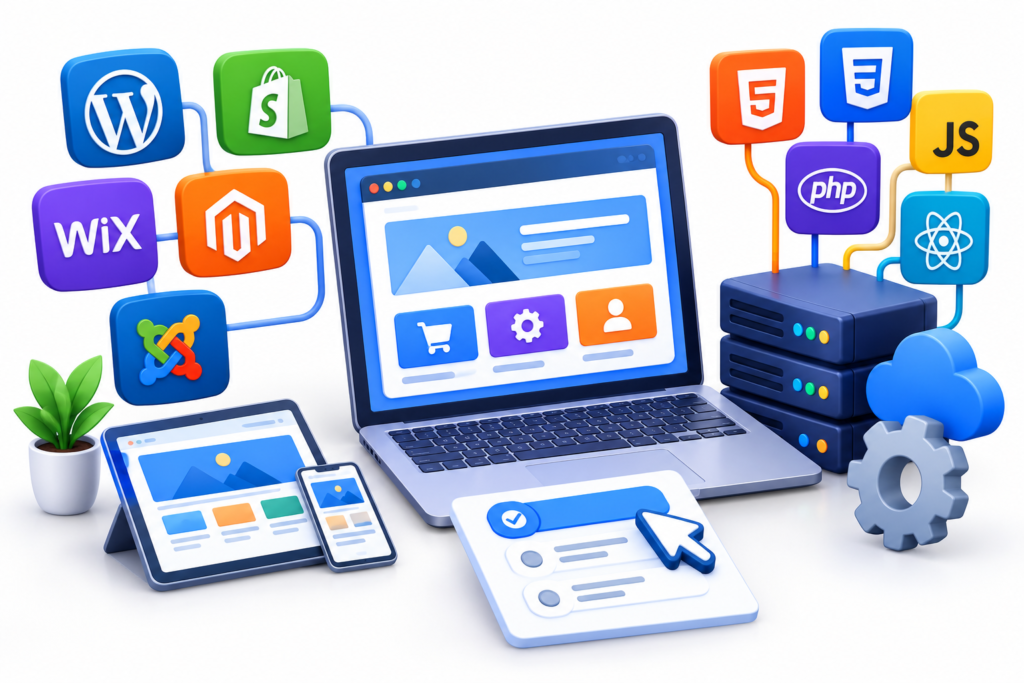
Selecting the right website design platform is an important decision because it affects the website’s functionality, flexibility, maintenance requirements, development costs, and future scalability. Different businesses have different needs, and there is no single platform that is automatically suitable for every project. A small service-based business may need a straightforward website with editable content and contact forms, while a large organisation may require custom functionality, complex integrations, multilingual capabilities, and advanced user permissions. E-commerce businesses have additional requirements involving product management, inventory, payment processing, shipping, and customer accounts. The platform should therefore be selected according to the actual business requirements rather than popularity or personal preference.
Content management systems are useful when businesses need to create, edit, and organise website content without changing code for every update. Platforms such as WordPress offer extensive themes, plugins, and customisation opportunities, making them suitable for many business websites and content-driven platforms. However, flexibility also creates responsibilities. Businesses must manage updates, plugin quality, hosting compatibility, security, and performance. Website builders can offer a simpler route for smaller organisations that prefer managed hosting and visual editing tools. They may reduce technical maintenance but can impose limitations on custom functionality, portability, or advanced integrations. E-commerce platforms provide specialised tools for managing online stores, although businesses should compare transaction costs, product features, payment options, and integration capabilities before choosing one.
Custom development may be appropriate when a project requires functionality that cannot be delivered effectively through standard platforms. A custom solution can provide greater control over application logic, user permissions, data structures, integrations, and interface behaviour. However, it usually requires more planning, development expertise, testing, and ongoing technical support. Businesses should carefully assess the total cost of ownership rather than focusing only on the initial development quotation. A low-cost solution may become expensive if it requires repeated fixes, extensive plugin subscriptions, or major redevelopment when the business grows. Similarly, a highly customised system may create unnecessary complexity if the organisation only needs a simple website. The most appropriate solution is the one that satisfies essential requirements while remaining manageable and adaptable.
Technology selection should also consider hosting, scalability, accessibility, security, performance, and ownership. Businesses should understand who controls the domain name, hosting account, website files, database, design assets, and third-party subscriptions. They should also clarify whether the website can be moved to another provider if requirements change. Development standards matter because clean code, sensible component structures, documentation, and reliable deployment processes make future maintenance easier. Integrations should be selected carefully, especially when they involve customer information or external services. Before committing to a platform, organisations should compare its strengths and limitations against their requirements and consider the people responsible for managing it after launch. A suitable technology foundation supports business operations without making the website unnecessarily difficult or expensive to maintain.
Website Testing, Launch Preparation, and Ongoing Maintenance
Website testing is a critical stage that ensures the finished platform works correctly before it becomes publicly available. Even carefully designed websites can contain problems that are difficult to identify during development, including broken links, layout inconsistencies, form errors, slow-loading pages, missing images, browser compatibility issues, and incorrect redirects. Launching without sufficient testing can create a poor first impression and may interrupt important business activities. A structured quality assurance process should therefore cover functionality, design consistency, content accuracy, accessibility, security, responsiveness, and technical performance. Testing should be planned early rather than left until the final day of development.
Functional testing should verify that every important feature works as intended. Navigation menus, buttons, forms, search tools, account systems, booking features, payment processes, and interactive elements should be tested using realistic scenarios. Form testing should include successful submissions, missing required information, invalid email addresses, and error handling. E-commerce websites should test the complete purchasing journey, including product selection, cart updates, discount codes where applicable, payment processing, order confirmation, and customer notifications. Content testing should identify spelling mistakes, outdated details, incomplete sections, incorrect prices, and broken internal or external links. Visual testing should check how pages appear across common screen sizes and browsers. It is also important to review the website with keyboard navigation and assistive technologies to identify accessibility problems.
Technical launch preparation should include configuring the production hosting environment, enabling HTTPS, checking DNS settings, verifying backups, and confirming that the correct website version is ready for publication. Developers should review robots.txt, XML sitemaps, canonical URLs, indexing directives, and redirect rules to avoid preventable search visibility problems. Temporary development restrictions should be removed where appropriate, while private or staging environments should remain protected. Analytics and conversion tracking should be configured and tested so the business can measure performance from the beginning. Google Search Console should be set up to monitor indexing and search visibility, and important pages can be inspected after launch. A rollback or recovery plan should also be available in case a significant issue occurs during deployment.
Website maintenance continues long after the launch announcement. Software updates, security reviews, backup checks, broken-link monitoring, content improvements, performance testing, and analytics reviews should form part of a regular maintenance schedule. Businesses should assign responsibility for these activities instead of assuming that a website will remain reliable without attention. Content should be reviewed whenever products, services, prices, contact details, or business policies change. Performance should be monitored as new images, plugins, scripts, and integrations are added. Website owners should also periodically review whether the platform still meets business requirements and whether user feedback indicates recurring problems. A successful launch is the beginning of an ongoing improvement process. Regular testing and maintenance help preserve reliability, protect customer confidence, and ensure that the website continues to support the organisation as its needs evolve.
Common Website Design Mistakes Businesses Should Avoid
One of the most common website design mistakes is prioritising appearance over usability and business objectives. Businesses sometimes invest heavily in visual effects, elaborate animations, oversized graphics, and complicated layouts without considering whether these elements help visitors achieve their goals. Although a distinctive design can support brand identity, unnecessary decoration can distract from important information and make navigation more difficult. Another frequent mistake is creating a homepage that looks attractive but fails to explain what the business actually offers. Visitors should be able to understand the company’s main purpose, its relevant products or services, and the next available action without searching through several pages. If the website relies on vague slogans instead of clear explanations, potential customers may struggle to recognise its value.
Poor navigation and confusing content structure are additional problems. Some websites place too many links in their main menus, use unclear category names, or organise pages according to internal company departments rather than visitor needs. Others bury important contact information, pricing details, or service descriptions deep within the website. These decisions increase friction and can prevent visitors from completing useful actions. Weak calls to action create a similar problem. Buttons that use unclear wording or compete with too many other promotional messages may leave visitors uncertain about what to do. Businesses should also avoid creating unnecessarily long forms that request information before it is genuinely required. Every additional field should have a clear purpose, and the form should explain what happens after submission.
Technical mistakes can also undermine an otherwise professional design. Common examples include uncompressed images, excessive third-party scripts, outdated plugins, poor hosting choices, broken links, missing redirects, and inconsistent mobile layouts. Some websites look acceptable on a desktop monitor but become difficult to use on smartphones because text is too small, buttons are too close together, or important sections are hidden. Others neglect security updates, backup procedures, HTTPS configuration, and access controls. These weaknesses can damage trust and increase the likelihood of technical problems. Businesses should not assume that installing a security plugin or purchasing a fast hosting package automatically solves every technical issue. Security and performance require ongoing attention to configuration, software quality, and actual website behaviour.
Another significant mistake is treating website launch as the end of the project. A website that is never reviewed can gradually become outdated, contain incorrect information, and fail to reflect changes in customer expectations. Businesses may also make redesign decisions based on personal opinions instead of analytics, user research, and meaningful conversion data. Search engine optimisation is sometimes neglected until after development, resulting in poor URL structures, missing page titles, duplicated content, and weak internal linking. To avoid these problems, businesses should establish clear requirements, plan content before finalising layouts, test important user journeys, and create a maintenance schedule. They should also prioritise accessibility, gather user feedback, and evaluate whether design changes improve measurable outcomes. Avoiding these common mistakes creates a more reliable website that serves customers effectively and supports long-term business growth.
Best Practices Summary for Building a Successful Website
Successful website design begins with a clear understanding of the business, its target audience, and the objectives the website needs to achieve. Every major design decision should contribute to a practical purpose, whether that involves explaining a service, generating an enquiry, supporting an online purchase, or helping customers find information. Businesses should conduct audience research, define measurable goals, prepare a content plan, and document essential technical requirements before beginning development. This preparation reduces uncertainty and helps prevent unnecessary features from increasing project costs. A well-defined project also makes it easier for designers, developers, content writers, and business stakeholders to work towards the same outcome. The strongest websites are built around genuine customer requirements rather than design trends alone.
A consistent visual identity and intuitive user experience should guide the design of every page. Businesses should use a clear colour palette, readable typography, meaningful imagery, logical spacing, and reusable interface components. Website navigation should make important information easy to locate, while content should be organised around clear headings and useful explanations. Mobile-responsive layouts should support different devices without removing essential information or functionality. Accessibility should be included from the beginning, with semantic HTML, keyboard-friendly interactions, appropriate contrast, meaningful alternative text, and understandable forms. Content should demonstrate real knowledge, answer user questions, and communicate business information accurately. These principles help create a website that is visually professional, easy to use, and useful to a broad range of visitors.
Technical quality is equally important. Businesses should choose an appropriate website platform, maintain secure hosting, configure HTTPS, protect administrative access, and implement reliable backups. Performance optimisation should focus on efficient images, lightweight code, responsive interactions, and stable page layouts. Core Web Vitals should be monitored using suitable tools, while technical SEO should include crawlable navigation, descriptive URLs, appropriate metadata, logical internal links, and correct indexing settings. Security updates, accessibility reviews, broken-link checks, and content maintenance should be included in ongoing website management. Organisations should also retain control over their domains, website assets, hosting accounts, and essential administrative credentials. These measures help protect the website’s long-term reliability and reduce the risk of avoidable technical problems.
Finally, businesses should treat website design as a continuous improvement process. After launch, performance should be evaluated using analytics, user feedback, conversion data, and technical monitoring. Important pages should be reviewed regularly, and changes should be prioritised according to their likely impact on visitors and business objectives. Rather than redesigning an entire website whenever a new trend appears, organisations should identify specific problems and test practical improvements. This approach makes development more controlled and helps preserve features that already work effectively. A high-performing website combines strong branding, useful content, intuitive navigation, responsive design, accessibility, security, and sustainable technical foundations. By following these best practices, businesses can create a professional online presence that builds trust, supports digital marketing, attracts relevant visitors, and provides lasting value.
Frequently Asked Questions
1. What is website design, and why is it important for businesses?
Website design is the process of planning and creating a website’s visual appearance, layout, structure, functionality, and user experience. It is important because a business website often acts as the first major point of interaction between an organisation and potential customers. A professionally designed website communicates business information, builds credibility, presents products and services, and helps visitors take meaningful actions. It also provides a foundation for digital marketing activities such as SEO, content marketing, social media campaigns, and paid advertising. A well-designed website can support lead generation, customer engagement, and online sales while helping businesses establish a consistent digital identity.
2. How much does professional website design cost?
The cost of professional website design depends on the size, complexity, functionality, and technical requirements of the project. A basic business website with a limited number of pages generally requires less development work than a large corporate platform or an e-commerce website with advanced integrations. Other cost factors include custom design, content creation, hosting, domain registration, booking functionality, payment systems, security requirements, and ongoing maintenance. Businesses should request a detailed quotation that explains the project scope, included features, delivery stages, ownership arrangements, and recurring costs. Comparing proposals based on value and suitability is more useful than choosing a provider solely because its initial price is the lowest.
3. How long does it take to design and develop a website?
Website development timelines vary according to project requirements and the availability of content, design approvals, and technical resources. A straightforward business website may take a few weeks, while a complex e-commerce platform or custom web application may require several months. The process normally includes research, planning, sitemap development, wireframing, visual design, content preparation, development, testing, and launch. Delays can occur when business information is incomplete, design feedback is slow, or new functionality is introduced after development has started. Establishing a clear project scope and providing content on time can help keep the development process organised.
4. What is the difference between responsive website design and mobile-friendly design?
Responsive website design uses flexible layouts and technical rules to adapt the website to different screen sizes and device orientations. A responsive page can rearrange its content, adjust images, and change navigation behaviour according to the available space. Mobile-friendly design is a broader term describing whether a website is convenient and usable on mobile devices. A website may have a separate mobile version or a responsive implementation. In modern development, responsive design is generally a practical approach because it supports a consistent experience across smartphones, tablets, and desktop computers while reducing the need to maintain separate versions of the same content.
5. Which platform is best for designing a business website?
The best platform depends on the organisation’s requirements, technical resources, budget, and future plans. WordPress is widely used for business websites and content-driven platforms because it offers flexibility and an extensive ecosystem. Website builders can be suitable for smaller businesses that prefer simplified management and integrated hosting. Dedicated e-commerce platforms may be more appropriate for online stores with product catalogues, payment processing, and inventory requirements. Custom development can be useful when a business needs specialised functionality or complex integrations. Businesses should compare flexibility, security, performance, ownership, maintenance requirements, and long-term costs before making a decision.
6. How does website design affect SEO and Google rankings?
Website design can influence several aspects of SEO, including mobile usability, navigation, content organisation, page performance, internal linking, and technical accessibility. Search engines need to discover and understand website content, so logical page structures, crawlable links, descriptive URLs, and relevant metadata are useful. Performance and mobile presentation also contribute to a positive page experience. However, good design does not guarantee high rankings. Search visibility also depends on content relevance, quality, competition, technical implementation, and other factors. Businesses should combine SEO-friendly website development with helpful content and ongoing performance monitoring rather than expecting design alone to produce organic traffic.
7. Why is website speed important for user experience?
Website speed affects how quickly visitors can access information and interact with important features. Slow pages can create frustration, especially when users are browsing on mobile devices or slower internet connections. Delayed interactions can make forms, navigation menus, and other components feel unreliable. Performance optimisation includes compressing images, reducing unnecessary scripts, improving hosting configuration, enabling appropriate caching, and removing inefficient code. Businesses can use PageSpeed Insights and real-user performance data to identify problems. Good performance supports usability and contributes to a more dependable experience, although no individual speed score guarantees search ranking improvements.
8. How often should a business website be updated or redesigned?
A business website should be reviewed regularly, but it does not necessarily need a complete redesign every year. Content updates should take place whenever business details, services, prices, contact information, or customer requirements change. Technical maintenance should include software updates, security checks, backup verification, and performance monitoring. A larger redesign may be appropriate when the website no longer supports business objectives, its structure has become difficult to manage, its user experience is outdated, or its technology cannot accommodate new requirements. Decisions should be based on measurable problems and business needs rather than following design trends without a clear reason.
Conclusion
Website design plays a central role in establishing a professional online presence, building customer confidence, and supporting sustainable business growth. A successful website is not simply a visually attractive collection of pages. It is a carefully planned digital platform that combines branding, usability, content strategy, responsive development, technical performance, accessibility, security, and search engine optimisation. Each element contributes to the overall experience, and weaknesses in one area can reduce the effectiveness of the entire website.
Businesses should begin with clear objectives and a strong understanding of their target audiences. These insights should guide website architecture, page layouts, navigation, content creation, and functionality. Choosing the right development platform and technical infrastructure helps ensure that the website remains manageable as business requirements change. Performance optimisation, secure connections, accessibility testing, and quality assurance should be integrated throughout the development process rather than postponed until after launch. Regular maintenance and evidence-based improvements then help protect the website’s value over time.
A strategically designed website can support many important business activities, including attracting organic visitors, explaining services, generating qualified enquiries, increasing online sales, and strengthening relationships with existing customers. However, achieving these benefits requires more than launching a new design. Businesses must continually review performance, understand visitor behaviour, update information, and improve areas where users experience difficulties. This ongoing commitment helps create a website that remains relevant, useful, and dependable.
At MyBlogPoster, professional digital growth begins with creating meaningful online experiences that help businesses communicate their value and reach their audiences effectively. Investing in a well-planned website design strategy can provide a strong foundation for future marketing activities, improve customer interactions, and support long-term business objectives. Whether you are building a new website or improving an existing one, the most important principle is to design around people, deliver genuine value, and maintain the technical quality needed to support continued growth.
Want to Implement This Easily?
AI Implementation Prompt
Prompt Text:
You are an expert website design consultant. Based on the blog post titled “Website Design”, provide a comprehensive, step-by-step, practical implementation guide.
Your objective is to help a business plan, design, develop, launch, and optimise a professional, high-performing website.
Include the following:
- Website Planning: Explain how to identify business objectives, research target audiences, define website requirements, and establish measurable goals.
- Brand Identity: Explain how to select colours, typography, imagery, layouts, and visual elements that create a consistent brand identity.
- Website Structure: Provide a practical method for creating a sitemap, organising pages, planning navigation, and developing effective information architecture.
- User Experience: Explain how to create intuitive interfaces, improve usability, design clear calls to action, and optimise customer journeys.
- Responsive Design: Provide instructions for building mobile-friendly layouts that work across smartphones, tablets, and desktop computers.
- Content Development: Explain how to create valuable website content, optimise page layouts, implement headings, and organise internal links.
- SEO Implementation: Include technical SEO, keyword research, metadata, image optimisation, crawlability, indexing, and structured data best practices.
- Performance Optimisation: Explain how to improve loading speed, optimise images, reduce unnecessary scripts, and monitor Core Web Vitals.
- Website Security: Include HTTPS, SSL/TLS configuration, secure hosting, backups, software updates, access control, and data protection.
- Accessibility: Explain how to implement accessible navigation, keyboard support, readable typography, colour contrast, and WCAG recommendations.
- Platform Selection: Compare suitable website builders, content management systems, e-commerce platforms, and custom development approaches.
- Testing and Launch: Provide a complete pre-launch checklist covering functionality, responsiveness, content, accessibility, security, analytics, and technical SEO.
- Ongoing Maintenance: Explain how to monitor performance, update content, maintain security, and improve website functionality.
- Tools and Resources: Recommend suitable tools for website design, development, SEO, performance testing, analytics, accessibility, and security.
- Advanced Tips: Include practical recommendations for improving conversions, scalability, user engagement, and long-term website performance.
For every implementation stage, provide:
- Clear objectives.
- Step-by-step instructions.
- Recommended tools.
- Practical examples.
- Best practices.
- Common mistakes to avoid.
- Expected outcomes.
Assume the reader wants to implement everything discussed in the article effectively. Keep the guide practical, actionable, professionally structured, and understandable for beginners as well as experienced business owners.
Call to Action:
Want our help implementing this? Just reach out to us via our website contact form: