













Learn how Facebook Ads work, from audience targeting and campaign strategy to creative optimisation, conversion tracking, budgeting, and profitable advertising growth.
Introduction
Facebook advertising has become an important digital marketing channel for businesses that want to reach relevant audiences, generate qualified leads, increase online sales, and build long-term customer relationships. With access to Meta’s advertising ecosystem, businesses can promote products and services to people based on a combination of available audience signals, interests, behaviours, engagement, and conversion data. When managed strategically, Facebook Ads can help businesses connect with potential customers throughout the buying journey, from initial awareness to purchase and repeat engagement.
However, successful Facebook advertising involves considerably more than boosting a post or increasing an advertising budget. Advertisers need to understand campaign objectives, audience research, creative development, conversion tracking, landing page performance, bidding strategies, and return on investment. They must also account for competition, changing consumer behaviour, privacy restrictions, and the learning processes used by modern advertising systems. A campaign that generates inexpensive clicks may still perform poorly if visitors do not convert, while a campaign with a higher cost per click may generate substantially more profitable customers.
This comprehensive guide explains how to develop, launch, measure, and improve Facebook Ads campaigns using practical marketing principles. It covers campaign planning, audience targeting, ad formats, persuasive copywriting, budgeting, retargeting, analytics, common mistakes, and advanced optimisation methods. Whether you are a small business owner, marketing professional, e-commerce operator, or agency specialist, the aim is to help you make informed decisions and build a sustainable advertising strategy. At MyBlogPoster, the focus is on practical digital marketing knowledge that helps businesses turn advertising activity into measurable commercial results.
Understanding Facebook Ads and Their Role in Digital Marketing
Facebook Ads are paid advertisements delivered through Meta’s advertising platform, allowing businesses to promote products, services, content, and offers to selected audiences. Depending on campaign settings and available placements, advertisers can reach people across Facebook and other eligible Meta platforms. Unlike organic social media posts, which depend on existing followers and unpaid distribution, paid advertising provides opportunities to reach new prospects, re-engage previous visitors, and generate measurable business outcomes. Businesses can use Facebook advertising to increase brand awareness, encourage website visits, collect enquiries, generate purchases, or develop relationships with potential customers. The most appropriate approach depends on the company’s business model, customer journey, budget, and commercial objectives.
One of the main advantages of Facebook Ads is the ability to combine audience insights with different creative formats and campaign objectives. An online retailer might advertise a product collection to prospective customers, while a professional service provider could promote a consultation or downloadable resource. A local business might focus on relevant enquiries, whereas a subscription company could use advertising to encourage trial registrations. The platform’s delivery system uses available signals to determine which eligible people are more likely to take the action associated with a campaign. However, advertising outcomes depend on several factors, including creative quality, competition, offer strength, website experience, and measurement accuracy. Advertising does not guarantee sales, and a large potential audience does not automatically translate into a profitable campaign.
To understand the platform properly, marketers should begin with the fundamentals of paid social advertising, customer acquisition, and conversion measurement. Before spending money, establish what the business wants to achieve, how success will be measured, and what a valuable customer is worth. Learn the relationship between campaign objectives, audience selection, ad creative, and the destination page. Meta’s official training on campaign objectives provides useful guidance on connecting advertising goals with the appropriate campaign setup. A practical strategy treats Facebook Ads as one part of a wider marketing system rather than an isolated promotional activity. When advertising is aligned with a clear offer, useful content, reliable tracking, and an effective sales process, it becomes easier to identify opportunities for improvement and make decisions based on evidence instead of assumptions.
Setting Clear Facebook Advertising Goals and KPIs
Every successful Facebook Ads campaign starts with a clearly defined business objective. Without one, advertisers risk measuring superficial outcomes instead of meaningful progress. For example, a campaign might generate thousands of impressions and hundreds of clicks but produce very few sales. Another campaign might attract fewer visitors while generating a greater number of qualified enquiries. The second campaign could deliver more commercial value despite having less traffic. Before launching an advertisement, decide whether the primary goal is awareness, website traffic, lead generation, online purchases, app promotion, or another measurable action supported by the platform. The campaign objective should reflect the intended outcome, not simply the result that appears easiest to achieve.
Once the objective has been selected, establish key performance indicators, or KPIs, that help evaluate progress. Awareness campaigns might be assessed using reach, frequency, impressions, and relevant brand-lift measures where available. Traffic campaigns can be monitored through landing-page views, cost per landing-page view, and subsequent engagement. Lead-generation campaigns should consider cost per lead, lead quality, appointment attendance, and conversion into paying customers. E-commerce campaigns should prioritise purchase volume, average order value, customer acquisition cost, revenue, and contribution margin. These measurements work together: a low cost per lead has limited value if the leads rarely become customers, and a high reported advertising return can be misleading if product costs and fulfilment expenses are ignored.
A useful starting point is to establish a baseline before launching a new campaign. Record existing conversion rates, average order value, historical acquisition costs, sales-cycle duration, and customer lifetime value where reliable data is available. Then set a realistic target and define the period over which performance will be assessed. For example, a service business might aim to generate qualified enquiries at a cost that allows enough margin to support follow-up and sales activity. A retailer might set a target acquisition cost based on the profit available from a first purchase. Avoid treating initial estimates as guaranteed outcomes; early results may fluctuate as the campaign gathers data. Review performance against the original objective, document important changes, and use consistent reporting periods. This process creates accountability, makes optimisation more disciplined, and helps businesses distinguish genuinely profitable growth from advertising activity that merely looks impressive in a dashboard.
Choosing the Right Facebook Ads Campaign Objective
Campaign objectives influence how the advertising system delivers ads and which outcomes it is encouraged to prioritise. Selecting an objective that matches the business goal is therefore essential. Depending on the current Ads Manager interface and campaign configuration, advertisers may encounter objectives such as Awareness, Traffic, Engagement, Leads, App promotion, and Sales. Each serves a different purpose, and the appropriate choice depends on the action that matters most to the business. For instance, a company launching a new brand might prioritise visibility among relevant audiences, whereas an established online store may focus on completed purchases. Understanding these differences prevents advertisers from optimising campaigns for actions that do not support their actual commercial priorities.
The Awareness objective can help businesses introduce a brand, product, or service to relevant audiences. Traffic is intended to attract people to a destination, such as a website or landing page. Engagement can support goals involving interactions or other eligible engagement outcomes. Leads can help businesses collect enquiries through supported forms, messaging experiences, calls, or website-based conversion journeys, depending on configuration. Sales is generally more appropriate when the goal is to encourage purchases or other supported sales-related conversions. App promotion supports eligible app-related outcomes. The exact settings and optimisation options can change, so advertisers should check the current platform interface rather than rely on outdated tutorials. Meta’s campaign objective training explains how business goals relate to objective selection.
Consider a company that sells home office furniture. If its priority is to sell desks through an online shop, a Sales campaign optimised towards purchases may be more appropriate than a Traffic campaign focused on website visits. Conversely, if a business is conducting market research and wants to attract relevant visitors to an informative page, a traffic-oriented approach may be justified. A consultancy that needs discovery calls might test a lead-generation route designed to collect relevant enquiries. The critical point is to align the objective with the desired action and ensure the business can measure what happens afterwards. Choosing a purchase-oriented objective without sufficient tracking or a functioning checkout can undermine performance. Similarly, selecting a traffic objective and then judging success exclusively by purchases can create confusion about what the campaign was designed to achieve. Define the objective, conversion location, performance goal, and success metrics before launching.
Audience Research and Facebook Ads Targeting
Audience research helps advertisers understand the people most likely to benefit from an offer and the circumstances that influence their purchasing decisions. Effective research considers customer needs, buying motivations, objections, budget constraints, preferred communication styles, and the problems a product or service solves. Instead of beginning with assumptions about age or interests, examine available customer records, sales conversations, customer feedback, product reviews, support enquiries, and website analytics. For business-to-business services, consider the buyer’s professional responsibilities, decision-making authority, purchasing timeline, and organisational challenges. For consumer products, explore lifestyle requirements, product preferences, common concerns, and the occasions that trigger a purchase. This information can guide both audience selection and creative messaging.
Meta advertising can support different audience approaches, depending on current account capabilities and applicable restrictions. Broad targeting allows the delivery system to identify potential customers using the available signals and campaign settings. Detailed targeting may use eligible demographic characteristics, interests, or behaviours where those options are available. Custom audiences can help businesses reach eligible groups based on interactions or customer information processed in accordance with platform requirements. Lookalike audiences, where available, can help identify people with characteristics similar to a source audience. These options are not interchangeable, and no targeting method guarantees better results in every situation. A broad audience may work well when the algorithm has sufficient conversion signals and the creative communicates the offer clearly, while a more defined audience may be useful when a business serves a specific market.
Build audience hypotheses around customer needs rather than creating dozens of narrowly defined groups without a clear reason. For example, an online fitness retailer might test different creative messages for people interested in home workouts, but the business should validate whether those signals actually correspond with profitable customers. A professional services company might test a broader eligible audience while using specialised messaging to communicate the relevance of its offer. Ensure that audience size, geography, language, age restrictions, and other settings are appropriate for the product and applicable advertising rules. Use customer information only when collection and processing are lawful, transparent, and consistent with applicable privacy requirements. Where personal data is used for advertising, review the relevant platform policies and consent obligations. Audience research should guide testing, while real conversion and customer-quality data should determine whether an audience strategy deserves continued investment.
Creating Detailed Customer Personas for Better Ad Performance
A customer persona is a practical representation of a relevant customer group. It summarises the audience’s circumstances, motivations, priorities, purchasing objections, and preferred outcomes. A useful persona is based on research rather than stereotypes. It helps advertisers create messages that answer genuine customer questions and communicate a product’s value in language the audience understands. For example, a small business owner considering marketing software may care about ease of implementation, predictable costs, lead quality, and time savings. A consumer comparing skincare products may prioritise ingredients, suitability, product information, and confidence in the seller. These groups need different messages because their decisions are shaped by different requirements, even if both use Facebook regularly.
Start by identifying the main customer segments that matter to the business. Examine the characteristics of existing customers, but go beyond surface-level demographics. Record what customers were trying to accomplish, what alternatives they considered, which concerns delayed their decisions, and which factors ultimately influenced the purchase. Where appropriate, conduct interviews or analyse anonymised feedback from support teams and sales representatives. For each persona, document the main problem, desired result, purchase trigger, common objection, evidence needed to build trust, and the next reasonable action. Avoid inventing precise behavioural claims when reliable evidence is unavailable. Personas should be treated as working hypotheses that can be refined as customer feedback and campaign data accumulate.
Translate these insights into distinct advertising concepts. A software provider could test a time-saving message against a message focused on improved reporting, provided both represent genuine product benefits. A furniture retailer could compare creative that highlights durability with creative that demonstrates how a product fits into a small room. Keep the central offer and destination page relevant to each message so that the resulting performance can be interpreted correctly. Customer personas should not be used to make sensitive personal inferences or to create discriminatory advertising practices. Instead, use them to improve relevance, clarity, and the usefulness of the advertising experience. When a persona accurately reflects the needs of a real customer group, it helps the business develop better headlines, more convincing visuals, more relevant landing pages, and a clearer sales journey. The outcome is a more coherent advertising strategy, not merely a collection of demographic descriptions.
Developing a Facebook Ads Funnel for Customer Acquisition
A Facebook Ads funnel describes the stages a potential customer moves through before and after taking a desired action. Although individual buying journeys differ, a practical model includes awareness, consideration, conversion, and retention. At the awareness stage, a person may have little knowledge of the business or its offer. At the consideration stage, the person may compare alternatives, examine product information, or evaluate whether the solution meets their needs. The conversion stage focuses on an action such as a purchase, enquiry, or registration. Retention involves encouraging satisfied customers to return, renew, purchase complementary products, or recommend the business. Understanding these stages helps marketers select relevant messages and decide what information prospects need at each point.
Top-of-funnel advertising can introduce a useful idea, demonstrate a problem-solving benefit, or present a product to an eligible audience. Consideration-stage creative can provide demonstrations, explain features, address objections, or offer a relevant resource. Conversion-focused advertisements may highlight pricing, product availability, a clear service offer, or a legitimate promotion. Existing customers may receive relevant communications about repeat purchases or complementary products where permitted. These activities do not always require separate campaigns: campaign structure should reflect budget, conversion volume, audience size, and the complexity of the buying process. A small business with limited data may benefit from a simpler structure rather than fragmenting its budget across many funnel stages.
To build the funnel, map the customer journey and identify the evidence required at each stage. A potential customer might first see a product demonstration, later visit a product page, and eventually return to complete a purchase. Appropriate measurement can help determine which interactions are associated with subsequent conversions, although attribution reports do not capture every influence on a decision. Retargeting can support the funnel by reaching eligible people who previously interacted with the business, subject to audience availability, privacy requirements, and platform rules. Avoid showing repetitive advertisements to people who have already completed the desired action when exclusion or suppression is appropriate and available. For a broader understanding of the commercial journey, connect advertising with your wider digital marketing strategy. The objective is to deliver relevant information at the right stage, reduce unnecessary friction, and create a consistent experience from the first impression to the completed transaction.
Choosing Facebook Ads Formats and Placements
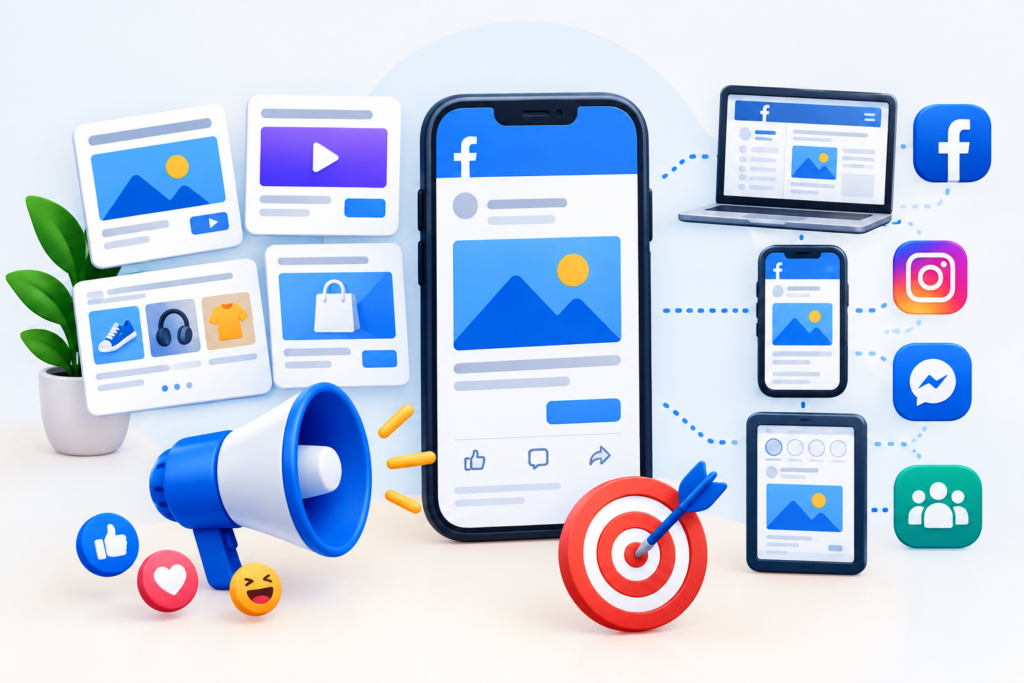
Facebook advertising supports multiple creative formats, and each offers different opportunities to communicate an offer. Image ads are useful when a single visual can explain the product or benefit clearly. Video ads can demonstrate a product, communicate a process, show a service in context, or explain a customer problem. Carousel ads can present several products, features, steps, or examples within one advertising unit. Collection-style experiences, where eligible, can help showcase product ranges and connect discovery with shopping. Lead-focused formats may support enquiry collection through an eligible form or other conversion destination. The right format depends on the message, audience, offer, available assets, and the action the advertiser wants people to take.
Creative format should support the information the customer needs, rather than being selected solely because it is popular. A product with visually distinctive features may benefit from a short demonstration video, while a professional service could use a clear image and concise copy that explain the offer. A carousel can be helpful when each card contributes something meaningful, but it may create unnecessary complexity if the message is simple. Videos should communicate the main idea quickly, work well on mobile devices, and remain understandable when sound is unavailable. Images should be clear and relevant, and the main message should not depend on tiny details that are difficult to see on a phone. Prepare suitable aspect ratios and placements based on current platform specifications, then preview the advertisement to check cropping, readability, and presentation.
Placements determine where eligible advertisements can appear across Meta’s advertising inventory. Depending on campaign settings, this may include Facebook Feed, Stories, Reels, and other supported placements across Meta platforms. Automatic placement options can give the delivery system more flexibility, while manual placement controls may be useful when a specific creative or business requirement justifies them. Avoid assuming that one placement always outperforms another; results vary according to the audience, campaign objective, creative, and competition. Review performance by placement when the available data is sufficient to support a meaningful decision. A placement with inexpensive impressions is not necessarily valuable if it generates weak leads or low-quality traffic. Design creative that communicates effectively in the placements you intend to use, maintain consistent messaging between the advertisement and its destination, and assess the results using business outcomes rather than appearance or engagement alone.
Writing Compelling Facebook Ads Copy That Converts
Effective Facebook Ads copy communicates a relevant benefit, captures attention, and encourages the reader to take a clear next step. The strongest advertisements do not simply describe a product; they explain why it matters to the intended customer. Before writing, identify the main problem the offer addresses, the outcome it helps achieve, and the evidence that supports its value. A business selling project management software might emphasise improved visibility across projects, while an online retailer could highlight product functionality, convenience, or a genuine customer benefit. The message should be specific enough to be meaningful without becoming complicated. Avoid exaggerated claims, unsupported promises, misleading urgency, or language that makes the advertisement sound more impressive than the actual product or service.
A practical Facebook Ads copywriting structure includes a hook, a relevant benefit, supporting information, and a call to action. The opening line should give people a reason to continue reading or watching. The body should explain the offer, demonstrate its relevance, and address a likely question or objection. Where appropriate, include proof such as accurate product specifications, a verified customer testimonial used with permission, a transparent guarantee, or a clear explanation of the service. The call to action should match the next step, whether that is viewing a product, requesting a quote, registering for an event, or making a purchase. Keep the language natural and easy to understand. There is no universal word count that guarantees performance, so test different lengths when the message and audience justify doing so.
For example, a generic advertisement might say, “Discover our professional marketing services today.” A more useful version could explain which businesses the service supports, what work is included, and how prospective customers can learn more. The improvement comes from greater clarity rather than simply adding persuasive words. Headlines, primary text, descriptions, and creative should reinforce one another instead of presenting disconnected messages. Make sure any discount, limited-time offer, delivery promise, or performance claim is accurate and that relevant conditions are easy to understand. Advertising copy must also comply with Meta’s advertising standards, including restrictions relating to prohibited content and certain personal attributes. Review the official Meta Advertising Standards before launching campaigns, particularly when promoting regulated products or sensitive categories. Strong copy builds trust by setting accurate expectations, helping the right customers recognise the value of the offer, and making the next action obvious.
Designing High-Performing Facebook Ads Creatives
Advertising creative includes the visual assets, videos, headlines, and messaging that people encounter in a campaign. Creative quality matters because the advertisement must compete for attention while communicating a relevant reason to act. However, an attractive design is not automatically an effective advertisement. The creative needs to connect the audience’s needs with the product’s value and make the intended next step easy to understand. A well-designed advertisement should communicate its main idea quickly, remain recognisable on mobile screens, and establish a consistent relationship between the offer and the destination page. Visual clarity, relevance, credibility, and message consistency are generally more useful starting points than adding decorative elements without a clear purpose.
Begin the creative development process by choosing one primary message for each advertisement. For a physical product, show the item clearly and, where useful, demonstrate how it works or how it fits into a real setting. For a service, communicate the problem addressed, the process involved, or the practical outcome customers can reasonably expect. Video can demonstrate functionality and answer common questions, while static imagery may be suitable for a straightforward offer. Carousel formats can explain several features or show a range of related products. Include branding where appropriate, but ensure it does not overpower the main message. Use readable text, sufficient contrast, appropriate image quality, and layouts that work in the intended placements. Check how each asset appears on mobile devices, where small text and poorly positioned elements can reduce comprehension.
Creative testing should be structured so that the business learns which messages influence meaningful outcomes. Consider testing different opening scenes, product demonstrations, benefit statements, visual concepts, or customer objections. Change one major variable at a time when the objective is to understand why performance differs. In other situations, testing complete creative concepts may be more practical, particularly when campaign volume is limited. Evaluate results using relevant indicators such as conversion rate, cost per qualified lead, purchase cost, revenue, and profitability. Do not declare a winner solely because an advertisement receives more likes or a higher click-through rate. Monitor creative fatigue as frequency increases and results change, but investigate other causes before replacing an advertisement. Audience saturation, seasonality, offer competitiveness, and website problems can also affect performance. A systematic creative process helps businesses develop a reusable library of effective messages instead of repeatedly producing advertisements without learning from earlier campaigns.
Facebook Ads Budgeting, Bidding, and Cost Management
A realistic Facebook Ads budget begins with the economics of the business rather than an arbitrary spending figure. Advertisers need to understand how much they can reasonably afford to spend to acquire a customer while maintaining an acceptable contribution margin. For an online store, this means considering selling price, product cost, fulfilment, payment processing, returns, discounts, and other variable expenses. For a service business, the calculation may include lead qualification, sales labour, delivery costs, and the percentage of enquiries that become paying clients. These factors help determine the maximum sustainable acquisition cost. A campaign can generate revenue and still lose money if the cost of acquiring and serving customers exceeds the contribution earned from those customers.
Suppose a business earns £80 in contribution before advertising from a completed sale. If it spends £25 to acquire that customer, the campaign leaves £55 before other relevant fixed costs and overheads. If acquisition costs rise to £70, the same sale leaves only £10 before those costs. This example illustrates why revenue alone does not demonstrate profitability. Work backwards from the acceptable acquisition cost, estimate the conversion rate between clicks and purchases, and calculate an initial budget that can support meaningful testing. These calculations are planning estimates, not predictions of guaranteed performance. Actual results depend on competition, customer demand, creative effectiveness, conversion tracking, and other factors. Businesses with longer sales cycles should also account for the delay between initial advertising expenditure and realised revenue.
Meta Ads Manager generally provides budget and bidding controls appropriate to the available campaign setup. Advertisers may use daily or lifetime budgets, while supported bidding strategies can include approaches focused on obtaining the most results within the available budget or meeting particular cost or value goals. Availability and behaviour depend on campaign configuration and the current platform interface. Start with a budget that the business can sustain while gathering sufficient evidence, and avoid frequent changes that make it difficult to interpret results. When increasing spending, evaluate whether acquisition costs, lead quality, and margins remain acceptable. Increasing a budget does not guarantee proportional growth, because additional delivery may reach different opportunities and face different auction conditions. Review the relationship between expenditure and business outcomes, and use a documented decision process for scaling, reducing, or pausing campaigns.
Conversion Tracking, Meta Pixel, and Conversions API
Accurate conversion tracking helps advertisers understand whether their campaigns contribute to meaningful business outcomes. Without reliable measurement, a business may mistake website visits or clicks for commercial success. Tracking can connect advertising interactions with subsequent actions, such as product views, add-to-cart events, purchases, registrations, or completed lead forms. The appropriate events depend on the business model and campaign objective. An e-commerce business may prioritise purchases and revenue, while a professional services company might measure completed enquiries and later connect those enquiries with qualified opportunities or sales. Clear event definitions are essential because inconsistent or duplicated measurement can lead to misleading reports and poor optimisation decisions.
The Meta Pixel is a browser-based measurement tool that can help record eligible website actions and support certain advertising functions. The Conversions API can provide a server-side method for sharing eligible event data with Meta. Depending on the implementation, businesses may use these tools together to improve measurement resilience. However, using both does not automatically guarantee complete attribution or accurate data. Events need to be configured correctly, and duplicate events should be handled using supported deduplication methods where applicable. Test the implementation, confirm that important events fire at the right stage, and check that purchase values and currency information are accurate. For implementation details, consult the official Meta Pixel documentation and Conversions API documentation.
Privacy and data governance must be considered throughout the tracking process. A business should not assume that installing a tracking tool automatically makes its data collection lawful. Depending on the jurisdiction, website activity, and technologies used, consent may be required before certain tracking technologies are activated. Review applicable privacy legislation, provide accurate disclosures, respect consent choices, and ensure that data shared with advertising platforms is permitted and appropriately minimised. Do not transmit sensitive information through event parameters or URLs. Where customer information is used for matching, follow the platform’s requirements and applicable legal obligations. Finally, compare advertising reports with trustworthy internal records, while recognising that attribution windows, reporting delays, consent limitations, and modelling can cause differences. Good tracking creates a more dependable foundation for optimisation, but it should never be treated as a perfect record of every customer interaction.
Landing Page Optimisation and Conversion Rate Improvement
A Facebook advertisement is only one part of the conversion journey. Once someone clicks, the landing page must deliver the information and experience needed to complete the intended action. If the advertisement promises a particular product, price, service, or benefit, the destination should clearly reflect that promise. A mismatch between the creative and landing page can cause visitors to leave before taking action. Effective landing pages communicate the offer quickly, establish credibility, explain important details, and provide a clear next step. Depending on the goal, that step might be purchasing a product, requesting a consultation, submitting an enquiry, or registering for an event. The page should be designed around the user’s decision rather than the business’s desire to include every possible detail.
Page speed, mobile usability, accessibility, and straightforward navigation can influence the quality of the experience. Visitors should not have to wait unnecessarily for essential content, search for basic product information, or complete a confusing form. Use clear headings, legible typography, relevant imagery, transparent pricing, and prominent calls to action. Where appropriate, include shipping information, returns policies, service details, customer support options, and credible evidence that reduces uncertainty. Keep forms proportionate to the purpose: requesting excessive information at the first interaction may reduce submissions without improving lead quality. Avoid misleading buttons, hidden fees, intrusive interruptions, or design patterns that pressure people into choices they did not intend to make. Google’s guidance on Core Web Vitals can help website owners understand important aspects of loading performance, responsiveness, and visual stability.
Conversion rate optimisation should be based on evidence. Begin by measuring the current proportion of visitors who complete the desired action, then identify the most significant points of friction. Analytics may reveal that visitors reach the product page but abandon the checkout, or that many people start a lead form but fail to submit it. Investigate the likely cause before changing the page. Test improvements such as a clearer headline, more relevant imagery, simplified forms, stronger product information, or a more visible call to action. Where traffic permits, use controlled experiments and compare results over an appropriate period. Do not assume that every design change will improve conversions, and avoid running too many simultaneous tests when their effects cannot be separated. Improving the landing page can make existing advertising traffic more valuable, but evaluate both conversion rate and downstream customer quality to ensure the changes support the business objective.
Facebook Ads Retargeting and Customer Retention
Retargeting allows advertisers to reconnect with eligible audiences who have previously interacted with a business. These interactions may include website visits, engagement with advertising or social content, video views, product activity, or other supported events. Retargeting can be useful because some customers require more time or information before making a decision. A visitor may compare products, discuss a purchase with someone else, or postpone an enquiry until a more convenient time. A relevant follow-up advertisement can remind the person of the offer, answer a common question, or provide useful additional information. However, not every previous visitor has the same level of interest, and repeated advertising does not automatically make someone more likely to purchase.
Build retargeting audiences around meaningful interactions where the platform supports them and where the data can be used appropriately. For example, a retailer might distinguish eligible product viewers from people who initiated checkout, while a service provider could use relevant engagement or website activity to present further information about an offering. Audience size and availability depend on traffic volume, account configuration, data restrictions, and platform rules. Exclude recent purchasers from advertisements designed specifically to generate a first purchase when suitable controls are available. Instead, consider relevant complementary products, repeat-purchase reminders, or customer education. Avoid treating every website visitor as a high-intent prospect, particularly when the visitor may have arrived accidentally or consumed only a small amount of content.
Retargeting creative should reflect the audience’s previous stage without making uncomfortable or unsupported assumptions about an individual’s behaviour. A product advertisement might provide additional specifications, explain delivery options, or show a different product angle. A service campaign could clarify the process, explain what a consultation involves, or answer frequently asked questions. Promotions should be genuine and financially sustainable rather than introduced automatically whenever a visitor does not convert. Monitor audience frequency, acquisition cost, conversion quality, and incremental performance where measurement allows. Some people would have converted without another advertisement, so reported retargeting conversions should not automatically be interpreted as entirely incremental sales. Combine retargeting with a wider customer retention strategy that includes helpful post-purchase communication, service quality, relevant follow-up offers, and respect for customer preferences. This approach supports more sustainable growth than relying exclusively on repeated advertising to the same audience.
Facebook Ads Analytics, Performance Optimisation, and Scaling
Campaign analytics help businesses understand how advertising expenditure translates into customer actions and commercial outcomes. Useful metrics include impressions, reach, frequency, CPM, link click-through rate, cost per click, landing-page views, conversion rate, cost per acquisition, revenue, and return on ad spend. Each metric answers a different question. CPM describes the cost of generating a thousand impressions, while click-through rate indicates how often an eligible impression leads to a measured click under the metric’s definition. Conversion rate measures the proportion of a defined group that completes an action, and cost per acquisition measures the advertising cost associated with obtaining that action. Return on ad spend compares attributed revenue with advertising expenditure, but it does not account for all business costs.
Consider a campaign that spends £500 and reports £1,500 in attributed sales revenue. Its reported return on ad spend is 3.0, or £3 in attributed revenue per £1 of advertising expenditure. This does not establish that the campaign generated a profit. Product costs, delivery, discounts, refunds, agency fees, and other expenses may materially change the result. A more useful assessment combines advertising metrics with contribution margin, customer quality, repeat purchases, and the broader economics of the business. Lead-generation campaigns require similar discipline: a £10 lead is not necessarily better than a £30 lead if the more expensive lead converts into customers at a substantially higher rate. Build reporting that follows the journey from initial interaction to the final business outcome whenever reliable data is available.
Optimisation should be a repeatable process rather than a series of emotional reactions to daily fluctuations. Establish a review schedule, define the minimum evidence needed for important decisions, and document significant campaign changes. When performance declines, investigate possible causes such as creative fatigue, shifts in auction competition, a weak offer, a tracking issue, a slower landing page, or changes in conversion quality. Avoid changing budgets, targeting, creative, and bidding settings simultaneously if you need to understand which factor caused the result. Once a campaign demonstrates consistent performance within an acceptable cost range, increase investment cautiously and monitor whether results remain sustainable. Scaling can involve increasing budgets, testing new creative concepts, expanding eligible audiences, improving conversion rates, or introducing additional products and offers. No single scaling method works universally. The objective is to grow profitable customer acquisition while preserving measurement quality and operational capacity.
Common Facebook Ads Mistakes and Best Practices Summary
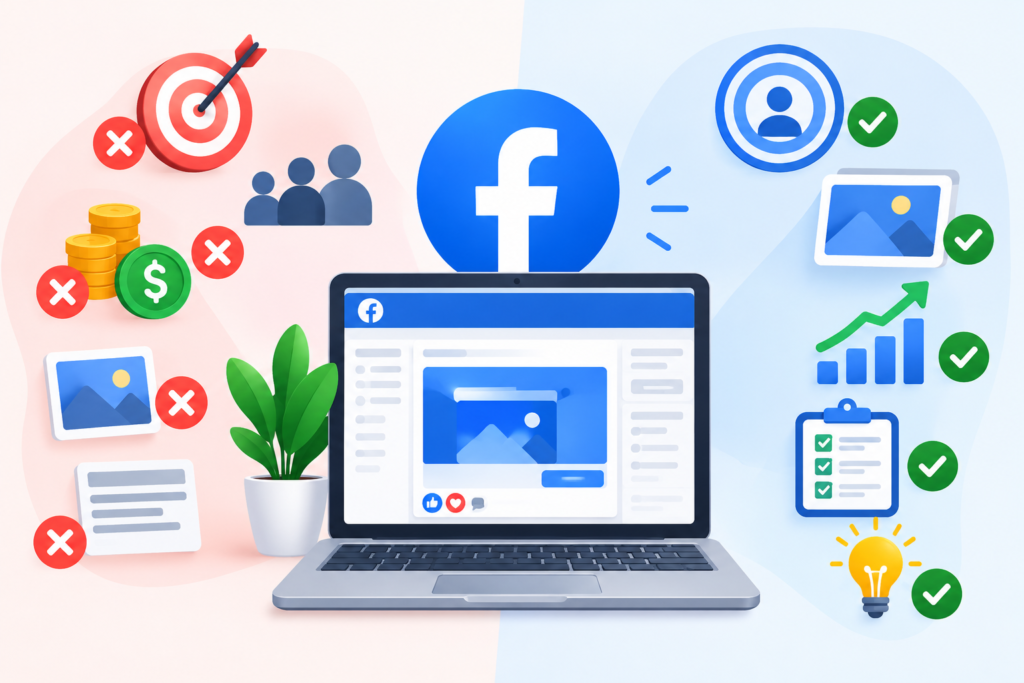
One of the most common Facebook advertising mistakes is launching campaigns without a clear business objective. When advertisers choose an objective simply because it produces inexpensive engagement or traffic, they may attract people who are unlikely to purchase or enquire. Another mistake is using weak creative that fails to explain the offer, relying on broad claims instead of meaningful benefits, or sending visitors to a landing page that does not match the advertisement. Poor tracking can make these problems harder to identify because the business may be unable to distinguish genuine conversions from incomplete or duplicated events. Other frequent issues include setting budgets without understanding profit margins, making major campaign changes too often, creating excessive ad-set fragmentation, and judging performance before enough relevant data is available.
Advertisers should also avoid assuming that a particular audience, format, or bidding strategy will work indefinitely. Customer behaviour, competition, platform capabilities, and creative performance change over time. Overly narrow targeting can limit delivery unnecessarily, while excessively broad targeting without a relevant offer or useful conversion signals may also perform poorly. Retargeting every visitor with the same advertisement can create fatigue, and increasing budgets simply because a campaign has produced a few positive results can expose the business to avoidable risk. Misleading urgency, unsubstantiated claims, poor privacy practices, and non-compliant creative can damage customer trust and put campaigns at risk. A disciplined approach involves testing sensible hypotheses, maintaining clear records, monitoring relevant metrics, and making decisions based on evidence rather than assumptions.
The best practices are straightforward in principle, although their execution requires consistency. Define the desired outcome before launching; establish a financially realistic acquisition target; develop creative that addresses real customer needs; and align the landing page with the advertisement. Implement and validate conversion tracking, respect privacy requirements, and compare platform reporting with internal business records. Use an appropriate campaign structure, test creative concepts methodically, and evaluate lead or customer quality instead of focusing exclusively on inexpensive clicks. Scale only when the available evidence supports the decision, and maintain a process for reviewing performance and learning from unsuccessful experiments. Finally, treat Facebook Ads as part of a broader customer acquisition and retention system. Advertising performs best when the offer, creative, website, measurement, fulfilment, and customer experience reinforce one another.
Frequently Asked Questions
1. What Are Facebook Ads and How Do They Work?
Facebook Ads are paid advertisements that businesses create and manage through Meta’s advertising platform. They allow advertisers to promote products, services, offers, and content to eligible audiences across supported placements. Advertisers choose a campaign objective, establish a budget, develop creative assets, configure relevant audience settings, and select where the advertisements should lead. Meta’s advertising system then delivers ads through its auction and delivery processes, using available signals to determine which eligible opportunities are most likely to achieve the campaign’s intended outcome. Performance depends on the quality of the offer, creative relevance, competition, audience response, and website experience. Businesses can measure outcomes through supported reporting and conversion-tracking tools. To get started, establish a clear goal, create a relevant advertisement, and ensure that the destination page makes the next step easy.
2. How Much Do Facebook Ads Cost?
There is no fixed price for Facebook advertising because costs vary according to competition, audience characteristics, campaign objective, creative quality, placement, seasonality, and other factors. Businesses may pay for advertising delivery while evaluating outcomes such as impressions, clicks, leads, or purchases. A small business can begin with a modest test budget, provided it can afford the expenditure and has a realistic way to assess results. Before launching, calculate the maximum acquisition cost that the business can sustain without undermining profitability. Monitor cost per qualified lead or purchase rather than focusing exclusively on cost per click. If a campaign generates inexpensive traffic but few valuable conversions, the apparent cost advantage may be misleading. Increase investment only when the evidence supports a reasonable expectation of sustainable performance.
3. Are Facebook Ads Effective for Small Businesses?
Facebook Ads can be effective for small businesses when the offer, audience, creative, and customer journey are well aligned. Local service providers can use advertising to generate relevant enquiries, while online retailers can promote products and encourage purchases. Consultants may advertise educational resources or introductory consultations, subject to applicable advertising policies. Small businesses should begin by identifying a specific customer problem and developing a clear offer that addresses it. They should then choose an appropriate objective, test a manageable number of creative concepts, and measure the quality of the resulting leads or customers. Success is not determined by business size alone. It depends on whether the business can acquire suitable customers at an economically sustainable cost and deliver the promised value.
4. What Is the Difference Between Facebook Ads and Boosted Posts?
Boosted posts are existing social media posts promoted through a simplified advertising process, while campaigns created in Ads Manager offer more extensive controls over objectives, structure, audiences, placements, measurement, and optimisation. The exact options depend on the current interface and account configuration. Boosting can be useful when a business wants to extend the reach of a post or encourage a straightforward engagement outcome. Ads Manager is generally more suitable when a campaign requires a defined conversion strategy, structured creative testing, detailed reporting, or more advanced campaign controls. Neither approach automatically guarantees better results. Choose the method that supports the intended objective, but use the available reporting to determine whether the expenditure generates meaningful business outcomes rather than simply increasing visible engagement.
5. How Can I Improve My Facebook Ads Conversion Rate?
Improving conversion rate begins with understanding where prospective customers abandon the journey. Review the relationship between impressions, clicks, landing-page views, form submissions, and completed purchases. If the advertisement attracts clicks but visitors leave quickly, investigate message relevance, page speed, mobile usability, and whether the landing page delivers what the advertisement promises. If visitors begin a checkout but do not complete it, examine unexpected costs, payment options, confusing forms, and delivery information. Test one significant improvement at a time when practical, and compare results over a suitable period. Ensure conversion events are configured correctly before drawing conclusions. Improving conversion rate is not simply a matter of making a button more prominent; the entire experience must provide enough clarity, relevance, and trust to help customers complete the intended action.
6. What Is the Meta Pixel, and Do I Need It?
The Meta Pixel is a browser-based tool that helps businesses measure eligible website activity and support certain advertising functions. It can record configured events, such as product views, add-to-cart actions, and purchases, subject to implementation and applicable privacy requirements. Businesses running website conversion campaigns should assess whether the Pixel and other supported measurement options are appropriate for their needs. Correct installation is essential: a tracking tool that records duplicate purchases, misses important events, or reports incorrect values can undermine campaign optimisation. The Conversions API may complement browser-based tracking through server-side event sharing. Before implementing either tool, review the relevant technical documentation, privacy obligations, consent requirements, and data-sharing policies. Test the configuration before relying on the reported results.
7. How Often Should I Optimise Facebook Ads Campaigns?
Campaigns should be monitored regularly, but major changes should be based on sufficient evidence rather than short-term fluctuations. The appropriate review frequency depends on expenditure, conversion volume, business risk, campaign maturity, and the length of the customer journey. Advertisers can check delivery, spending, technical issues, and unusual changes frequently while evaluating broader performance over more meaningful periods. Avoid repeatedly changing budgets, creative, targeting, and bidding settings without a clear reason, because this can make results difficult to interpret. Instead, maintain a testing log, define the conditions that justify intervention, and investigate potential causes before making adjustments. Campaigns with limited conversion volume may need more time to produce useful evidence than campaigns generating frequent purchases.
8. How Can Businesses Scale Facebook Ads Profitably?
Profitable scaling requires evidence that a campaign can acquire customers at a cost the business can sustain. Start by confirming that conversion tracking is reliable, customers are genuinely valuable, and contribution margins remain acceptable after relevant expenses. Then identify opportunities to increase investment, test additional creative concepts, expand suitable audiences, improve landing pages, or promote complementary offers. Make changes gradually enough to understand how performance responds, while recognising that no specific budget increase guarantees a proportional increase in sales. Monitor acquisition cost, conversion quality, revenue, and contribution margin as spending grows. Businesses should also ensure that their customer support, inventory, fulfilment, and sales teams can handle additional demand. Sustainable scaling means increasing profitable business outcomes, not merely spending more on advertising.
Conclusion
Facebook Ads can be a valuable component of a business’s digital marketing strategy when campaigns are built around clear objectives, relevant creative, reliable measurement, and a customer-focused experience. Successful advertising requires more than selecting an audience and setting a budget. Businesses need to understand customer motivations, communicate a credible offer, choose an appropriate campaign objective, and ensure that the destination page supports the intended action. Conversion tracking and meaningful performance indicators then help advertisers determine which activities contribute to measurable commercial results.
Long-term performance depends on consistent experimentation and disciplined decision-making. Rather than expecting every advertisement to succeed immediately, businesses should develop a structured process for testing creative concepts, evaluating audience quality, improving landing pages, and understanding acquisition costs. They should also account for privacy requirements, advertising policies, and the financial realities of acquiring and serving customers. Regular reviews help identify problems before they become expensive, while documented learning makes future campaigns more informed and efficient.
At MyBlogPoster, the objective is to help businesses understand practical digital marketing strategies and use them to support sustainable growth. Whether you are launching your first campaign or improving an established advertising account, focus on delivering genuine customer value, measuring outcomes accurately, and investing according to evidence. With a clear strategy, thoughtful execution, and continuous improvement, Facebook Ads can help businesses reach relevant audiences, develop customer relationships, and pursue measurable growth without relying on guesswork.
Best Practices Summary for Facebook Ads
Use this checklist when planning, launching, and improving your campaigns.
- Define a measurable objective: Decide whether you want awareness, qualified leads, purchases, or another specific business outcome.
- Understand your customers: Research their needs, objections, priorities, and purchasing decisions before creating advertising messages.
- Select the right campaign objective: Align the campaign’s optimisation goal with the action that matters to your business.
- Develop relevant creative: Use clear visuals, compelling copy, accurate claims, and a specific call to action.
- Establish a sustainable budget: Calculate acquisition costs using realistic conversion estimates and business margins.
- Implement reliable tracking: Validate important events, purchase values, and supported measurement integrations.
- Optimise the landing page: Maintain message consistency, improve mobile usability, and remove unnecessary conversion barriers.
- Test creative systematically: Compare meaningful concepts and record the results instead of changing everything simultaneously.
- Evaluate customer quality: Measure qualified leads, completed sales, contribution margin, and other commercially relevant outcomes.
- Use retargeting responsibly: Reach eligible audiences with relevant messages while respecting privacy requirements and customer preferences.
- Scale based on evidence: Increase investment when the results support a financially sustainable decision.
- Review performance consistently: Investigate problems, document lessons, and refine campaigns according to reliable data.
Following these principles helps establish a more structured approach to Facebook advertising. The goal is not to maximise every metric independently but to build a marketing system that connects advertising expenditure with valuable customer outcomes.
Want to Implement This Easily?
AI Implementation Prompt
You are an expert consultant. Based on the blog post titled “(Facebook Ads)”, provide a step-by-step, practical implementation guide. Include tools, best practices, common mistakes to avoid, and advanced tips. Assume the reader wants to implement everything discussed in this article effectively.
Call to Action
Want our help implementing this? Just reach out to us via our website contact form: https://myblogposter.co.uk/contact-us/