














Learn how to use Facebook Ads to reach the right audience, generate qualified leads, increase online sales, improve campaign performance, and scale advertising profitably with proven strategies and best practices.
Introduction
Facebook Ads have become an important part of digital marketing for businesses that want to reach potential customers, generate leads, increase sales, and build long-term brand awareness. With detailed audience targeting, flexible campaign objectives, creative advertising formats, and measurable performance data, Facebook advertising gives businesses opportunities to connect with people throughout the customer journey. However, achieving meaningful results requires more than simply creating an advertisement and setting a budget. Successful campaigns depend on understanding customer behaviour, selecting appropriate objectives, developing persuasive creative content, managing advertising costs, and continuously evaluating performance.
For businesses operating in competitive markets, Facebook Ads can support a wide range of commercial goals. An online retailer might use product advertisements to encourage purchases, a service provider might focus on qualified enquiries, and a growing brand might invest in video campaigns to introduce its products to new audiences. The most effective approach depends on the business model, the offer, the customer acquisition process, and the results the company wants to achieve. Advertisers must also consider landing-page quality, conversion tracking, privacy requirements, and the relationship between advertising expenditure and business revenue.
This comprehensive guide from MyBlogPoster explains how to develop a structured Facebook advertising strategy, from initial planning and audience research to campaign creation, creative testing, conversion measurement, and sustainable scaling. It explores practical techniques, common mistakes, optimisation methods, and responsible advertising practices that businesses can apply to improve decision-making. Whether you are launching your first campaign or refining an established advertising account, the objective is to help you build a more disciplined, measurable, and customer-focused approach to paid social advertising.
Facebook advertising operates through Meta’s advertising ecosystem, which includes Facebook placements and, where selected, other eligible placements across Meta platforms. Interface labels, campaign options, and delivery features can change over time, so advertisers should verify current settings in the official Meta Business Help Centre. Throughout this guide, recommendations are designed to support practical business outcomes rather than promise guaranteed rankings, conversions, or advertising returns.
Understanding Facebook Ads and Their Role in Digital Marketing
Facebook Ads are paid promotional messages delivered through Meta’s advertising system. Businesses can use them to introduce products, demonstrate services, promote offers, collect leads, encourage website visits, and support purchases. Unlike organic social media posts, paid advertisements allow advertisers to define campaign objectives, allocate budgets, select eligible audiences, choose placements, and evaluate delivery through reporting tools. This combination of targeting, creative flexibility, and measurable distribution makes Facebook advertising useful for businesses that need a repeatable method of reaching prospective customers.
One of the main advantages of Facebook Ads is their ability to support multiple stages of the customer journey. A person who has never encountered a business may respond to an educational video or an engaging demonstration. Someone who has visited a product page may benefit from a more detailed advertisement explaining features, benefits, or customer support. A returning customer may respond to a relevant new-product announcement or a carefully designed repeat-purchase offer. These situations require different messages, and an effective strategy recognises that people do not all have the same level of awareness or purchasing intent. Advertisers should therefore align their campaign objectives and creative messages with the needs of the intended audience instead of showing every prospect the same generic advertisement.
Facebook advertising also provides opportunities for businesses of different sizes, but accessibility should not be confused with automatic profitability. A small company can launch a campaign with a modest budget, yet its results will still depend on product-market fit, offer quality, competition, conversion experience, and the cost of reaching likely customers. A business with a strong product but a confusing checkout process may pay for substantial traffic without generating enough sales. Similarly, a well-designed advertisement cannot compensate indefinitely for unrealistic pricing, poor customer service, or an offer that does not solve a genuine problem. Paid advertising amplifies the strengths and weaknesses of the wider customer experience.
To understand where Facebook Ads fit into a broader marketing strategy, businesses should distinguish between reach, engagement, traffic, leads, and conversions. Reach measures exposure to people, engagement measures interactions, traffic measures visits, and conversion metrics measure actions that matter to the business. These measurements are related but not interchangeable. A campaign that generates many inexpensive clicks may perform poorly if visitors leave immediately, while a campaign with fewer clicks may produce more qualified enquiries or profitable orders. The appropriate success measure depends on the commercial objective.
Businesses should also understand the difference between Facebook Ads and organic social media marketing. Organic content can develop community relationships, communicate brand personality, and support ongoing engagement, while paid advertising can provide more deliberate distribution and controlled testing. These approaches can complement one another: organic comments may reveal customer questions, existing content may inspire advertising concepts, and paid campaigns may introduce new people to the brand. The strongest approach is usually not to treat advertising as an isolated activity but to connect it with the website, sales process, customer support, email marketing, and overall digital marketing strategy.
Setting Clear Facebook Advertising Goals and KPIs
Every successful Facebook advertising campaign begins with a clearly defined objective. Before creating an advertisement, businesses should identify the specific outcome they want to achieve, the audience they need to reach, and the evidence that will demonstrate whether the campaign is working. Without this foundation, advertisers can become distracted by attractive but commercially unimportant metrics, such as impressions or likes, while overlooking the actual performance of their marketing investment. A clear goal creates a consistent basis for campaign configuration, creative development, budget allocation, and optimisation.
The first step is to translate a broad business ambition into a measurable advertising objective. For example, a company that wants to increase online revenue might aim to generate purchases at a customer acquisition cost that leaves sufficient margin for fulfilment and other operating expenses. A business that sells professional services may focus on qualified leads rather than the total number of submitted forms. A local service provider might measure completed booking requests, while a new brand may initially prioritise relevant reach and audience education. Each objective requires a suitable combination of campaign settings, creative messages, conversion events, and reporting metrics. Advertisers should also establish a realistic measurement period because results can fluctuate as campaigns gather data and customer demand changes.
Key performance indicators, commonly called KPIs, help translate advertising activity into business outcomes. Useful metrics include cost per click (CPC), click-through rate (CTR), cost per lead (CPL), conversion rate, customer acquisition cost (CAC), return on ad spend (ROAS), average order value, and customer lifetime value. These indicators answer different questions. CTR can help assess whether an advertisement attracts attention, while conversion rate indicates how effectively visitors complete a desired action. CAC estimates the cost of acquiring a customer, whereas ROAS compares attributed revenue with advertising expenditure. None of these metrics should be interpreted in isolation because a lower CPC does not necessarily mean a lower acquisition cost, and a high ROAS does not automatically guarantee profitability.
Consider an online store that spends £500 on advertising and attributes £1,500 in sales to the campaign. Its reported ROAS is 3.0, calculated by dividing £1,500 in attributed revenue by £500 in advertising expenditure. However, the business must still account for product costs, shipping, payment processing, discounts, returns, and other expenses. If these costs consume most of the revenue, the campaign may not produce an acceptable profit despite its apparently strong ROAS. This example demonstrates why advertising targets should be based on unit economics rather than industry averages alone.
A practical planning framework should document the primary objective, the conversion event, the target cost per result, the available budget, the evaluation period, and the next action if performance falls below expectations. Businesses should define success thresholds before launching whenever possible, while allowing enough time and evidence to avoid reacting to random fluctuations. They should also distinguish between platform-attributed conversions and total business results, using analytics and sales records to understand the wider picture. For guidance on measurement foundations, consult Google’s documentation on conversion tracking. Although that resource focuses on Google Ads, its measurement principles help explain why clearly defined conversion actions matter across paid advertising channels.
Researching Your Target Audience and Customer Intent
Audience research helps advertisers understand whom they are trying to reach, what those people need, and which messages are most likely to be relevant. Facebook Ads can provide several audience-selection options, but targeting settings are only as effective as the strategy behind them. Businesses should begin by identifying their ideal customers through genuine commercial evidence, including existing customer records, sales conversations, customer feedback, product reviews, support enquiries, and website behaviour collected with appropriate consent. This research can reveal recurring problems, purchase motivations, common objections, and the language customers use when describing their needs.
A useful customer profile should focus on meaningful differences rather than create an unnecessarily elaborate fictional persona. For a business-to-consumer product, relevant characteristics may include the customer’s practical needs, buying motivations, price sensitivity, preferred product features, and purchase timing. For a business-to-business service, the research may examine company size, job responsibilities, operational challenges, approval processes, and the risks associated with choosing a provider. Advertisers should not assume that every person within a demographic group shares the same intentions. Two people with similar ages or locations may respond to completely different messages because their priorities, budgets, and levels of awareness differ.
Customer intent is particularly important when deciding what an advertisement should communicate. A person encountering a brand for the first time may need a simple explanation of the problem the product solves. Someone comparing alternatives may want evidence, feature comparisons, transparent pricing, or information about implementation. A person who has already expressed interest may need reassurance about delivery, support, compatibility, returns, or the next step. Matching the message to the audience’s stage of awareness helps reduce unnecessary friction and makes advertising more useful. It also prevents businesses from relying exclusively on aggressive discounts when customers may actually need better information or greater confidence.
Advertisers can test different audience approaches within Meta’s available targeting options. Depending on account eligibility and current platform features, these may include broader audiences, location-based audiences, permitted demographic or interest signals, custom audiences, and lookalike audiences. Availability and restrictions can vary by account, market, and advertising category. Broad targeting may be useful when conversion signals and creative assets provide sufficient information for delivery optimisation, while more specific audiences may help address legitimate geographic or customer requirements. Businesses should avoid narrowing audiences without a clear reason because excessive restrictions can limit delivery and reduce the system’s ability to find relevant prospects.
Research should continue after campaigns go live. Advertisers can compare the performance of different creative concepts, examine qualified lead rates, review search and website behaviour where available, and gather feedback from sales teams. If a campaign generates many leads but few sales, the issue may involve audience quality, the offer, the follow-up process, or the definition of a qualified lead. If an advertisement receives attention but little website engagement, the message may be attracting curiosity without matching the product’s actual value. These findings should inform the next round of testing rather than encourage unsupported assumptions about the audience.
Finally, audience research must respect privacy, consent, and advertising policies. Businesses should use customer information only when they have an appropriate legal basis and comply with applicable platform requirements. They should not attempt to target or exclude people through prohibited discriminatory practices or exploit sensitive personal circumstances. Good audience research identifies genuine customer needs and improves relevance; it does not justify intrusive profiling or misleading claims.
Choosing the Right Facebook Ads Campaign Objective
Selecting the correct campaign objective is an important step because it helps align advertising delivery with the result a business wants to achieve. Meta Ads Manager provides campaign objectives designed around different marketing outcomes, including awareness, traffic, engagement, leads, app promotion, and sales. The precise options and settings available may change as Meta updates its advertising platform. Advertisers should therefore confirm the current configuration in Ads Manager rather than rely on outdated tutorials or assume that every account has identical features.
An awareness campaign may suit a business introducing a new brand, launching a product, or expanding recognition within a relevant market. Traffic campaigns can help attract website visits, although website traffic alone does not establish whether visitors are likely to purchase. Engagement campaigns may support interactions with eligible content or other engagement outcomes, depending on the settings selected. Lead campaigns are useful when a business wants to collect enquiries through supported lead forms, messaging experiences, or a website. Sales campaigns are generally more appropriate when the objective is to encourage purchases or other supported conversion actions. App promotion campaigns can help businesses market mobile applications and encourage relevant app activity.
The important principle is to choose an objective that corresponds to the intended business result. Selecting a traffic objective when the real goal is purchases may encourage delivery toward people likely to click rather than people likely to complete a transaction. Similarly, optimising for inexpensive form submissions may generate a high volume of enquiries without producing qualified opportunities. Advertisers should consider the quality of the result, not merely its availability or low cost. If a campaign’s purpose is to generate qualified leads, the business should evaluate how many leads meet its criteria and how many progress to meaningful sales conversations.
Campaign structure also matters. Meta’s advertising system commonly organises campaigns into three levels: campaign, ad set, and ad. The campaign contains the objective and relevant campaign-level settings. The ad set controls elements such as audience, placements, schedule, budget configuration where applicable, and optimisation settings. The ad contains the creative material that people see, including the image or video, primary text, headline, destination, and call to action. Understanding these levels helps advertisers diagnose problems and make deliberate changes rather than repeatedly rebuilding campaigns without a clear hypothesis.
For example, a business selling home office furniture might create a sales campaign directed toward online purchases. Its ad sets could test a justified audience or placement strategy, while the ads test different product demonstrations and value propositions. A professional consultancy might instead use a leads objective and evaluate whether enquiries meet its service criteria. These examples illustrate that campaign structure should follow business logic, not a universal template.
Before publishing a campaign, verify the selected objective, conversion location, performance goal, tracking configuration, budget, destination URL, and creative assets. Check whether the campaign’s intended conversion event is correctly configured and whether the destination provides a consistent experience. Where available, review the relevant official Meta advertising objectives and campaign guidance. This reduces avoidable configuration errors and creates a stronger foundation for meaningful optimisation.
Creating a Realistic Facebook Ads Budget and Bidding Strategy

A Facebook advertising budget should reflect the business’s financial capacity, commercial objectives, conversion economics, and ability to fulfil the demand generated by successful campaigns. There is no universally correct daily budget for every business because advertising costs vary according to market competition, audience characteristics, product category, seasonality, creative quality, and conversion performance. A realistic budget begins with an understanding of how much the business can afford to spend while maintaining acceptable margins and cash flow.
The first step is to calculate an economically sustainable customer acquisition cost. An online store should consider gross margin, fulfilment costs, transaction fees, expected returns, discounts, and any other variable expenses associated with an order. A service business should consider delivery costs, sales effort, lead-to-customer conversion rates, and the expected value of a new client. These calculations establish the maximum acquisition cost the business can tolerate under its chosen profitability requirements. If a business can afford to spend £40 to acquire a customer, for example, it can use that figure as a planning reference while recognising that the actual target may need to be lower to account for overheads and profit objectives.
The next step is to determine an initial test budget. Advertisers should allocate enough money to gather useful evidence without risking funds needed for essential operations. The appropriate amount depends on the expected cost of the desired outcome and the amount of information needed to compare different approaches. Very small budgets can make it difficult to distinguish between genuine performance differences and random fluctuations, while excessively large budgets can waste money before an offer or tracking setup has been validated. A sensible approach is to test a limited number of meaningful hypotheses, review the results, and increase investment only when evidence supports doing so.
Meta offers budget and bidding controls whose availability depends on the campaign configuration. Advertisers may encounter daily or lifetime budgets and different performance or cost-control options. A daily budget is designed around an average daily spend, and actual expenditure can fluctuate under the platform’s applicable rules. A lifetime budget sets spending for a defined campaign period. The choice should reflect whether the advertiser needs ongoing delivery or a campaign with a fixed duration. Bid and cost controls should be used with an understanding of their effect on delivery: restrictive settings may limit the system’s ability to generate results, while looser settings can increase the risk of spending more than intended if performance is not monitored.
Budget decisions should be linked to the business’s results rather than arbitrary spending targets. If a campaign generates qualified leads below the target cost and those leads convert into profitable customers, an increase may be justified. If a campaign produces inexpensive clicks but no meaningful enquiries, increasing its budget is unlikely to solve the underlying problem. Advertisers should review the full conversion path, from impression and click to landing-page engagement and final purchase.
A practical budget management process should define the maximum acceptable spend, the target result, the review schedule, and the circumstances that trigger a change. Avoid changing multiple variables at once because doing so makes the outcome difficult to interpret. Monitor delivery, conversion quality, cash flow, and overall business performance together. The objective is not to spend the largest possible amount; it is to invest consistently where there is credible evidence of sustainable returns.
Developing High-Converting Facebook Ad Creatives
Creative quality plays a central role in Facebook advertising because the advertisement must earn attention, communicate value, and motivate an appropriate next step. Even carefully selected audiences may ignore an advertisement if the message is unclear, the visual presentation is weak, or the offer appears irrelevant. Strong creative development begins with a clear understanding of the customer’s problem and the specific benefit the business can credibly provide. Rather than trying to communicate every product feature in one advertisement, advertisers should prioritise a single main idea that can be understood quickly.
An effective creative concept typically combines a relevant opening, a clear value proposition, supporting evidence, and an appropriate call to action. The opening should give the audience a reason to pay attention without relying on misleading claims or exaggerated promises. The value proposition should explain why the product or service matters. Supporting evidence may include a product demonstration, accurate specifications, a transparent explanation of the process, or genuine customer feedback used with appropriate permission. The call to action should make the next step clear, whether that means learning more, requesting a quotation, exploring a product, or completing a purchase. Each component should work together rather than compete for attention.
Visual formats should be selected according to the product, audience, message, and placement. Static images can communicate a product benefit or offer quickly. Short-form videos can demonstrate how something works, show a service in context, or answer a common objection. Carousel formats may be useful for presenting several products, features, or steps in a process, while collection or catalogue-based formats may suit eligible shopping experiences. Advertisers should use clear, high-quality assets and verify current placement specifications before publishing. Mobile readability is especially important because many people encounter social advertisements on smaller screens, where dense layouts and tiny text can reduce comprehension.
Creative testing should focus on meaningful differences between concepts. An advertiser might compare a practical demonstration with a lifestyle image, or test whether a convenience-led message performs differently from a durability-led message. Changing the headline, visual, audience, offer, and landing page simultaneously makes it difficult to identify the factor responsible for a result. A structured test changes a limited number of variables and evaluates the outcome against a predefined objective. This helps businesses develop a reusable understanding of what motivates their customers instead of relying on one-off creative successes.
Authenticity is another important factor. Customer testimonials should reflect genuine experiences, product demonstrations should accurately represent what buyers receive, and any claims about savings or performance should be supported by evidence. If an advertisement uses a limited-time offer, the restriction should be genuine. Businesses should avoid fabricated urgency, deceptive before-and-after comparisons, or visual elements that misrepresent the product. Such tactics can damage customer trust and may create policy or legal problems.
Finally, creative development should be treated as an ongoing process. Advertising performance can change as audiences see the same assets repeatedly, competitors introduce new offers, or customer preferences evolve. Monitor frequency alongside engagement, conversion quality, and acquisition costs, but do not assume that frequency alone proves creative fatigue. When performance deteriorates, investigate whether the problem comes from the creative, the offer, audience saturation, seasonal demand, or the destination experience. This evidence-led approach helps maintain creative relevance while preserving the brand’s credibility.
Writing Persuasive Facebook Ad Copy That Builds Trust
Persuasive Facebook ad copy helps potential customers understand an offer and decide whether it is relevant to their needs. The most effective copy is usually specific, clear, and focused on a genuine customer benefit. It does not need complicated vocabulary or exaggerated language. Instead, it should communicate the problem being addressed, explain the solution, and provide enough information for the reader to take an informed next step. Good copy also sets appropriate expectations so that the experience after the click matches the promise made in the advertisement.
A practical structure is to begin with a relevant customer situation, explain the value of the offer, support the message with useful detail, and finish with a clear call to action. For example, an advertisement for a website design service could explain how confusing navigation makes it harder for visitors to find important information, describe the service’s focus on clear navigation and mobile usability, and invite the reader to review the available service details. This is more informative than simply claiming that the company offers the best website design. A useful message provides a reason to believe the offer is worth considering.
Advertisers should test different copy approaches without assuming that one formula works for every product. A problem-and-solution message may suit a service that addresses an obvious operational challenge. A product demonstration may work better when the main benefit is easier to understand visually. A comparison of features may be useful when buyers are evaluating alternatives, provided that comparisons are fair and substantiated. A customer story may help explain how a product fits into everyday life, provided the account is genuine and presented accurately. The objective is to match the communication style to the decision the customer needs to make.
Clarity also means removing unnecessary friction. Avoid long introductions that delay the main benefit, ambiguous claims, excessive punctuation, and calls to action that do not explain what happens next. If the offer involves a consultation, state whether the visitor can request one and what information they may need to provide. If an advertisement promotes a product, ensure that the pricing, availability, delivery details, and product information on the destination are consistent with the advertisement. When the product has limitations, communicating them honestly can prevent unsuitable enquiries and improve customer satisfaction.
Trustworthiness is particularly important when advertising financial services, health-related products, employment opportunities, or other sensitive categories. Advertisers must follow the applicable platform policies and legal requirements, including any special restrictions on targeting, claims, disclosures, and data collection. Copy should not imply knowledge of a person’s sensitive characteristics or use personal circumstances in a way that violates policy. It should not promise guaranteed outcomes when results depend on factors outside the advertiser’s control.
A useful copywriting process involves developing several distinct message concepts, checking every factual claim, confirming that the offer is accurately represented, and reviewing the final text on mobile devices. Track how each message performs against the intended outcome rather than judging it solely by reactions or clicks. If one message attracts attention but produces poor-quality leads, investigate whether its promise is attracting people who are unlikely to become customers. Effective copy is not merely designed to persuade people to click; it helps the right people understand the offer and make a well-informed decision.
Building Effective Landing Pages for Facebook Advertising
A landing page is the destination people reach after clicking an advertisement, and its quality can significantly influence the results of a Facebook campaign. A compelling advertisement may attract relevant visitors, but if the landing page is confusing, slow, inconsistent, or difficult to use, those visitors may leave without completing the intended action. For this reason, landing-page optimisation should be considered part of the advertising strategy rather than a separate technical task. The goal is to create a clear transition between the promise made in the advertisement and the experience delivered on the website.
Message consistency is the first requirement. If an advertisement promotes a specific product, discount, consultation, or service, the landing page should immediately confirm that visitors have arrived at the correct destination. The headline should explain the principal benefit, supporting content should answer relevant questions, and the primary call to action should be easy to identify. Avoid sending every advertisement to the homepage when a more specific product or service page would better match the customer’s intent. A visitor who clicks an advertisement about a particular service should not have to navigate through several unrelated pages to find the information they expected.
The landing page should also provide enough information to support an informed decision. Depending on the offer, this may include product specifications, pricing, service details, delivery information, eligibility requirements, customer support arrangements, genuine testimonials, or answers to common objections. Lead-generation pages should request only information that is reasonably necessary for the stated purpose. Long forms can create friction, but removing essential qualification questions may result in a higher volume of unsuitable leads. Businesses should balance convenience with the information required to respond appropriately. Privacy information should be accessible, and data collection should follow applicable legal and platform requirements.
Mobile usability and technical performance are equally important. Many visitors will access a landing page from a mobile device, so layouts, buttons, forms, images, and navigation should work correctly on smaller screens. Avoid intrusive overlays that obscure important content, excessively large images that delay rendering, or form fields that are difficult to complete. Test the page across representative devices and browsers, and check whether key interactions work reliably. Google’s Core Web Vitals provide useful guidance on loading performance, responsiveness, and visual stability. Google’s PageSpeed Insights can help identify performance issues and suggest improvements.
Measurement should connect landing-page activity to meaningful business results. Depending on the setup, businesses can evaluate landing-page views, form completion rates, checkout progression, purchases, and other relevant events. If a campaign generates many clicks but relatively few landing-page views, investigate load time, redirects, or tracking differences. If visitors reach the page but do not convert, review the offer, page clarity, pricing, trust signals, and form experience before assuming that the audience is unsuitable. Use controlled tests when possible, changing a clear element such as the headline, form length, or call-to-action wording while keeping other important variables stable.
Finally, landing-page improvements should be evaluated against the commercial outcome, not merely visual preference. A redesign that looks more attractive may still perform poorly if it hides important information or introduces extra steps. Maintain accurate claims, accessible content, functioning links, secure connections, and a clear route to customer support. A well-optimised landing page makes it easier for interested visitors to understand the offer, assess whether it meets their needs, and complete the intended action with confidence.
Setting Up Facebook Pixel, Conversion Tracking, and Measurement
Accurate conversion tracking is essential for understanding whether Facebook Ads are contributing to meaningful business results. Without reliable measurement, advertisers may see clicks, impressions, and engagement but struggle to determine which campaigns generate qualified leads, purchases, bookings, or other valuable actions. Tracking provides information that helps businesses evaluate performance, identify weaknesses, and make more informed budget decisions. It can also support advertising delivery optimisation when the appropriate events are configured and the platform has sufficient eligible data.
The Meta Pixel is a website data-collection tool that can help businesses measure specified website activity and connect eligible events with advertising campaigns. Depending on the website, advertising setup, and available features, businesses may also use the Conversions API to share eligible events with Meta through a server-side integration. These technologies can complement one another, but they are not substitutes for a clear measurement strategy or appropriate privacy safeguards. Businesses should define which events matter before implementation, such as viewing a product, adding an item to a basket, beginning checkout, completing a purchase, submitting a lead form, or booking a consultation. Each event should represent the action it is intended to measure, rather than being triggered by unrelated page activity.
Implementation requires careful testing. An ecommerce business should verify that purchase events fire at the correct point in the checkout process and that revenue values and currency are reported accurately. A service business should confirm that a lead event represents a genuine submission rather than a form-page visit. Duplicate events, incorrect event values, missing parameters, and inconsistent implementations can distort reporting. When the Pixel and Conversions API are used together, appropriate event deduplication may be necessary to prevent the same conversion from being counted twice. Advertisers should use Meta’s available diagnostics and testing tools, conduct real test journeys, and compare platform reporting with their own website and transaction records.
Privacy is an equally important part of measurement. Businesses should assess their legal obligations, obtain consent where required, provide appropriate disclosures, and avoid sending sensitive or unnecessary personal information through tracking systems. They should follow applicable data-protection laws and the current Meta Business Tools Terms. For websites serving people in the UK or European Economic Area, requirements concerning cookies, tracking technologies, and personal data may be particularly relevant. A technically functioning tracking setup is not automatically a legally compliant one, so organisations should obtain appropriate professional guidance where necessary.
Measurement should extend beyond platform-reported conversions. A business can compare advertising data with its ecommerce platform, customer relationship management system, booking records, and financial reports to understand the broader commercial outcome. Differences may arise because attribution windows, consent choices, browser restrictions, reporting delays, and measurement methods do not always align. These differences should be investigated rather than treated as proof that one source is necessarily correct. Consistent definitions and documented reporting methods make comparisons more useful.
Finally, advertisers should create a simple measurement dashboard containing the metrics that relate directly to their goals. Depending on the business, this may include spend, qualified leads, purchases, conversion rate, customer acquisition cost, average order value, and attributed revenue. Review tracking whenever a website changes, checkout steps are updated, or a new campaign objective is introduced. Reliable measurement helps businesses make decisions based on credible evidence while recognising that no tracking system captures every customer interaction perfectly.
Using Retargeting and Custom Audiences Responsibly
Retargeting allows businesses to reconnect with eligible audiences who have previously interacted with their brand, website, content, or other supported touchpoints. It can be useful because a customer’s first interaction rarely leads immediately to a purchase. Someone may visit a product page to compare specifications, review a service offering before requesting a quotation, or watch an introductory video before deciding whether the company is relevant. A subsequent advertisement can provide additional information, answer common objections, or remind the person of an offer they previously considered.
Custom Audiences are one method advertisers may use to create eligible audiences from supported sources, subject to Meta’s current requirements and restrictions. Depending on the account and configuration, sources may include website activity, customer information collected and used appropriately, app activity, or engagement with eligible Meta content. Advertisers should review the current platform documentation before relying on any particular audience source because availability and permitted uses can change. They should also ensure that any customer data used for audience creation has been obtained and processed lawfully and is eligible for the intended advertising purpose.
A successful retargeting strategy should reflect the audience’s likely needs rather than repeatedly display the same advertisement. A visitor who viewed a service page may benefit from a clear explanation of the process, pricing structure, or support offered. Someone who added a product to a basket may need accurate information about delivery, returns, or product availability. A person who engaged with educational content may respond to a more detailed demonstration or a relevant next step. However, advertisers should avoid assuming that every visit indicates strong purchase intent. Visitors may have arrived accidentally, completed the desired action elsewhere, or decided that the offer was unsuitable.
Audience exclusions and suppression rules can help make retargeting more relevant. For example, a business may exclude recent purchasers from a campaign intended to acquire first-time customers, provided the audience and exclusion are available and permitted. It may instead develop a separate communication strategy for existing customers when repeat purchases are appropriate. Lead-generation businesses can use their sales records to distinguish between new enquiries, qualified prospects, existing customers, and unsuitable leads, while respecting data-use permissions. These distinctions help reduce unnecessary advertising and prevent customers from repeatedly seeing offers that no longer apply to them.
Frequency and audience size deserve attention. A small retargeting audience can experience repetitive exposure, particularly when the budget is too large relative to the number of eligible people. Monitor frequency, negative feedback, conversion quality, and performance trends to determine whether creative rotation, budget adjustments, or audience expansion may be appropriate. Frequency alone is not a universal reason to stop a campaign, but repeated exposure without useful results can indicate a need for change.
Businesses should also recognise that retargeting performance can be affected by consent choices, browser settings, platform restrictions, and incomplete audience matching. It is therefore unwise to rely on retargeting as the only source of conversions. Combine it with relevant prospecting, useful content, strong landing pages, and effective customer follow-up. The objective is to offer appropriate information to interested audiences, not to create an intrusive advertising experience.
Scaling Facebook Ads Without Losing Profitability
Scaling Facebook Ads means increasing advertising activity while maintaining acceptable business performance. It may involve increasing budget, expanding the eligible audience, introducing new creative concepts, entering additional markets, or promoting more products. However, a campaign that performs well at a smaller scale may not maintain the same results after expansion. The most sustainable scaling decisions are based on reliable conversion data, sound unit economics, fulfilment capacity, and a clear understanding of the factors driving performance.
Before scaling, advertisers should establish whether the campaign’s results are commercially meaningful. A low cost per purchase is encouraging, but the business should also assess gross margin, refunds, repeat purchases, customer service costs, and cash flow. For lead-generation campaigns, the quality of enquiries and the percentage that become paying customers matter more than the headline cost per lead. A campaign that generates inexpensive but unsuitable enquiries may become less profitable as spending increases. Businesses should therefore connect advertising reporting to sales and financial records wherever practical.
There are several ways to expand a campaign. One approach is to increase the budget of an established campaign when performance is sufficiently consistent and the business can handle additional demand. Another is to expand the creative portfolio so the system has more relevant messages to deliver. Businesses may also explore additional eligible audiences, placements, products, or geographic markets when supported by evidence. Each approach has trade-offs. A budget increase may change delivery conditions, new markets may introduce different customer expectations, and a broader product range may require different creative messages and landing pages. Scaling should follow a reasoned hypothesis rather than a desire to spend more.
Advertisers should avoid assuming that a specific percentage increase or fixed waiting period works in every account. Campaign delivery depends on many variables, including conversion volume, competition, budget, objective, and seasonality. Large or frequent changes can make results more difficult to interpret and may disrupt delivery in some circumstances. Instead, use a documented change process: establish the current performance baseline, identify the proposed change, define the expected outcome, monitor relevant indicators, and determine whether the evidence supports further expansion. The scale and pace of changes should reflect the campaign’s stability and the financial risk involved.
Creative scalability is particularly important. An advertisement that performs well initially may lose effectiveness when the same audience sees it repeatedly. Businesses should build a pipeline of new concepts based on customer questions, product demonstrations, genuine reviews, different value propositions, and useful educational material. The objective is not to produce endless minor variations without a purpose. It is to develop distinct messages that help different customers understand the offer. Creative testing should be paired with consistent measurement so that new concepts are judged on their contribution to the business objective.
Operational capacity must also keep pace with advertising growth. A service business that generates more enquiries than its team can handle may experience slow response times and lower conversion rates. An ecommerce company may face inventory shortages, shipping delays, or increased return volumes. These problems can undermine the value of additional advertising expenditure and damage customer trust. Before increasing investment, confirm that staffing, stock, fulfilment, customer support, and cash flow can support the expected demand.
Ultimately, profitable scaling is a process of controlled expansion. Increase investment where evidence supports it, preserve sufficient financial flexibility, and monitor both advertising performance and the wider customer experience. A smaller campaign that produces dependable margins may be more valuable than a larger campaign that generates impressive revenue but creates operational strain or unprofitable growth.
Analysing Facebook Ads Performance and Improving Campaign Results
Performance analysis turns advertising data into practical decisions. Facebook Ads Manager provides reporting information that can help advertisers understand delivery, engagement, expenditure, and attributed outcomes. However, a report is only useful when the metrics are interpreted in the context of the campaign objective and the wider business. Rather than checking every available figure, businesses should focus on the indicators that explain whether the campaign is progressing toward its goal and where improvements may be possible.
Start with the main outcome metric. For a sales campaign, this might be purchases, purchase value, cost per purchase, or an appropriate profitability measure. For a lead campaign, it may be qualified leads, cost per qualified lead, or the percentage of leads that become customers. Supporting metrics can help explain changes in the primary result. For example, CTR may indicate whether the creative attracts attention, CPC may help assess the cost of generating visits, and landing-page conversion rate may reveal how effectively the destination turns visitors into leads or sales. These metrics should be interpreted together because a change in one part of the funnel can affect the overall result.
A useful diagnostic process follows the customer journey. If impressions are low, investigate budget, audience availability, bidding or cost controls, campaign configuration, and potential delivery restrictions. If impressions are available but engagement is weak, review the creative concept, relevance, and offer. If people click but do not reach the landing page, check page speed, redirects, and tracking. If landing-page visits are healthy but conversions are poor, examine the page experience, pricing, form requirements, product availability, and alignment between the advertisement and the destination. If leads arrive but rarely become customers, investigate lead qualification, response speed, sales conversations, and the quality of the offer.
Attribution deserves particular attention when evaluating performance. Meta-reported conversions are attributed according to the platform’s applicable measurement settings and attribution windows. Analytics systems and internal sales records may use different rules, and some customer interactions cannot be observed because of privacy choices or technical limitations. Therefore, businesses should document their measurement definitions and compare sources carefully. A reported ROAS of 3.0 is not necessarily comparable to another campaign’s ROAS of 3.0 if the reporting periods, attribution settings, or revenue definitions differ.
Controlled experiments can improve the quality of optimisation decisions. Instead of changing many variables at once, test a defined hypothesis such as whether a different value proposition improves qualified lead generation or whether a shorter form increases completed submissions without reducing lead quality. Where suitable tools are available, use structured experiments and avoid interpreting small samples as conclusive evidence. Account for seasonality, changes in market demand, promotional activity, and the delay between an initial click and a completed purchase.
Reporting should lead to a documented action. Each review might conclude that the campaign should continue, a creative concept should be tested, the landing page requires improvement, tracking needs investigation, or budget should be adjusted. Record the reason for each change and the outcome observed afterward. This creates an internal learning process that becomes more valuable over time. For additional measurement context, Google’s Analytics Help Centre provides documentation on website analytics and conversion measurement concepts that can complement advertising reports.
The purpose of analysis is not to produce a large dashboard filled with numbers. It is to understand what is happening, identify plausible causes, and take measured actions that improve the customer experience and commercial outcome.
Integrating Facebook Ads With SEO, Email Marketing, and Other Channels
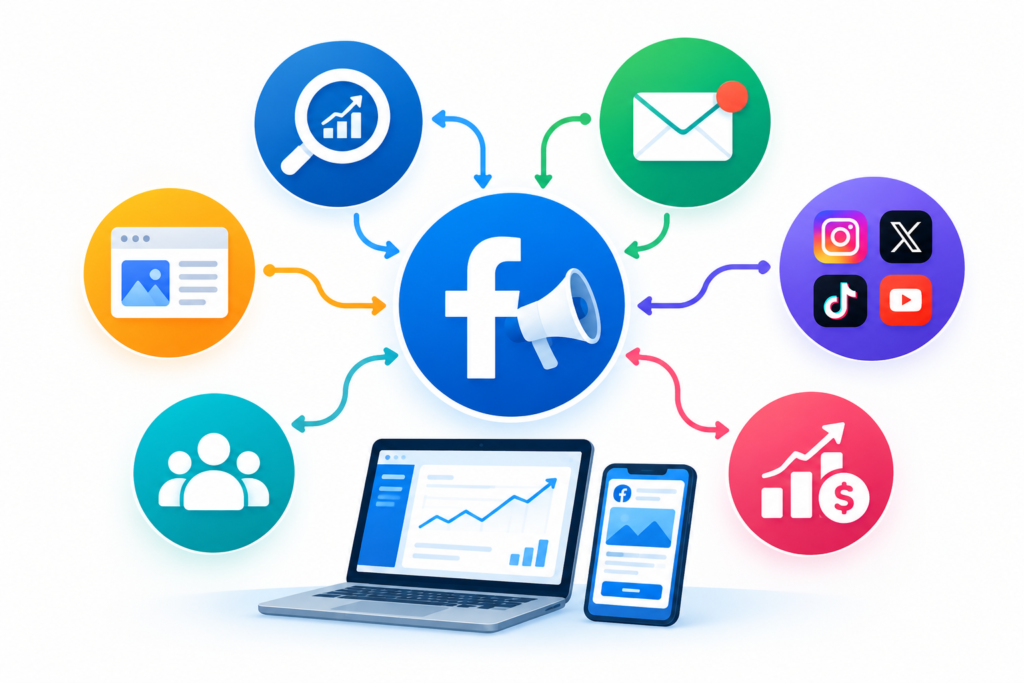
Facebook Ads are often most effective when they operate as part of a coordinated marketing system rather than as an isolated source of traffic. Customers may encounter a business through social advertising, search for its name later, read an article, subscribe to an email list, compare alternatives, and eventually complete a purchase. These interactions can occur in different orders and across multiple devices. A connected strategy helps businesses maintain consistent messaging and understand how their marketing activities support the customer journey.
Search engine optimisation and Facebook advertising can complement one another in several ways. SEO can attract people who are actively researching a topic or looking for a product or service through organic search, while Facebook Ads can introduce a business to eligible audiences who may not yet be searching for it. Advertising results may also reveal customer questions, common objections, and creative messages worth exploring in organic content. For example, if a product demonstration consistently helps customers understand a particular feature, the business could develop a detailed product guide explaining that feature. Organic content can then provide deeper information to visitors who want to evaluate the offer before purchasing.
Email marketing can support the relationship after an initial interaction, provided that subscribers have been collected and contacted in accordance with applicable consent requirements. A business might use an eligible lead-generation campaign to offer a useful resource or invite prospects to request more information. Subsequent emails can explain the service, answer common questions, and help subscribers determine whether the offer is suitable. The content should reflect the expectations established at sign-up, provide a straightforward unsubscribe mechanism where required, and avoid sending irrelevant messages simply because someone submitted a form.
Customer relationship management systems can further connect advertising activity with sales outcomes. When appropriate integrations and lawful data practices are in place, a business may record whether leads are contacted, qualified, converted, or disqualified. This information can reveal whether advertising is attracting the right people and whether the sales process is effective. It can also help teams avoid treating all leads as equally valuable. Businesses should carefully manage access, data retention, and the transfer of customer information to advertising platforms, following current requirements and professional guidance where needed.
Consistency across channels is essential. If a Facebook advertisement promotes a specific discount, the website and relevant email communications should explain the same offer and its conditions. If a company positions itself as a premium provider, its creative content, landing pages, customer support, and sales process should reinforce that positioning. Inconsistent pricing, conflicting claims, or different eligibility rules can reduce trust and undermine campaign performance.
Cross-channel reporting should avoid double-counting success. A customer may interact with several channels before converting, and each platform may attribute the purchase according to its own rules. Businesses should distinguish between platform-reported attribution and a broader view of the customer journey. Depending on their size and resources, they may use analytics reporting, CRM records, controlled tests, or a documented reporting model to compare outcomes. No single attribution method perfectly captures every influence, but consistent definitions improve decision-making.
Finally, allocate investment according to the role each channel plays and the evidence available. SEO may provide long-term organic visibility, email may support customer retention, and Facebook Ads may help accelerate discovery or generate demand. Their contributions differ, so judging every channel by the same immediate metric can lead to poor decisions. A connected strategy allows each channel to support the others while maintaining clear goals, credible reporting, and a consistent customer experience.
Facebook Ads Policies, Privacy, and Responsible Advertising
Responsible advertising is essential for protecting customers, maintaining account integrity, and building a sustainable business. Advertisers must follow Meta’s current advertising policies as well as the laws and regulations that apply to their markets and products. Requirements can differ according to the type of product, geographic location, audience, and advertising claim. Before launching a campaign, businesses should review the current Meta Advertising Standards rather than rely on outdated advice or assume that approval of a previous advertisement guarantees approval of a new one.
Accuracy is one of the most important principles. Advertisements should represent products and services honestly, use substantiated claims, and avoid misleading pricing, fabricated discounts, or promises that cannot be supported. A business should not advertise a feature that is unavailable, present an ordinary price as a temporary promotion without justification, or imply that a customer will definitely achieve a particular outcome when results depend on other factors. If a claim requires evidence, the business should retain appropriate supporting material and ensure that the advertisement, landing page, and offer conditions are consistent.
Some advertising categories are subject to additional restrictions. Financial products, housing, employment, health-related offerings, and other regulated or sensitive areas may have special rules affecting eligibility, targeting, disclosures, or claims. Businesses should confirm whether their product falls within a restricted category and use only the permitted campaign configurations. They should never attempt to circumvent platform review systems by disguising a prohibited offer or repeatedly submitting substantially identical advertisements in the hope that one will be approved.
Privacy and data protection must also be integrated into the advertising process. Businesses should understand what information they collect, why they collect it, how long they retain it, and with whom they share it. Lead forms should explain the relevant purpose, collect only appropriate information, and link to a suitable privacy notice. Tracking technologies should be implemented with the necessary consent and disclosures where required. Customer lists and other personal information must not be uploaded or used for advertising unless the business has the appropriate rights and meets the relevant platform conditions.
For businesses operating in the UK, the Information Commissioner’s Office provides guidance on data protection and direct marketing. Organisations should review applicable requirements under the UK GDPR, the Data Protection Act 2018, and relevant rules governing electronic marketing and tracking technologies. Other countries may impose different or additional requirements, so businesses operating internationally should assess their obligations in each relevant jurisdiction. General information is useful for planning, but it does not replace legal advice tailored to a particular business.
Account security is another important consideration. Restrict access to trusted team members, use strong authentication, review business permissions, and remove access that is no longer required. Verify unexpected requests for account access or payment information through official channels, and avoid sharing login credentials among staff or external agencies. Documenting account ownership, billing arrangements, and administrative responsibilities can help prevent disruption when team members change.
Finally, responsible advertising includes respect for customers. Avoid exploiting vulnerabilities, creating false urgency, using deceptive creative techniques, or collecting unnecessary personal information. Monitor feedback, respond appropriately to legitimate concerns, and correct inaccurate claims promptly. Compliance should not be treated as a final approval step alone; it should guide campaign planning, creative development, tracking, and ongoing optimisation.
Building a Long-Term Facebook Ads Strategy for Sustainable Growth
A long-term Facebook advertising strategy combines clear commercial objectives, a repeatable testing process, accurate measurement, creative development, and disciplined financial management. Rather than treating each campaign as a separate experiment with no connection to previous work, businesses should develop a system that captures what has been learned and applies it to future decisions. This creates a more reliable foundation for growth and reduces the temptation to make large changes in response to short-term fluctuations.
The first element is a documented strategy. It should identify the business’s products or services, priority customer groups, core value propositions, target conversion actions, financial constraints, and principal performance indicators. It should also explain how Facebook Ads support the wider marketing plan. For example, the strategy may use prospecting campaigns to introduce the brand to new audiences, conversion campaigns to encourage eligible purchase actions, and carefully designed follow-up communications to support interested prospects. The exact structure should depend on the business model, available data, current platform capabilities, and the customer journey rather than a fixed formula.
The second element is a structured experimentation programme. Businesses should maintain a record of tested creative concepts, audience approaches, offers, landing pages, and optimisation settings. Each test should have a clear question, a defined success measure, and an appropriate evaluation method. If a test fails, record what was learned rather than simply discarding it. For example, a product demonstration may attract strong engagement but fail to increase purchases, suggesting that attention alone does not resolve the customer’s main buying concern. Another creative concept may attract fewer clicks but generate more qualified enquiries. These findings can improve future decisions even when an experiment does not produce the hoped-for result.
The third element is financial discipline. Establish acceptable acquisition costs, evaluate margins, monitor refunds and customer quality, and maintain enough cash flow to support fulfilment. Avoid scaling solely because an advertising dashboard shows rising revenue. A sustainable strategy should consider the entire business outcome, including customer retention and repeat purchases where relevant. Businesses should also recognise that customer lifetime value estimates involve uncertainty and should not be used to justify unlimited acquisition spending without credible evidence.
The fourth element is operational readiness. Advertising growth can expose weaknesses in inventory management, response times, website reliability, customer service, or internal processes. Before expanding campaigns, confirm that the organisation can deliver the advertised offer consistently. A reliable customer experience supports repeat business, genuine recommendations, and long-term brand trust. If a campaign generates demand that the business cannot fulfil, short-term advertising gains may create longer-term losses.
The fifth element is adaptability. Meta regularly changes its tools, interfaces, policies, and delivery features. Advertisers should monitor official announcements, review platform guidance, and periodically audit their campaign setup. At the same time, they should avoid rebuilding their entire strategy around every new feature or industry trend. The underlying principles remain important: understand customers, communicate value clearly, measure meaningful outcomes, protect privacy, and make evidence-led decisions.
A practical review cycle can help maintain consistency. Each week, examine delivery, conversion quality, budget pacing, and any technical issues. Each month, review performance against business targets, compare campaign results, assess creative fatigue, and document the next set of experiments. At longer intervals, revisit the target audience, offer positioning, unit economics, customer retention, and the overall role of Facebook Ads within the marketing mix. Review frequency should be adapted to campaign volume and business risk rather than followed as an inflexible schedule.
The goal is to build a marketing capability that improves over time. Sustainable success rarely comes from one advertisement or one clever targeting setting. It comes from understanding the customer, making the offer compelling, providing a trustworthy experience, measuring results accurately, and improving the system through disciplined learning.
Common Mistakes in Facebook Ads and How to Avoid Them
Facebook advertising mistakes can waste budget, reduce lead quality, distort reporting, and weaken customer trust. Recognising common problems early allows businesses to correct their processes before unnecessary expenditure accumulates.
1. Launching campaigns without a defined business objective
A campaign may generate likes, impressions, or clicks without contributing meaningfully to revenue or qualified enquiries. This often happens when advertisers choose an objective because it appears inexpensive or produces attractive dashboard figures.
How to avoid it: Define the primary business result before launching. Select the most appropriate available objective and establish a corresponding KPI, such as qualified leads, purchases, or cost per acquisition. Use engagement and traffic metrics as diagnostic indicators rather than automatic evidence of commercial success.
2. Targeting audiences too narrowly
Excessively restrictive audience settings can limit delivery and prevent the campaign from reaching potentially suitable customers. Narrow targeting is not always wrong, but it should have a clear justification, such as genuine service-area restrictions or an appropriate customer requirement.
How to avoid it: Start with customer research and test audience approaches that fit the offer. Consider broader eligible audiences when appropriate, and assess results based on conversion quality rather than assumptions about demographic precision.
3. Using weak or misleading creative content
Generic images, unclear product demonstrations, crowded designs, and exaggerated claims can reduce trust and attract the wrong audience. Creative that generates curiosity without communicating the offer may also produce low-quality traffic.
How to avoid it: Make the main benefit clear, use relevant visuals, demonstrate the offer honestly, and ensure that the call to action reflects the next step. Test distinct creative concepts and retain evidence to support factual claims.
4. Sending all advertising traffic to the homepage
A homepage may not provide the specific information promised in an advertisement. Requiring visitors to search for the relevant product or service adds friction and can reduce conversion rates.
How to avoid it: Use a destination that closely matches the advertisement’s message. Ensure that the landing page clearly explains the offer, provides relevant information, and makes the next action easy to complete.
5. Ignoring conversion tracking
Without reliable tracking, advertisers may make budget decisions using incomplete or misleading information. Incorrect purchase values, duplicate events, or lead events that fire before a genuine submission can further undermine reporting.
How to avoid it: Test important events before launch, use available diagnostics, validate transaction values, and review tracking after website changes. Compare platform reports with internal sales or transaction records where practical.
6. Changing too many campaign variables at once
Repeatedly changing budgets, audiences, creative, placements, and objectives makes it difficult to understand which factor influenced the result. It can also encourage decisions based on short-term noise.
How to avoid it: Document each optimisation hypothesis and make controlled changes where possible. Allow an appropriate evaluation period based on conversion volume and business risk, and avoid treating every daily fluctuation as a reason for intervention.
7. Scaling before profitability is established
Increasing expenditure on a campaign with weak margins or poor customer quality can magnify losses. Attributed revenue alone does not show whether a campaign is financially sustainable.
How to avoid it: Evaluate acquisition costs, gross margins, fulfilment expenses, refunds, and lead-to-customer conversion rates. Expand gradually when the evidence supports it and the business can handle additional demand.
8. Neglecting privacy, policy compliance, and account security
Using customer information without appropriate permissions, making unsupported claims, or giving unnecessary people access to an advertising account can expose a business to legal, operational, and reputational risks.
How to avoid it: Review current advertising standards, apply appropriate privacy and consent practices, restrict account permissions, enable available security protections, and keep records of important changes and approvals.
The common lesson is that effective Facebook advertising requires more than creative production and budget allocation. A dependable process combines clear objectives, credible offers, accurate measurement, careful experimentation, and responsible customer communication.
Best Practices Summary for Sustainable Facebook Ads Growth
The following practices provide a practical framework for maintaining and improving Facebook advertising performance.
– Define measurable goals: Connect campaign objectives to business outcomes such as profitable sales, qualified leads, or completed bookings.
– Understand the customer: Use genuine customer research to identify needs, objections, buying motivations, and the information people require before taking action.
– Select appropriate objectives: Configure campaigns around the desired result instead of prioritising inexpensive clicks or engagement without a clear commercial reason.
– Develop compelling creative: Use relevant images, videos, product demonstrations, and concise messages that explain a credible benefit.
– Write honest ad copy: Avoid unsupported promises, fabricated urgency, misleading comparisons, and claims that the business cannot substantiate.
– Optimise landing pages: Maintain message consistency, clear navigation, mobile usability, fast loading, accessible content, and a straightforward conversion process.
– Measure conversions accurately: Test tracking events, validate reported values, investigate discrepancies, and use platform data alongside appropriate business records.
– Manage budgets responsibly: Base investment decisions on unit economics, cash flow, conversion quality, and the business’s ability to fulfil additional demand.
– Test with a purpose: Define each experiment, change meaningful variables carefully, and document the results so future decisions benefit from previous learning.
– Use retargeting appropriately: Deliver relevant follow-up messages to eligible audiences while respecting privacy, frequency, and current platform requirements.
– Scale using evidence: Expand campaigns when performance is sufficiently consistent and operational capacity supports additional sales or enquiries.
– Integrate marketing channels: Coordinate Facebook Ads with SEO, email marketing, website content, customer support, and sales processes to create a consistent customer journey.
– Maintain compliance and security: Follow current advertising policies, applicable data-protection laws, and sound account-access practices.
– Review performance regularly: Establish a practical reporting schedule, investigate meaningful changes, and prioritise improvements that support business goals.
– Focus on long-term customer value: Evaluate customer quality, retention, satisfaction, and profitability rather than relying solely on short-term advertising metrics.
These practices work best when they form part of an ongoing operating process. Businesses should adapt their approach to their budget, market, available data, and customer journey. There is no universal campaign configuration that guarantees success, but a disciplined approach can improve the quality of decisions and reduce avoidable waste.
Frequently Asked Questions
1. What are Facebook Ads, and how do they work?
Facebook Ads are paid advertisements delivered through Meta’s advertising system. Advertisers select a campaign objective, configure the available audience and delivery settings, choose creative assets, set a budget, and define the action they want to encourage. The platform then delivers eligible advertisements according to its delivery systems, campaign settings, and applicable policies.
Businesses can use Facebook Ads to build awareness, attract website visitors, generate leads, promote products, and encourage purchases. The results depend on several factors, including the quality of the offer, the relevance of the creative, competition, the customer experience, and the accuracy of measurement. Advertising can provide access to prospective customers, but it does not guarantee sales or profitability.
2. How much should a business spend on Facebook Ads?
There is no fixed budget that works for every business. An appropriate starting budget depends on the desired conversion, expected acquisition cost, profit margins, market competition, and the amount of evidence required to evaluate a campaign.
Before setting a budget, calculate how much the business can afford to spend to acquire a customer or qualified lead. Then establish a controlled testing budget that the business can sustain without putting essential operations at risk. Monitor the cost and quality of results, and increase expenditure only when the evidence supports the decision. A larger budget can increase opportunities for delivery, but it cannot automatically fix an ineffective offer, weak landing page, or inaccurate tracking.
3. Are Facebook Ads effective for small businesses?
Yes, Facebook Ads can be useful for small businesses when the offer, audience, budget, and conversion process are aligned. Smaller organisations may use them to promote a local service, introduce a product, generate enquiries, or reach eligible audiences beyond their existing followers.
However, small businesses should be especially careful about cash flow and profitability. Begin with a clearly defined objective, a focused offer, and a practical measurement plan. Make sure the business can respond to enquiries promptly and deliver what the advertisement promises. Evaluate the quality of customers and the total cost of acquiring them instead of judging success solely by clicks or impressions.
4. What is the difference between Facebook Ads and boosted posts?
A boosted post is an existing social media post promoted through a simplified advertising process. It can help increase the distribution of content and encourage selected forms of engagement or other available outcomes.
Ads created through Meta Ads Manager generally provide more extensive campaign configuration, reporting, and optimisation options. The appropriate choice depends on the objective. Boosting a post may be suitable for straightforward content promotion, while Ads Manager is generally more appropriate when a business needs a structured campaign, specific conversion measurement, more detailed testing, or a carefully managed sales and lead-generation strategy.
5. How can I improve my Facebook Ads conversion rate?
Begin by examining the entire customer journey rather than changing the advertisement immediately. Check whether the creative communicates a clear benefit, the offer matches the audience’s needs, and the landing page delivers what the advertisement promises. Review mobile usability, loading speed, pricing clarity, form length, trust information, and the visibility of the main call to action.
Use tracking data to identify where potential customers leave the process. If people click but do not complete a form, investigate the landing page and form experience. If purchases are low despite strong engagement, consider whether the offer, price, product information, or checkout process is creating friction. Test one meaningful improvement at a time and assess whether it improves the business outcome, not just a secondary metric.
6. What is the Meta Pixel, and does every business need it?
The Meta Pixel is a tool that helps eligible websites measure specified visitor actions and connect those events with advertising activity. It can be particularly useful for businesses that want to evaluate product views, basket additions, purchases, or other website conversions.
Whether and how it should be implemented depends on the business’s objectives, website, technical setup, and privacy obligations. Advertisers should configure only the events they need, test them for accuracy, and apply required consent and disclosure practices. The Conversions API may provide an additional measurement option in eligible setups. Neither tool eliminates privacy obligations, and businesses should avoid sending unnecessary or sensitive information.
7. How long does it take to see results from Facebook Ads?
Some campaigns may generate initial clicks, enquiries, or purchases shortly after launch, but early activity does not necessarily establish whether the campaign is profitable. The time required to evaluate performance depends on budget, conversion volume, the complexity of the purchase decision, seasonal conditions, and the quality of the tracking setup.
A low-cost purchase with a short decision cycle may be evaluated differently from a professional service that requires several sales conversations. Businesses should establish an appropriate review period and avoid making major decisions based on very limited data. Monitor early indicators for technical problems, then evaluate conversion quality and commercial performance as sufficient evidence becomes available.
8. How can businesses scale Facebook Ads without wasting money?
Start by confirming that the campaign produces commercially valuable outcomes at an acceptable cost. Review margins, customer acquisition cost, lead quality, repeat purchases where relevant, and the operational resources needed to support additional demand.
Expand gradually through justified budget adjustments, new creative concepts, or suitable additional audiences and markets. Record each change and monitor the effect on results. Maintain a pipeline of creative tests, keep tracking accurate, and ensure that customer support and fulfilment can handle increased volume. If performance deteriorates, investigate the cause before increasing expenditure further. Sustainable scaling depends on repeatable economics and a reliable customer experience, not simply on spending more.
Conclusion
Facebook Ads can be a valuable part of a business’s digital marketing strategy when campaigns are built around clear objectives, genuine customer needs, compelling creative content, and reliable measurement. Their value does not come from targeting options or advertising technology alone. Results depend on the relationship between the offer, the audience, the advertisement, the landing page, and the wider process used to convert and retain customers.
Businesses should begin with a realistic plan, define measurable goals, establish an appropriate budget, and implement tracking that reflects meaningful customer actions. They should then test creative concepts, review conversion quality, improve the landing-page experience, and make optimisation decisions using credible evidence. Privacy, policy compliance, and honest communication must remain central throughout the process. No campaign can guarantee a particular return, but a structured approach helps businesses identify opportunities, manage risk, and improve their understanding of customer behaviour.
Long-term performance also requires coordination between advertising, website development, SEO, email marketing, customer support, and sales. When these activities work together, a business can provide a more consistent customer experience and make better use of the information gained from each interaction. Scaling should follow demonstrated commercial performance and operational readiness rather than assumptions that more expenditure will automatically produce better results.
At MyBlogPoster, the broader objective is to help businesses understand digital marketing and make more informed decisions about online growth. By applying the principles in this guide, businesses can build a more disciplined approach to Facebook Ads, strengthen customer trust, and develop an advertising process focused on measurable and sustainable outcomes.
Want to Implement This Easily?
AI Implementation Prompt:
You are an expert consultant. Based on the blog post titled “(Facebook Ads)”, provide a step-by-step, practical implementation guide. Include tools, best practices, common mistakes to avoid, and advanced tips. Assume the reader wants to implement everything discussed in this article effectively.
Call to Action:
Want our help implementing this? Just reach out to us via our website contact form: https://myblogposter.co.uk/contact-us/