











Learn how to build, optimize, and scale Facebook Ads campaigns with practical strategies for audience targeting, creative development, ad copy, budgeting, conversion tracking, retargeting, testing, and sustainable business growth.
Introduction
Facebook Ads have become an important component of modern digital marketing because businesses can use paid social advertising to reach potential customers, introduce products and services, generate qualified leads, increase website traffic, and support online sales. However, successful advertising requires considerably more than creating an advertisement and selecting an audience. Sustainable performance depends on the relationship between customer research, campaign objectives, audience targeting, creative quality, persuasive messaging, landing-page experience, conversion tracking, testing, and ongoing optimization.
A successful advertising strategy begins with the customer rather than the advertising platform. Businesses need to understand who their ideal customers are, what problems they are trying to solve, what outcomes they want, what objections may prevent them from buying, and why a particular offer deserves their attention. This customer-first approach allows advertisements to become more relevant and useful instead of simply attempting to maximize clicks, impressions, or engagement.
For businesses using MyBlogPoster, Facebook advertising can become a valuable part of a broader digital growth strategy when campaigns are built around measurable business outcomes. This guide explains how to approach Facebook Ads from strategy through execution, covering audience research, campaign objectives, account structure, creative development, ad copy, landing pages, budgeting, tracking, testing, retargeting, scaling, automation, common mistakes, and best practices.
The central idea is simple: the advertisement creates attention, the message establishes relevance, the offer creates motivation, the landing page builds confidence, and the conversion process turns interest into measurable business value. When these components work together, paid social advertising can become a repeatable acquisition system rather than an unpredictable source of traffic.
Understanding Facebook Ads and Their Role in Digital Marketing
Facebook Ads are paid advertising placements that allow businesses to promote products, services, offers, content, and brand messages to selected audiences across Meta’s advertising ecosystem. Depending on the campaign configuration and available placements, advertisements can appear in feeds, Stories, Reels, video environments, and other supported placements. This creates opportunities for businesses to introduce their offers to new audiences while also reconnecting with people who have already interacted with their brand.
The value of Facebook advertising extends beyond exposure. Its strength comes from combining audience discovery, creative communication, measurable actions, and optimization. An e-commerce business can promote products and encourage purchases. A professional service provider can generate enquiries or consultation requests. A local business can promote appointments. A software company can encourage registrations or trials. Each use case requires a different strategy because the desired customer action is different.
Advertising technology cannot compensate indefinitely for weaknesses elsewhere in the customer journey. If the offer is unclear, the product is poorly positioned, the landing page creates friction, or the sales process is ineffective, increasing advertising expenditure may simply increase the amount of unsuccessful traffic.
This is why Facebook Ads should be considered one part of a wider digital marketing system. Paid social advertising can work alongside SEO, content marketing, email marketing, social media marketing, website optimization, and customer retention. Each channel can support a different stage of the customer journey.
Businesses should also avoid evaluating campaign quality exclusively through platform-level metrics. A low cost per click may look attractive, but inexpensive traffic does not automatically produce valuable customers. The more important question is whether the people reached by the campaign take actions that contribute to meaningful business outcomes.
Meta’s official advertising resources provide information about different advertising placements and creative formats. When developing vertical video for Reels, for example, advertisers can follow Reels Ads guidance around placement-specific creative considerations.
Ultimately, effective Facebook advertising connects the right message with an appropriate audience at the right stage of the buying journey. The objective is not simply to maximize exposure. It is to create relevant attention that can develop into meaningful customer action.
Defining Clear Business Goals Before Launching Facebook Ads
Every Facebook Ads campaign should begin with a clearly defined business objective. Without a specific goal, advertisers can become overly focused on surface-level metrics such as impressions, clicks, reactions, or video views. These measurements can be useful for diagnosis, but they do not necessarily prove that a campaign is producing commercial value.
The first step is to identify the action that represents success. For an e-commerce company, this may be a completed purchase. For a professional service provider, it could be a qualified enquiry, consultation request, or booked appointment. A software business might prioritize registrations, trials, or subscriptions. A local company may focus on calls or bookings.
After establishing the primary outcome, supporting metrics can be defined. An e-commerce advertiser may monitor purchases, conversion rate, average order value, customer acquisition cost, and return on advertising spend. A lead-generation business may track leads, qualified leads, sales opportunities, customer acquisition cost, and lead-to-customer conversion rate.
Financial planning is equally important. Businesses should know how much they can reasonably spend to acquire a customer while maintaining sustainable economics. That calculation may depend on profit margins, customer lifetime value, average order value, repeat purchases, sales conversion rates, and operating costs.
For example, a company selling a high-value service may be able to support a higher acquisition cost than a business selling a low-margin product. Looking only at advertising expenditure without considering customer value can therefore lead to poor decisions.
Clear objectives also improve communication between marketing and sales teams. Instead of asking whether an advertisement “performed well,” teams can ask whether it generated more qualified opportunities, increased purchases, improved acquisition efficiency, or contributed to revenue.
The objective should also remain stable enough to allow meaningful learning. Constantly changing the desired result makes it difficult to compare campaigns and identify genuine improvements.
A strong Facebook Ads strategy therefore starts with business economics and customer outcomes, not advertising settings. Once the desired result is established, campaign structure, audience targeting, creative, budget, landing pages, and measurement can all support the same goal.
Audience Research and Customer Intent
Audience research is one of the foundations of effective Facebook advertising. Businesses often begin with demographic characteristics such as age, location, gender, or broad interests. These characteristics can provide useful context, but they rarely explain why a person will actually become a customer.
Strong audience research examines the customer’s problem, desired outcome, motivation, urgency, objections, awareness level, and buying behavior. Two people with similar demographic characteristics may have completely different reasons for purchasing a product or service.
Businesses can gather customer insights from sales conversations, support requests, customer interviews, surveys, reviews, CRM information, website analytics, and previous campaign results. Customer language is especially valuable. If customers repeatedly describe a problem using particular words, those words may reveal useful opportunities for advertising messages and content.
Customer awareness also influences how advertisements should be developed. Someone who has never heard of a particular solution may need education before receiving a direct sales message. Someone comparing alternatives may need differentiation, proof, or a clear explanation of benefits. A person who has already visited a product page may need reassurance or an answer to an objection before completing a purchase.
Audience segmentation should therefore reflect meaningful differences in customer behavior and intent. Useful categories can include cold prospects, engaged users, website visitors, previous leads, existing customers, and high-value customers.
Exclusions can also improve relevance. Someone who has already purchased a product may not need to continue seeing a customer-acquisition advertisement for the same product.
However, businesses should avoid creating unnecessary complexity. Excessive audience segmentation can fragment data and make optimization more difficult. The objective should be to identify important customer differences while maintaining enough scale for useful campaign learning.
The strongest audience strategy combines customer research with real campaign evidence. Research creates the initial hypothesis, while actual advertising data reveals how customers respond to different messages, offers, creative concepts, and calls to action.
Selecting the Right Campaign Objective and Conversion Event
The campaign objective should reflect the business outcome that matters most. Choosing an objective simply because it produces inexpensive activity can create a disconnect between platform optimization and commercial performance.
For example, a company that needs qualified leads may not benefit from optimizing primarily for inexpensive engagement. Likewise, an online retailer that needs purchases may receive limited value from a campaign focused mainly on generating website visits.
The correct approach is to map the customer journey and identify important actions throughout the process. An e-commerce journey may include product views, add-to-cart actions, checkout initiation, and purchases. A service business may have a journey that includes service-page visits, enquiry submissions, consultations, qualified opportunities, proposals, and closed sales.
Not every event has the same commercial value. A page visit indicates interest, but a completed purchase is much closer to revenue. A form submission can demonstrate intent, but a qualified lead is more valuable when the sales team can identify genuine buying potential.
Conversion events should therefore be carefully defined and accurately implemented. Businesses should regularly test their tracking to make sure important actions are being recorded correctly.
Tracking problems can seriously affect campaign decisions. Missing conversions, duplicate events, incorrect configurations, or incomplete data can create a false picture of campaign performance.
Businesses should also avoid constantly changing the primary conversion event without a clear strategic reason. A consistent measurement framework makes it easier to identify genuine trends and compare performance over time.
The core principle is simple: optimize toward the outcome that represents genuine business value. Clicks, impressions, and engagement can provide useful diagnostic information, but they should support rather than replace the main commercial objective.
Building a Logical Facebook Ads Campaign Structure
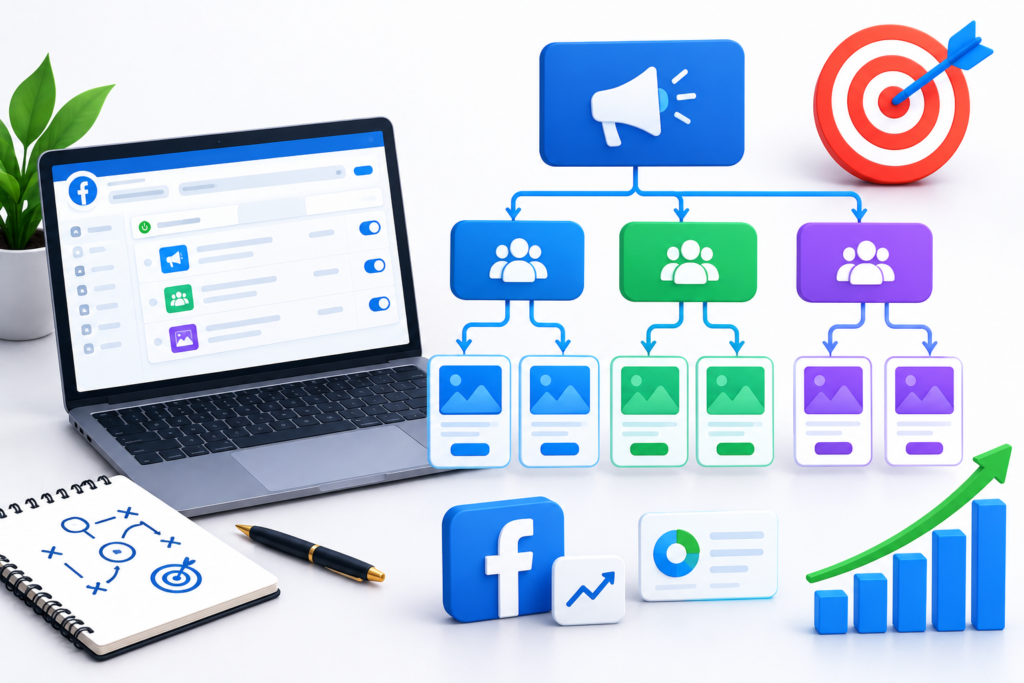
Campaign structure affects how easily an advertising account can be managed, tested, analyzed, and scaled. A logical structure should reflect meaningful differences between products, audiences, markets, business objectives, and creative strategies.
At the campaign level, establish the strategic purpose. This might be sales, lead generation, awareness, traffic, or another measurable objective. At the audience or delivery level, separate variables only when they genuinely require different treatment. At the advertisement level, introduce different creative concepts, messages, formats, and offers.
One common mistake is excessive fragmentation. Businesses sometimes create numerous campaigns and small audience groups because they assume more segmentation automatically creates better control. In practice, excessive fragmentation can divide available data, increase management complexity, and make optimization more difficult.
The opposite problem can also occur. Combining completely different products, markets, or commercial objectives into one campaign structure can make performance analysis difficult.
The appropriate structure therefore provides enough control to answer important questions without creating unnecessary complexity.
Consistent naming conventions become increasingly valuable as accounts grow. A naming system can identify the campaign objective, product, market, audience, funnel stage, or testing variable.
Documentation is also useful. Record important changes such as budget adjustments, creative replacements, audience changes, landing-page updates, tracking modifications, and offer changes. When performance changes, these records provide context for understanding why.
A well-organized account should allow marketers to answer several questions quickly:
What is this campaign designed to achieve? Who is it intended for? What is being tested? What conversion matters? How much is being spent?
When those questions can be answered easily, optimization becomes more systematic and less dependent on guesswork.
Creating High-Performance Facebook Ad Creative
Creative is one of the first elements that determines whether someone notices an advertisement. However, effective creative is not simply about attractive design. It must communicate a relevant idea quickly and provide the viewer with a reason to continue paying attention.
The creative process should begin with the customer message rather than the visual design. Determine the problem, benefit, transformation, demonstration, objection, or insight that needs to be communicated. Then select the format that best supports the message.
Video can be useful for product demonstrations, tutorials, customer experiences, educational content, behind-the-scenes material, and visual transformations. Static creative can communicate a focused proposition quickly. Carousel formats can present several products, features, benefits, or stages of a process.
Mobile-first presentation is important because many users encounter social advertising on smaller screens. Important information should remain readable, while video should communicate its main message quickly.
Placement-specific creative can also improve the user experience. Advertisers can use Reels Ads guidance when developing vertical creative specifically for Reels environments.
Creative testing should focus on meaningful concepts rather than superficial changes. For example, comparing a “save time” message with a “reduce risk” message can provide much more useful insight than simply changing a background color.
Businesses should create a continuous pipeline of new creative concepts. Customer questions, objections, reviews, demonstrations, case studies, educational topics, product benefits, and sales conversations can all become sources of new advertising ideas.
A practical creative testing framework can include:
- Problem-focused creative
- Benefit-focused creative
- Product demonstration creative
- Customer testimonial creative
- Educational creative
- Comparison creative
- Objection-handling creative
- Offer-focused creative
The goal is not to create random variations. It is to discover which messages and creative concepts attract appropriate customers and contribute to meaningful downstream conversions.
Writing Facebook Ad Copy That Encourages Action
Facebook ad copy should help the right audience understand an offer quickly. Effective copy does not need to describe every feature. Instead, it should establish relevance, communicate value, reduce uncertainty, and guide the reader toward the next appropriate action.
A practical structure can begin with a customer problem, question, opportunity, observation, or desired outcome. The copy can then explain how the product or service addresses that need. Supporting evidence may include customer experiences, demonstrations, case studies, relevant credentials, process information, or specific differentiators.
Clear language is generally more credible than exaggerated promotional statements. Businesses should avoid unsupported claims such as “guaranteed results,” “the best,” or “instant success” when those claims cannot be substantiated.
Specificity is often more persuasive than hype. Instead of saying that a service is “amazing,” explain what it does, who it is designed for, what problem it solves, and what makes the approach different.
Copy should also reflect the customer’s awareness level. Cold audiences may need education. Prospects comparing alternatives may need differentiation. Previous visitors may need reassurance or objection handling. Existing customers may require retention or cross-selling messages.
The advertisement should align closely with the landing page. If the ad promises a specific product, offer, discount, or experience but the destination page does not immediately reinforce that promise, the visitor may become confused.
Calls to action should match the level of commitment being requested. Someone encountering a business for the first time may be encouraged to learn more, while a high-intent prospect may be ready to book, enquire, or purchase.
Effective Facebook ad copy is therefore not about using as many persuasive phrases as possible. It is about making the right information clear, relevant, credible, and useful.
Building Landing Pages That Convert Facebook Traffic
An advertisement can generate attention and clicks, but the landing page determines what happens after the click. Businesses sometimes try to solve weak conversion rates by continuously changing their advertisements when the underlying problem is actually the destination page.
A strong landing page should immediately reinforce the reason the visitor clicked. The headline should communicate the central value proposition clearly, while supporting sections should explain benefits, features, differentiation, proof, and the next step.
The page should minimize unnecessary friction. Forms should request information that is genuinely necessary, calls to action should be easy to identify, and visitors should not have to navigate through excessive distractions to understand what they should do next.
Trust is particularly important for people who have never interacted with a business. Depending on the business model, useful trust elements may include testimonials, case studies, reviews, relevant qualifications, transparent policies, product demonstrations, contact information, and answers to common objections.
Technical performance also matters. Google’s official page experience guidance covers areas including Core Web Vitals, mobile usability, secure website delivery, intrusive interstitials, and the usability of the main content.
Landing pages should be tested from the customer’s perspective. Businesses should check the page on desktop and mobile, test forms and buttons, verify confirmation pages, confirm conversion tracking, and ensure that the entire customer journey works correctly.
A campaign can lose valuable conversions because of a simple technical problem that may not be obvious from the advertising dashboard.
The strongest landing pages are not necessarily the longest. They are pages where message relevance, value proposition, trust, usability, and conversion intent work together.
Developing a Sustainable Facebook Ads Budget
A sustainable Facebook Ads budget should be connected to customer economics rather than selected arbitrarily. Businesses should understand how much they can spend to acquire a customer while maintaining acceptable profitability.
The appropriate budget differs considerably between business models. A high-value service company may support a much higher acquisition cost than a low-margin product business. A subscription company with strong retention may also have different economics from a business that depends on one-time purchases.
Budget planning should therefore begin with customer value and acceptable acquisition cost. Businesses can estimate the number of customers or qualified opportunities required and then calculate an appropriate advertising investment.
New campaigns should initially be treated as learning environments. Before increasing spending significantly, advertisers should confirm that tracking works correctly, the offer is clear, the creative is relevant, the landing page performs effectively, and the sales process can handle incoming demand.
At the same time, advertisers should avoid making changes too quickly. Constantly changing the budget, audience, creative, and objective can make it difficult to determine what caused performance to improve or decline.
Daily results should also be interpreted carefully. Campaign performance can fluctuate because of auction conditions, audience behavior, creative delivery, conversion timing, and other factors.
Scaling should therefore be gradual and evidence-based. Increasing spending does not guarantee a proportional increase in profitable conversions.
The important question is not simply “How much can we spend?” It is “Where can additional advertising expenditure create additional business value?”
That mindset helps businesses build a more sustainable approach to Facebook advertising rather than treating budget increases as the primary growth strategy.
Conversion Tracking and Performance Measurement
Accurate conversion tracking is essential because Facebook Ads optimization depends on the quality of the information available to advertisers. If conversions are missing, duplicated, incorrectly attributed, or poorly defined, campaign decisions can become unreliable.
The tracking framework should begin by mapping the complete customer journey. Identify meaningful actions from the first interaction through to the final commercial outcome.
For an e-commerce company, this may include product views, add-to-cart actions, checkout initiation, purchases, and revenue. For a service provider, it might include website visits, enquiry submissions, qualified leads, appointments, proposals, and closed customers.
Businesses should distinguish between interest metrics and business-value metrics. A click demonstrates that an advertisement generated attention, but it does not prove that the visitor is a suitable customer.
A lead represents stronger intent, but a lead may still have limited commercial value if the person is not qualified.
Connecting advertising data with CRM and sales information can therefore produce a much more complete picture. A campaign generating fewer leads can potentially produce more customers if the leads are significantly better qualified.
A useful reporting framework can include three levels.
Advertising metrics include impressions, reach, clicks, engagement, frequency, and cost metrics.
Conversion metrics include leads, purchases, conversion rates, cost per conversion, and revenue.
Business metrics include qualified leads, customers, customer acquisition cost, profit contribution, repeat purchases, and customer lifetime value.
The business-level metrics should guide major strategic decisions.
Google’s official Google Search Central resources provide guidance covering technical requirements, helpful content, search best practices, and spam policies. Although these resources focus on Google Search rather than Facebook advertising, they reinforce an important principle: digital experiences should be useful, trustworthy, and created for people rather than primarily designed to manipulate systems.
Reliable measurement turns Facebook advertising into a process of testing, learning, optimization, and continuous improvement rather than guesswork.
Facebook Ads Testing and Optimization Strategies
Facebook Ads performance rarely improves through one major change. Sustainable improvement usually comes from a structured process of testing, measuring, learning, and refining. Once a campaign has enough reliable data, advertisers can test variables such as audience segments, creative formats, headlines, primary text, calls to action, landing pages, offers, placements, budgets, and conversion events. The purpose of testing is not simply to discover which advertisement receives the most clicks. A strong test should determine which combination produces meaningful business outcomes, such as qualified leads, completed purchases, booked appointments, or profitable customer acquisition. Businesses should therefore define the success metric before launching each meaningful experiment. This prevents teams from changing campaigns based on impressions, likes, or inexpensive clicks when those metrics do not contribute directly to the commercial objective.
Creative testing is particularly important because users encounter large amounts of advertising content every day. Instead of producing several advertisements that look almost identical, businesses can create clearly differentiated concepts. One version might focus on a customer problem, another on a specific benefit, another on product demonstration, and another on social proof. Visual treatments can also vary between static imagery, short-form video, carousel-style presentation, and other suitable formats. When testing creative, keep important variables sufficiently controlled so the results remain interpretable. Changing the audience, offer, landing page, creative, and budget simultaneously can make it difficult to understand why performance changed. A disciplined testing framework creates a learning system in which each experiment contributes information that can influence the next campaign decision.
Optimization should also consider what happens after the advertisement receives the click. A campaign can have an attractive click-through rate while generating poor commercial results if the landing page is slow, confusing, irrelevant, or difficult to use. Google recommends focusing on helpful, people-first content and providing a good experience for visitors rather than creating pages primarily to manipulate search rankings. Although Facebook advertising and organic search are different acquisition channels, the underlying principle of providing useful, relevant experiences remains valuable. Businesses should review the complete customer journey from advertisement impression to landing page, form completion, checkout, sales conversation, or purchase. For technical website improvements, resources covering page experience and Core Web Vitals can help teams understand broader website performance considerations.
Retargeting and Building Full-Funnel Facebook Ads Campaigns
Retargeting allows businesses to communicate with people who have already interacted with their brand or marketing assets. These audiences can include previous website visitors, people who engaged with social content, previous customers, video viewers, lead-form users, or other eligible groups depending on the data and advertising setup available. The value of retargeting comes from relevance: someone who has already demonstrated interest may require different information from someone encountering the brand for the first time. A new prospect may need education and problem awareness, while an existing prospect may need product details, evidence, answers to objections, or a clear reason to take the next step. Effective campaigns therefore align advertising messages with the user’s stage in the buying journey rather than showing identical advertisements to everyone.
A practical full-funnel structure can be divided into awareness, consideration, conversion, and retention stages. At the awareness stage, content can introduce a problem, category, service, or solution. During consideration, advertisements can explain benefits, demonstrate the product, answer common questions, or provide useful educational material. Conversion campaigns can focus on a specific offer, consultation, purchase, registration, or other measurable action. After conversion, customer-focused campaigns can support retention, repeat purchases, referrals, cross-selling, or ongoing engagement where appropriate. The exact structure should reflect the business model rather than following a fixed template. A subscription business, local service company, e-commerce store, and B2B organization may require very different customer journeys.
Retargeting should also have sensible exclusions and frequency controls. Someone who has already purchased should not necessarily continue seeing an advertisement designed to persuade them to make their first purchase. Similarly, someone who has submitted a lead form may need a different message from someone who only viewed a page. Audience segmentation helps reduce wasted impressions and improves message relevance. Advertisers should also respect applicable privacy requirements, platform policies, consent obligations, and data-management responsibilities. First-party customer data should be collected and handled responsibly, and businesses should understand the applicable legal requirements in the markets where they operate. Retargeting works most effectively when it is treated as part of a complete customer experience rather than simply as a mechanism for repeatedly displaying advertisements.
Scaling Facebook Ads Without Losing Profitability
Scaling Facebook Ads requires more than increasing the daily budget. A campaign that works at a modest level may behave differently when spending increases because audience availability, auction conditions, creative fatigue, conversion volume, and marginal acquisition costs can change. Before increasing investment, businesses should establish clear economic thresholds. These may include target customer acquisition cost, acceptable cost per lead, target return on advertising spend, contribution margin, average order value, lead-to-sale rate, or customer lifetime value. The appropriate metric depends on the business model. The objective is to understand how much the company can sustainably spend to acquire a customer while still maintaining acceptable economics.
There are several ways to approach scaling. Budget expansion is one method, but businesses can also scale by introducing additional creative concepts, expanding suitable audience opportunities, developing new offers, entering additional geographic markets, or creating new customer segments. Creative diversification is particularly valuable because increasing spend against a narrow set of advertisements can accelerate creative fatigue. New variations should preserve the underlying value proposition while giving the system additional material to test. Scaling should also be gradual enough that teams can observe whether performance remains consistent. Sudden increases can make it harder to identify the point at which efficiency begins to deteriorate.
Profitability should always be evaluated at the business level rather than from advertising metrics alone. A campaign producing inexpensive leads may appear successful until the sales team discovers that those leads rarely become customers. Conversely, an advertisement with a higher initial acquisition cost may generate customers with stronger order values, higher retention, or greater lifetime value. This is why advertising data should be connected with downstream business outcomes whenever practical. Businesses should maintain a regular reporting process that compares advertising spend with leads, qualified opportunities, sales, revenue, margins, and customer retention. Scaling then becomes an evidence-based business decision rather than simply an attempt to spend more money.
Common Mistakes Businesses Make With Facebook Ads
One common mistake is launching campaigns without defining a measurable business objective. Businesses sometimes begin with broad goals such as “get more exposure” or “increase engagement” without deciding what action should ultimately result from the advertising investment. Without a clear objective, it becomes difficult to select suitable campaign settings, creative, audiences, landing pages, and measurement criteria. Another frequent problem is trying to target everyone. Broad reach can be useful in some situations, but an effective campaign still needs a clear understanding of the customer, their problem, their motivations, and the value proposition being presented. Audience strategy should therefore be based on customer research and business evidence rather than assumptions about demographics alone.
Another mistake is changing campaigns too frequently. Advertisers may react to a few hours or a small amount of data and repeatedly modify budgets, audiences, advertisements, or campaign settings. This creates an unstable testing environment and makes it difficult to determine what actually caused an improvement or decline. Optimization should instead follow a defined schedule and sufficient evidence. Businesses should also avoid judging performance from a single metric. A high click-through rate does not automatically mean profitable advertising, and a low cost per lead does not necessarily indicate valuable leads. The complete conversion path matters. Tracking should connect the advertisement with the eventual action that represents business value whenever the available technology and privacy requirements permit.
Creative fatigue is another major challenge. Reusing the same advertisement indefinitely can reduce attention and eventually weaken performance. However, replacing every advertisement without learning from previous results is equally inefficient. The better approach is to identify patterns in successful creative and develop new variations around those insights. Businesses should also avoid sending paid traffic to generic pages that do not match the advertisement. If an advertisement promises a particular solution, offer, product, or benefit, the destination should make that promise clear and provide the information necessary for the visitor to continue. Website quality matters because advertising cannot compensate indefinitely for a poor post-click experience. Businesses should also consult Google’s helpful content guidance when developing supporting website content, particularly where paid campaigns and organic content operate together.
Best Practices Summary for Long-Term Facebook Ads Growth
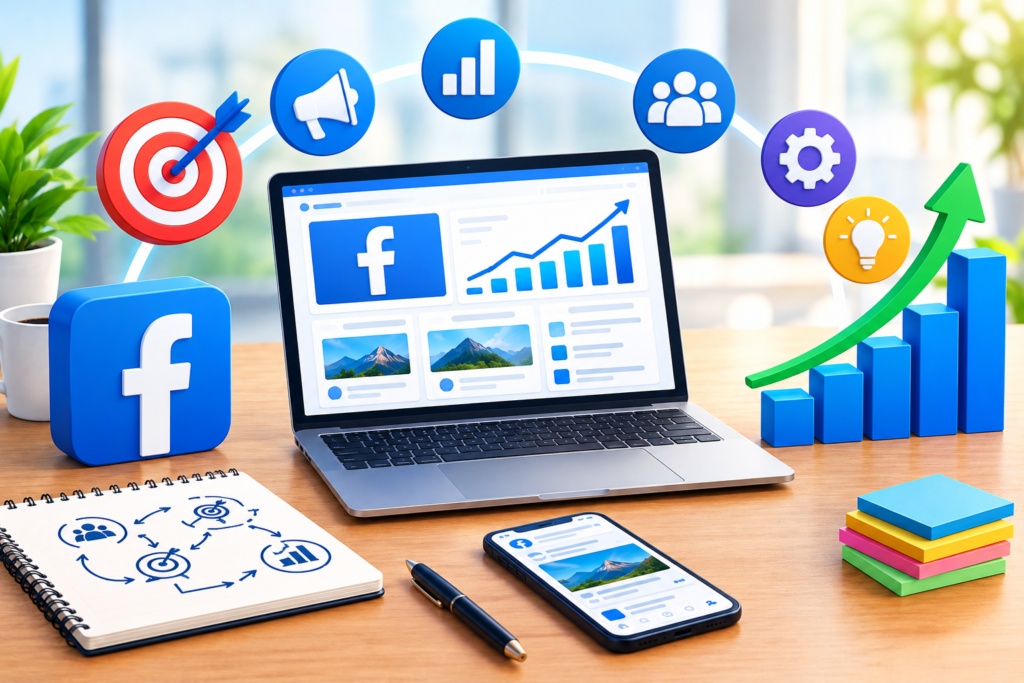
Long-term Facebook Ads success starts with customer understanding. Before creating campaigns, businesses should know who they are trying to reach, what problem they are solving, why the customer should care, what objections may prevent action, and what evidence can build confidence. From there, campaigns should be organized around meaningful business objectives and measurable conversion events. Creative should communicate one clear idea at a time, demonstrate genuine value, and fit the context in which the audience encounters it. Ad copy should be specific rather than exaggerated, while landing pages should provide a logical continuation of the advertisement. This creates greater consistency between the advertisement, customer expectation, and post-click experience.
Measurement should remain at the center of the optimization process. Businesses should monitor appropriate metrics across the entire funnel rather than focusing exclusively on superficial engagement statistics. Depending on the business, useful measurements can include reach, frequency, click-through rate, cost per click, conversion rate, cost per acquisition, qualified lead rate, revenue, return on advertising spend, average order value, and customer lifetime value. The most important measurements should be determined by the commercial objective. Tracking should also be reviewed regularly because changes to websites, forms, checkout processes, attribution systems, privacy requirements, or campaign structures can affect data quality. Where search visibility is also important, businesses can use Google Search Central as an official source for Google’s search-related documentation and guidance.
Finally, successful Facebook Ads management should be treated as an ongoing growth system rather than a one-time campaign. Market conditions change, customer expectations evolve, competitors introduce new offers, and creative trends develop. Businesses should therefore maintain a testing pipeline, refresh creative concepts, review audience performance, evaluate landing pages, monitor economics, and document meaningful campaign learnings. The strongest strategy is not necessarily the one with the largest budget or the greatest number of advertisements. It is the one that consistently connects a relevant audience with a valuable offer, measures the resulting business outcome, and uses reliable evidence to improve the next decision. This approach creates a more sustainable foundation for paid social growth.
Frequently Asked Questions
1. What are Facebook Ads?
Facebook Ads are paid advertisements delivered through Meta’s advertising ecosystem to reach selected audiences based on available targeting, campaign objectives, placements, creative formats, and other campaign settings. Businesses can use them for objectives such as generating awareness, website traffic, leads, sales, app activity, or other measurable actions. The appropriate approach depends on the business model and the desired customer journey. A local business may use advertising to generate enquiries, while an online store may focus on purchases and repeat customers.
2. How much should a business spend on Facebook Ads?
There is no universal budget that works for every business. The appropriate advertising budget depends on factors such as average customer value, profit margin, conversion rate, sales capacity, competitive environment, target acquisition cost, and available testing budget. Businesses should first establish what a valuable conversion is worth and then determine how much experimentation is financially sustainable. Starting with a controlled budget can allow a business to gather information before committing substantially more capital.
3. How long does it take for Facebook Ads to work?
The time required varies considerably. A campaign may generate early conversions quickly, while another may require more testing before a reliable pattern becomes visible. The sales cycle also matters. A low-cost consumer purchase may happen shortly after an advertisement click, while a B2B service may require weeks or months of follow-up. Businesses should therefore distinguish between early advertising signals and mature business results rather than expecting every campaign to produce definitive conclusions immediately.
4. What makes a Facebook Ad effective?
An effective advertisement generally combines a relevant audience, clear value proposition, appropriate creative, persuasive but accurate messaging, a suitable call to action, and a conversion experience that supports the promised next step. Strong creative captures attention, but attention alone is not enough. The advertisement should attract people who are genuinely relevant to the offer. The landing page, form, checkout, or sales process should then make it easy for interested users to continue.
5. Should businesses use video or image Facebook Ads?
Both can be useful. The right format depends on the message, audience, product, placement, and available creative resources. Video can be particularly useful for demonstrations, explanations, storytelling, product usage, and showing a service experience. Static imagery can communicate an offer or benefit quickly and can be easier to produce in large variations. Rather than assuming one format is universally superior, businesses can test different creative approaches and evaluate them against the campaign’s actual business objective.
6. How often should Facebook Ads be optimized?
Optimization should be regular but evidence-based. Businesses should monitor campaigns frequently enough to identify technical problems, tracking issues, unusual spending, or major performance changes, while avoiding unnecessary changes based on insufficient data. A structured review can examine spend, conversion volume, acquisition cost, creative performance, audience behavior, frequency, landing-page performance, and downstream sales quality. Larger strategic reviews can then determine whether the overall campaign structure still matches the business objective.
7. What is the difference between Facebook Ads and organic social media?
Facebook Ads involve paid distribution, allowing businesses to invest budget to reach selected audiences through advertising placements. Organic social media relies on unpaid distribution and ongoing community or content activity. The two approaches can complement each other. Paid advertising can provide controlled distribution and measurable acquisition opportunities, while organic content can support credibility, education, community engagement, and brand familiarity. Businesses should define the role of each channel rather than treating them as interchangeable.
8. How can businesses reduce wasted Facebook Ads spending?
Reducing waste starts with measurement and relevance. Businesses should define valuable conversions, remove unnecessary audience overlap where appropriate, review creative performance, exclude audiences that should not receive certain messages, improve landing-page relevance, and connect advertising data with actual sales outcomes. They should also identify campaigns that generate inexpensive but low-quality conversions. The goal is not simply to minimize advertising costs; it is to allocate spending toward activities that produce meaningful business results.
Conclusion
Facebook Ads can become a powerful customer acquisition channel when campaigns are built around clear objectives, meaningful customer insights, relevant creative, reliable measurement, and disciplined optimization. The strongest approach is not based on blindly increasing budgets or producing large quantities of advertisements. It comes from understanding the complete customer journey and continuously improving the connection between audience, message, offer, landing experience, and business outcome.
Businesses should begin with a clear commercial objective, establish suitable conversion measurement, develop a structured campaign architecture, and create advertisements that communicate genuine value. From there, systematic testing can identify useful opportunities for improvement, while retargeting can help maintain relevant communication throughout different stages of the customer journey. Scaling should be based on sustainable economics rather than spending growth alone.
For businesses seeking to develop a stronger digital presence, MyBlogPoster can serve as a starting point for exploring practical digital marketing and content strategies. The key is to treat Facebook Ads as an evolving business system: measure what matters, learn from meaningful data, improve the customer experience, and make each new campaign more informed than the last.
Want to Implement This Easily?
Implementation Prompt:
“You are an expert consultant. Based on the blog post titled “(Facebook Ads)”, provide a step-by-step, practical implementation guide. Include tools, best practices, common mistakes to avoid, and advanced tips. Assume the reader wants to implement everything discussed in this article effectively.”
CTA:
Want our help implementing this? Just reach out to us via our website contact form: (https://myblogposter.co.uk/contact-us/)