










Discover how to create, optimise, and scale high-performing Facebook Ads campaigns. Learn audience targeting, campaign objectives, creative strategy, conversion tracking, budgeting, optimisation, common mistakes, and advanced advertising techniques for sustainable business growth.
Introduction
Facebook advertising has developed into one of the most powerful digital marketing channels available to businesses. Whether an organisation wants to increase brand awareness, generate qualified leads, attract website visitors, promote products, or increase online sales, a carefully planned advertising strategy can help it reach highly relevant audiences at scale.
However, successful advertising is no longer simply about creating an advertisement and selecting a large audience. Modern campaigns require a deeper understanding of customer behaviour, campaign objectives, advertising creative, data measurement, conversion tracking, and continuous optimisation. Businesses that approach paid social advertising strategically are more likely to achieve sustainable results than those relying on random targeting or short-term tactics.
This comprehensive guide explains the essential principles behind successful Facebook advertising and provides practical insights for businesses, marketers, and website owners. From understanding the advertising ecosystem to creating campaigns that support long-term growth, you will learn how to make better decisions throughout the entire advertising process. At My Blog Poster, we believe effective digital marketing should focus on measurable business outcomes rather than vanity metrics alone.
Understanding Facebook Ads and How the Advertising Ecosystem Works
Facebook Ads are paid advertisements delivered across Meta’s collection of platforms and advertising placements. Advertisers can use the advertising system to promote products, services, content, events, applications, and other business objectives to selected audiences. The platform combines advertiser-defined targeting, campaign settings, user behaviour, and automated delivery systems to determine which advertisements may be shown to particular people.
A major advantage of social media advertising is the ability to connect campaigns with specific business goals. For example, one company may want to generate website purchases, while another may need appointment requests or newsletter registrations. A successful campaign begins by identifying the desired outcome before determining the audience, budget, creative format, and optimisation strategy. When these elements are disconnected, advertising budgets can easily be wasted on activity that does not produce meaningful commercial results.
Understanding the advertising ecosystem also requires marketers to recognise the importance of automated delivery. Modern advertising platforms use sophisticated systems to evaluate potential ad opportunities. Rather than attempting to manually control every possible outcome, advertisers should provide strong strategic inputs, accurate conversion data, compelling creative assets, and realistic campaign objectives. The official Meta Business Help Centre provides guidance on advertising tools, campaign management, measurement, and platform features.
The most successful approach is to treat Facebook advertising as part of a broader marketing system. An advertisement may introduce a potential customer to a brand, but the website, landing page, offer, follow-up communication, and customer experience ultimately influence whether that interaction becomes a conversion. Therefore, advertising performance should be evaluated across the entire customer journey rather than through isolated metrics alone.
Setting Clear Business Goals Before Creating a Campaign
Every successful Facebook advertising strategy starts with a clearly defined objective. Launching advertisements without knowing what success looks like often leads to confusion during optimisation. A business might receive thousands of impressions, hundreds of clicks, or significant engagement while still failing to generate revenue, leads, or other valuable outcomes.
Before building a campaign, marketers should ask an important question: What specific action do we want the right audience to take? The answer may involve making a purchase, completing a lead form, booking a consultation, downloading a resource, registering for an event, or visiting a particular webpage. Once the desired action has been identified, the campaign can be structured around supporting that goal.
Strong objectives should also be measurable. For example, instead of stating that a campaign should “perform well,” establish meaningful performance indicators. An e-commerce business might monitor purchases, revenue, cost per acquisition, and return on advertising spend. A service-based business may focus on qualified leads, booked appointments, and the eventual value of acquired customers. These measurements provide a more useful picture of campaign effectiveness than likes or impressions alone.
It is also essential to consider the customer journey. Someone discovering a brand for the first time may need more information before making a purchase, whereas an existing customer may respond immediately to a relevant offer. Businesses can therefore develop advertising campaigns that support awareness, consideration, and conversion at different stages. This approach helps prevent the common mistake of expecting every advertisement to generate an immediate sale.
Clear objectives also improve decision-making during optimisation. If a campaign is designed to generate leads, changes should be evaluated according to lead quality and business value rather than simply the lowest possible cost per click. The right objective creates strategic alignment between advertising activity and genuine business growth.
Researching Your Target Audience and Understanding Customer Intent
Audience research is one of the foundations of effective Facebook advertising. Even exceptional creative and a generous advertising budget can produce disappointing results when advertisements are shown to people with little interest in the offer. Businesses should therefore invest time in understanding who their customers are, what problems they experience, and what motivates them to take action.
A useful audience profile should go beyond basic demographic information. Age, location, and general interests may provide an initial starting point, but effective marketers also consider customer motivations, challenges, purchasing behaviour, and decision-making processes. Understanding these factors makes it easier to develop advertising messages that feel relevant to the intended audience.
First-party business data can provide particularly valuable insights. Existing customers, website visitors, email subscribers, and previous purchasers may reveal patterns that help businesses understand their most valuable audience segments. Customer feedback, sales conversations, product reviews, and website analytics can also identify common questions and objections. These insights can then influence both targeting and advertising creative.
However, audience targeting should not become unnecessarily restrictive. A common mistake is creating numerous small audience segments based on assumptions rather than evidence. Excessive fragmentation can limit campaign learning and make it difficult for advertising systems to identify potential customers efficiently. In many cases, a strong creative strategy combined with clear conversion signals can help the delivery system identify relevant users.
Advertisers should also remember that targeting works alongside the advertisement itself. The copy, imagery, video, offer, and landing page all influence who responds. A highly specific advertisement may naturally attract a particular audience even when targeting is relatively broad. This principle encourages marketers to focus on the complete advertising experience rather than assuming targeting alone determines campaign success.
Choosing the Right Campaign Objective for Your Marketing Goals
Campaign objectives influence how an advertising platform attempts to deliver advertisements and optimise results. For this reason, selecting an objective should never be treated as a minor technical setting. It represents an important connection between the business goal and the advertising system’s delivery strategy.
The appropriate objective depends on the desired outcome. A business introducing a new company or product may initially focus on awareness and audience development. Another organisation promoting a time-sensitive offer may concentrate on generating website conversions or leads. An online retailer may optimise around purchase activity, while a local service provider could prioritise appointment requests or enquiries.
The key principle is alignment. If the ultimate business goal involves generating qualified leads, optimising exclusively for low-cost traffic may create a large number of visitors who never become customers. Similarly, campaigns focused solely on engagement can generate interactions without contributing significantly to commercial performance. Advertisers should select objectives and conversion events that reflect genuine value.
Campaign objectives should also be considered alongside the readiness of the business infrastructure. A conversion-focused campaign requires a website or landing page capable of supporting the desired action. Sending paid traffic to a slow, confusing, or poorly designed webpage can reduce the effectiveness of even the best advertising campaign.
Before launching a campaign, marketers should review the entire path from advertisement to conversion. Ask whether the advertisement accurately communicates the offer, whether the destination page fulfils that promise, and whether the conversion process is simple enough for users to complete. The Meta Business Suite offers tools that can help businesses manage advertising and related business activity across Meta’s platforms.
Choosing the correct campaign objective does not guarantee success by itself, but it creates a stronger foundation for optimisation. It ensures that campaign performance is measured against the outcomes that actually matter to the organisation.
Building a Strong Facebook Ads Campaign Structure
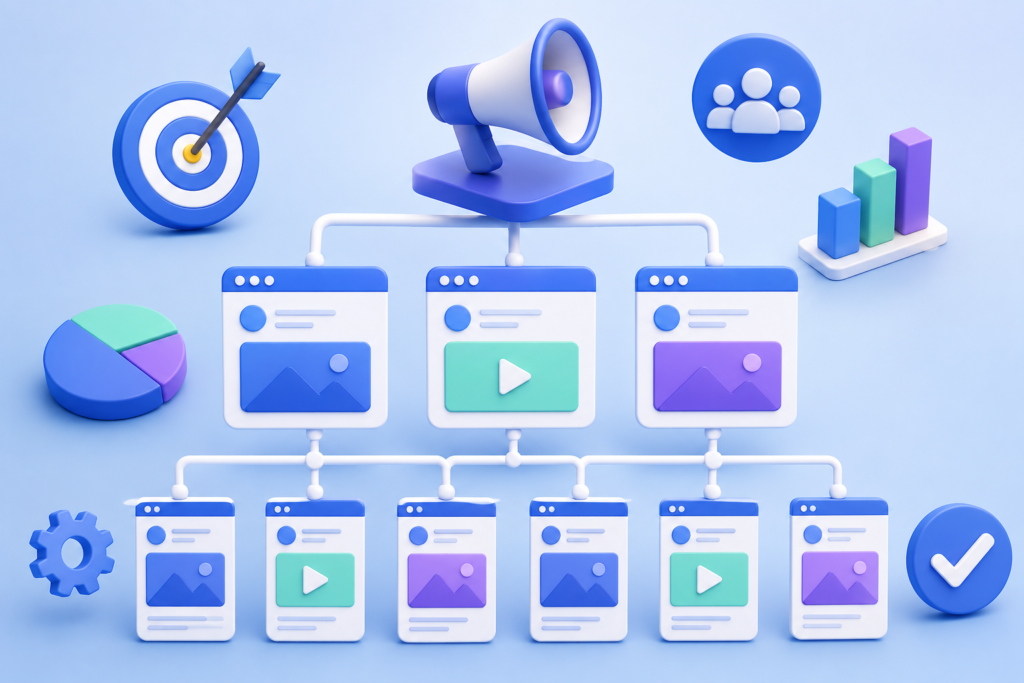
Campaign structure plays an important role in organisation, reporting, testing, and budget management. A poorly structured advertising account can become difficult to analyse, especially when numerous campaigns and audience variations compete against one another. Creating a logical structure from the beginning makes future optimisation significantly easier.
A typical advertising system uses multiple levels of organisation, allowing marketers to establish broad campaign goals before defining audiences, budgets, placements, and individual advertisements. The structure should reflect the marketing strategy rather than becoming unnecessarily complicated. Each campaign should have a clear purpose that can be understood by anyone reviewing the account.
For example, businesses may separate campaigns according to major objectives or customer journey stages. One campaign could focus on attracting new potential customers, while another may communicate with previous website visitors or existing customers. This separation can make it easier to analyse how different audience groups respond to specific marketing messages.
However, excessive campaign duplication can create unnecessary complexity. Some advertisers create large numbers of almost identical campaigns, each containing minor variations in targeting. This approach can fragment budgets and reduce the amount of useful data available for optimisation. A simpler structure often provides clearer insights and allows campaigns sufficient opportunity to generate meaningful results.
Naming conventions are also valuable. Clear campaign, ad set, and advertisement names can make reporting more efficient and reduce mistakes when multiple team members manage an account. Names might identify the campaign objective, audience category, product, offer, or testing purpose without becoming excessively long.
An effective campaign structure should evolve as the business learns more about customer behaviour. Initial campaigns may begin with a limited number of strategic tests before expanding successful approaches. This creates a more controlled and evidence-based advertising process.
Creating Facebook Ad Creative That Captures Attention
Advertising creative is one of the most influential components of campaign performance. People encounter a large volume of content while browsing social media platforms, meaning an advertisement must communicate its relevance quickly and clearly. Strong creative does not necessarily mean complicated design; often, the most effective advertisements are visually clear, easy to understand, and closely connected to the audience’s needs.
The opening moments of an advertisement are particularly important. Whether the format uses an image, video, carousel, or other creative asset, the content should immediately provide a reason for the viewer to continue paying attention. This may involve identifying a familiar problem, demonstrating a product benefit, presenting a compelling visual, or creating curiosity around a relevant solution.
Authenticity can also strengthen advertising performance. Overly polished promotional material may sometimes feel less relatable than content that demonstrates real products, real experiences, or genuine customer situations. Businesses should test different creative approaches rather than assuming one style will always perform best. Educational videos, demonstrations, customer stories, product comparisons, and problem-solution concepts can all serve different marketing purposes.
The message should remain consistent throughout the customer journey. If an advertisement promises a particular benefit, the destination page should clearly continue that message. A disconnect between the advertisement and landing page can create confusion and reduce trust. Consistency also helps potential customers understand exactly what they are being offered.
Creative fatigue should be monitored over time. Audiences who repeatedly see the same advertisement may become less responsive, particularly when targeting smaller groups. Regularly developing new creative concepts can help businesses maintain relevance while learning which messages resonate most effectively.
The best creative strategy combines experimentation with measurement. Rather than constantly changing advertisements based on assumptions, marketers should establish a testing process that evaluates meaningful differences in messaging, visuals, offers, and formats.
Writing High-Converting Facebook Ad Copy
Effective Facebook ad copy should communicate a clear message while respecting the limited attention available in social media environments. The goal is not to include every possible detail about a business or product. Instead, strong advertising copy should identify the most relevant message and present it in a way that encourages the intended audience to take the next step.
A useful starting point is the customer’s problem or desired outcome. People are generally more interested in how a product or service can improve their situation than in a lengthy description of company features. Therefore, advertising copy should translate features into understandable benefits wherever appropriate. A software tool may contain advanced functionality, but the customer may primarily care about saving time, improving efficiency, or reducing complexity.
Clarity is equally important. Avoid vague claims that could apply to almost any business. Specific messaging helps an advertisement stand out and makes it easier for potential customers to understand the offer. For example, explaining what a service does, who it is designed for, and why it may be valuable can be more persuasive than relying on generic phrases such as “the best solution.”
Trust-building elements can also strengthen ad copy. Depending on the business, this may include evidence, relevant expertise, customer outcomes, guarantees that can genuinely be honoured, or transparent information about the product. Advertisers should avoid misleading claims or exaggerated promises simply to increase clicks. Long-term success depends on maintaining alignment between advertising messages and the actual customer experience.
A clear call to action should provide direction without creating unnecessary pressure. The appropriate next step may be to shop, learn more, request information, register, or book a consultation. The wording should match the user’s stage in the customer journey and the campaign’s overall objective.
Finally, copywriting should be continuously tested. Small differences in headlines, opening statements, offers, and calls to action can affect performance. However, meaningful testing requires enough data and a structured approach rather than making random changes every day.
Setting Up Conversion Tracking and Measuring Meaningful Results
Successful Facebook advertising depends on accurate measurement. Without reliable conversion tracking, businesses may struggle to understand which advertisements generate meaningful results and which campaigns consume budget without contributing to business growth. Clicks and impressions can provide useful information, but they do not always demonstrate whether advertising activity is producing valuable outcomes.
Businesses should identify the actions that represent genuine value before configuring their measurement strategy. For an e-commerce website, these actions may include product views, add-to-cart events, checkout activity, and completed purchases. A service-based company may instead focus on contact form submissions, telephone enquiries, booked consultations, or qualified leads. The most useful tracking system connects advertising performance with the actions that matter most to the business.
Meta provides advertising measurement tools that can help businesses understand activity occurring after users interact with advertisements. Correct implementation is essential because inaccurate or incomplete tracking can lead to poor optimisation decisions. Marketers should regularly test whether important conversion events are being recorded correctly and whether the data corresponds with actual business activity. The official Meta Events Manager provides further information about managing and measuring website events.
Privacy changes, browser restrictions, and user consent requirements have also made measurement more complex. Businesses should take a responsible approach to data collection and ensure their websites handle user information appropriately. For websites using Google tools, the Google Analytics documentation provides useful guidance for understanding website measurement and reporting.
It is important to compare advertising data with broader business results. A campaign dashboard may report conversions, but businesses should also consider lead quality, sales outcomes, refunds, customer value, and other relevant commercial indicators. The ultimate goal is not simply to generate recorded events; it is to generate meaningful business outcomes that support sustainable growth.
Optimising Landing Pages for Facebook Advertising Traffic
A Facebook advertisement and its landing page should work together as a single conversion experience. Many businesses devote significant time to improving advertisements while sending paid visitors to pages that are slow, confusing, or poorly aligned with the original message. This disconnect can reduce conversion rates and increase the overall cost of customer acquisition.
The first priority is message consistency. If an advertisement promotes a specific product benefit, offer, or solution, visitors should immediately find that information on the destination page. They should not have to search through multiple pages to understand why they clicked. A clear headline, relevant supporting information, and a logical call to action can help maintain momentum after the initial advertisement interaction.
Website speed and usability are also important. Visitors using mobile devices may leave a page if it takes too long to load or requires excessive effort to navigate. Businesses should review their websites using reliable performance tools and address significant technical problems. Google PageSpeed Insights can help website owners evaluate performance and identify areas for improvement.
Landing pages should also reduce unnecessary friction. A lead-generation form that requests excessive information may discourage potential customers from completing the process. Similarly, complicated checkout procedures can cause potential buyers to abandon a purchase. Every additional step should have a clear purpose.
Trust is another essential component. Relevant testimonials, transparent business information, clear product details, secure payment processes, and honest policies can help visitors feel more confident about taking action. Businesses should avoid misleading urgency or exaggerated claims that could damage credibility.
Continuous testing can improve landing page performance over time. Marketers may test headlines, calls to action, page layouts, forms, product information, and other elements. However, the goal should always be to improve the customer experience and business outcome rather than manipulate users into taking actions they do not genuinely want to take.
Managing Facebook Ads Budgets and Bidding Strategies
Advertising budgets should be managed strategically rather than emotionally. Some businesses spend too little to collect meaningful data, while others increase budgets rapidly without first demonstrating that their campaigns can produce profitable or valuable results. An effective budget strategy balances experimentation, performance evaluation, and controlled growth.
The appropriate advertising budget depends on factors such as business goals, product pricing, target market size, conversion rates, and customer value. A company selling a high-value service may be able to invest more to acquire a qualified customer than a business with a low-margin product. Therefore, advertising budgets should be evaluated in relation to expected business returns rather than according to arbitrary amounts.
New campaigns generally benefit from a structured testing phase. During this stage, businesses can evaluate audience responses, creative concepts, offers, and conversion performance. It is important to avoid making major changes before sufficient data has been collected. Constant adjustments can make it difficult to determine which changes are responsible for improvements or declines.
Once a campaign demonstrates consistent value, budgets can be increased carefully. Sudden and dramatic budget changes may alter campaign performance and make results less predictable. Gradual adjustments allow businesses to monitor how increased investment affects conversion costs and overall returns.
Bidding strategies should also support the campaign’s primary objective. The advertiser should understand what action the platform is being asked to optimise toward and whether that action reflects genuine business value. Focusing exclusively on the cheapest possible result can sometimes produce lower-quality leads or customers.
Budget decisions should ultimately be based on profitability and long-term sustainability. A campaign generating a higher cost per lead may still be more valuable if those leads consistently become high-value customers. For this reason, businesses should connect advertising data with sales information whenever possible.
Using Retargeting to Reconnect With Interested Audiences
Not every potential customer converts during their first interaction with a business. People may visit a website to conduct research, compare alternatives, save a product for later, or simply become distracted before completing an intended action. Retargeting can help businesses reconnect with relevant audiences who have already demonstrated some level of interest.
A thoughtful retargeting strategy should recognise that different users have different experiences with a brand. Someone who viewed a homepage briefly may require a different message from someone who added a product to a shopping basket. Similarly, an existing customer may respond better to complementary products or useful content than to the same introductory advertisement.
Effective retargeting advertisements can address common barriers to conversion. For example, a potential customer may need additional product information, reassurance about quality, or a clearer understanding of how a service works. Rather than repeatedly displaying identical promotional messages, businesses can develop creative content that provides useful answers and supports the customer’s decision-making process.
Frequency should be monitored carefully. Repeatedly showing advertisements to the same people can eventually create fatigue or negative brand perceptions. Retargeting audiences should therefore be managed responsibly, with appropriate exclusions for people who have already completed the desired conversion.
Businesses should also ensure that retargeting activity respects applicable privacy requirements and platform policies. Data collection and audience use should be handled transparently and responsibly. Trust is particularly important because customers may react negatively when advertising feels excessively intrusive.
When implemented effectively, retargeting can support the wider customer journey. It should not be treated simply as a technique for repeatedly pursuing every website visitor. Instead, it should provide relevant information or offers that make sense based on a person’s previous interaction with the business.
Analysing Facebook Ads Performance and Making Data-Driven Decisions
Campaign optimisation should be based on meaningful evidence rather than assumptions. A marketer may personally prefer one advertisement, while the target audience responds more positively to another. Data provides valuable insight into actual user behaviour and helps businesses identify where improvements may be required.
Important performance metrics vary depending on campaign objectives. Reach and impressions may help evaluate awareness campaigns, while click-through rates can provide insight into advertisement engagement. For conversion-focused campaigns, metrics such as conversion rate, cost per acquisition, purchase value, and return on advertising spend may be more relevant.
However, no individual metric should be viewed completely in isolation. A low cost per click does not necessarily mean a campaign is successful if those visitors never convert. Similarly, a high conversion rate may not be profitable if the advertising cost exceeds the value generated by new customers. Marketers should examine the relationship between advertising activity and business outcomes.
Performance analysis should also include segmentation. Results may differ according to audience, placement, creative format, device, location, or stage of the customer journey. Identifying these differences can help businesses understand where advertising budgets are being used effectively.
Testing is particularly important when making significant changes. Instead of changing audiences, budgets, creative, and landing pages simultaneously, marketers should isolate important variables whenever practical. This creates clearer learning opportunities and reduces the risk of drawing incorrect conclusions.
Long-term analysis can be more valuable than reacting to short-term fluctuations. Advertising performance naturally changes because of competition, seasonality, consumer behaviour, and market conditions. Businesses should therefore develop regular reporting processes that identify meaningful trends rather than making impulsive decisions based on limited data.
Scaling Successful Facebook Ads Campaigns Sustainably
Scaling an advertising campaign means increasing its ability to produce valuable results without allowing efficiency to decline beyond acceptable levels. Many businesses attempt to scale too quickly after experiencing initial success, only to discover that performance becomes less predictable when budgets increase substantially.
A sustainable scaling strategy begins with a strong foundation. The campaign should have a clearly defined business objective, reliable tracking, effective creative assets, a functional landing page, and evidence that the offer appeals to the target market. Increasing expenditure cannot solve fundamental problems with a weak advertising strategy.
One approach to scaling is gradually increasing investment in campaigns that consistently generate profitable or high-quality results. This allows marketers to monitor whether performance remains stable as spending grows. Another approach involves expanding successful creative concepts to new audience segments or developing additional campaigns based on proven messaging.
Creative production becomes increasingly important during scaling. A single successful advertisement may eventually experience audience fatigue, particularly when campaigns reach large numbers of people repeatedly. Businesses should maintain a creative pipeline containing new concepts, formats, customer stories, demonstrations, and messaging angles.
Operational capacity should also be considered. A successful lead-generation campaign is only valuable if the business can respond effectively to additional enquiries. Similarly, an e-commerce business should ensure sufficient inventory, customer support, and fulfilment capabilities before aggressively increasing advertising expenditure.
True scaling is therefore a business-wide process rather than merely an advertising decision. Marketing performance, sales processes, website capacity, and customer experience must all support growth. Companies that scale carefully are more likely to build sustainable systems rather than experiencing temporary increases followed by declining performance.
Common Facebook Ads Mistakes That Waste Advertising Budget
One of the most common Facebook advertising mistakes is launching campaigns without a clearly defined objective. When businesses do not know whether they want sales, leads, awareness, or another outcome, they cannot accurately evaluate campaign performance. This often results in excessive attention being given to vanity metrics instead of meaningful business results.
Another major mistake is relying entirely on targeting while neglecting creative quality. Advertisers may spend hours creating highly complex audience segments but use generic advertisements that fail to communicate a compelling reason to take action. Effective targeting and strong creative should work together rather than being treated as separate strategies.
Poor conversion tracking can also lead to significant waste. If a business cannot accurately identify which campaigns produce valuable outcomes, optimisation decisions become unreliable. Marketers may pause successful campaigns or increase spending on ineffective advertisements simply because the available data is incomplete or incorrectly configured.
Making changes too frequently is another common problem. Advertising systems need sufficient information to identify patterns and optimise delivery. Constantly changing budgets, audiences, advertisements, and campaign settings can make it difficult to understand what is actually influencing performance. A more structured testing process usually produces better learning opportunities.
Finally, many advertisers overlook the post-click experience. An excellent advertisement cannot compensate for a website that loads slowly, provides unclear information, or makes conversion unnecessarily difficult. Businesses should review the entire customer journey regularly. Sustainable Facebook advertising requires alignment between targeting, creative, measurement, landing pages, offers, and customer service.
Facebook Ads Best Practices Summary for Long-Term Growth

Successful Facebook advertising is built on strategy, experimentation, accurate measurement, and continuous improvement. The most important principle is to connect every campaign with a meaningful business objective. Before spending money on advertisements, businesses should understand what outcome they want and how they will measure success.
Audience understanding should guide both targeting and creative development. Research customer problems, motivations, questions, and decision-making processes. Use these insights to create advertisements that communicate genuine value rather than relying on generic promotional language. Strong creative should attract attention while accurately representing the product or service.
Reliable conversion tracking is essential for effective optimisation. Businesses should regularly check whether important events are being measured correctly and compare advertising data with actual commercial results. Website analytics, sales information, and customer feedback can provide a broader understanding of campaign effectiveness.
Testing should be deliberate. Experiment with creative concepts, offers, audience approaches, and landing page elements while maintaining sufficient control to understand the results. Avoid making multiple unnecessary changes simultaneously. Documenting tests can help businesses build valuable institutional knowledge over time.
Finally, focus on sustainability rather than short-term metrics alone. A campaign that generates inexpensive clicks but no valuable customers is unlikely to support business growth. The best advertising strategies balance acquisition costs, conversion quality, customer experience, and long-term value. By following these principles, businesses can create a more resilient and effective paid advertising system.
Frequently Asked Questions
1. How much should a business spend on Facebook Ads?
There is no universal advertising budget that works for every business. The appropriate amount depends on factors such as business goals, market competition, product pricing, profit margins, and customer lifetime value. A small business can begin with a controlled testing budget and increase spending once campaigns demonstrate meaningful results.
The most important consideration is not simply how much money is spent but whether the investment generates valuable outcomes. Businesses should calculate what they can reasonably afford to pay for a lead or customer based on expected revenue and profitability.
A structured testing approach can help identify effective campaigns before larger investments are made. Once performance is consistent, budgets can be increased gradually while monitoring efficiency and overall returns.
2. How long does it take for Facebook Ads to produce results?
The timeline depends on the campaign objective, offer, audience, and business model. Some campaigns may generate immediate interactions or conversions, while others require a longer customer journey. High-value services, for example, may involve extensive research before a prospect makes a purchasing decision.
Advertisers should avoid making major conclusions based on a very small amount of data. Campaigns require sufficient activity before meaningful patterns can be identified, and results can fluctuate because of competition, seasonality, and audience behaviour.
The best approach is to establish realistic expectations, monitor relevant metrics, and optimise based on evidence. Long-term improvement is usually more valuable than constantly pursuing immediate changes.
3. Are Facebook Ads suitable for small businesses?
Facebook Ads can be suitable for small businesses because campaigns can be developed around specific objectives and controlled budgets. However, success depends on having a clear offer, understanding the target customer, and providing a reliable conversion experience.
Small businesses should avoid attempting to compete solely by spending more money than larger organisations. Instead, they can focus on specific customer needs, relevant messaging, strong creative, and well-defined conversion goals.
Starting with carefully planned tests can help smaller businesses learn what works before expanding their advertising investment. The ability to measure results is particularly valuable because it allows businesses to make informed decisions about future marketing budgets.
4. What is the difference between Facebook Ads and organic social media?
Organic social media involves creating and sharing content without directly paying for distribution, while Facebook Ads involve paying to promote content or offers to selected audiences. Both approaches can support a broader digital marketing strategy.
Organic content can help businesses build trust, maintain relationships, and demonstrate expertise over time. Paid advertising can provide additional reach and support specific marketing objectives more quickly.
The two approaches can work together. For example, insights from successful organic content may inspire paid advertising creative, while paid campaigns can introduce new audiences to a brand’s wider content ecosystem.
5. Why am I getting clicks but no conversions?
Clicks without conversions can indicate several possible problems. The advertisement may attract people who are curious but not genuinely interested in the offer. Alternatively, the landing page may be slow, unclear, or poorly aligned with the advertisement.
Businesses should review the entire customer journey. Check whether the advertisement accurately represents the offer, whether the destination page continues the same message, and whether the conversion process contains unnecessary barriers.
It is also important to verify conversion tracking. Sometimes conversions occur but are not being recorded correctly. A technical review can help ensure that optimisation decisions are based on accurate information.
6. Should I use broad or highly specific audience targeting?
The best approach depends on the business, campaign objective, available data, and target market. Highly specific targeting may be useful in certain situations, particularly when a product serves a clearly defined niche. However, excessive restrictions can reduce audience size and limit campaign flexibility.
Broader targeting can sometimes allow advertising delivery systems to identify relevant potential customers based on campaign signals and creative response. This approach should still be tested strategically rather than adopted without evaluation.
Businesses should compare approaches using meaningful performance data and focus on the quality of results rather than assuming one targeting method is always superior.
7. How often should Facebook ad creative be changed?
There is no fixed schedule because the need for new creative depends on audience size, campaign frequency, performance trends, and advertising goals. Some advertisements may remain effective for extended periods, while others experience fatigue quickly.
Businesses should monitor performance and develop new creative regularly rather than waiting until every existing advertisement stops working. Maintaining a creative testing pipeline can reduce the risk of sudden performance declines.
New creative should be based on customer insights and previous campaign learning. Changing advertisements randomly simply to create activity is less effective than developing new concepts with a clear testing purpose.
8. How can I improve the quality of Facebook advertising leads?
Lead quality should be considered throughout the entire advertising process. The advertisement should clearly communicate what is being offered so that unsuitable prospects are less likely to submit an enquiry.
Lead forms and landing pages can also help qualify potential customers by requesting relevant information. However, businesses should balance qualification with user experience and avoid creating unnecessarily complicated forms.
Finally, advertising data should be connected with sales outcomes whenever possible. Understanding which campaigns produce actual customers allows marketers to optimise for long-term business value rather than simply generating the highest possible number of leads.
Conclusion
Facebook advertising can provide significant opportunities for businesses that approach it with a clear strategy and commitment to continuous improvement. Successful campaigns require more than attractive visuals or large advertising budgets. They depend on understanding customers, defining meaningful objectives, creating relevant messages, measuring important actions, and improving performance based on reliable evidence.
The strongest advertising systems also consider the complete customer journey. An advertisement is only one part of the experience. Landing pages, product quality, customer service, sales processes, and follow-up communication all influence the final result. Businesses that create consistency across these areas are better positioned to convert advertising investment into sustainable growth.
Trust should remain central to every campaign. Honest messaging, transparent offers, responsible data practices, and a positive customer experience help create stronger long-term relationships. Short-term tactics designed purely to attract clicks may generate activity, but they rarely build lasting business value.
At My Blog Poster, the goal is to help businesses understand the strategic principles behind effective digital marketing and create systems that support measurable, sustainable growth. By applying the practices outlined throughout this guide, businesses can develop more informed, customer-focused, and performance-driven Facebook advertising campaigns.
Want to Implement This Easily?
Prompt Text:
You are an expert consultant. Based on the blog post titled “(Facebook Ads)”, provide a step-by-step, practical implementation guide. Include tools, best practices, common mistakes to avoid, and advanced tips. Assume the reader wants to implement everything discussed in this article effectively.
Call to Action: Want our help implementing this? Just reach out to us via our website contact form: contact form