




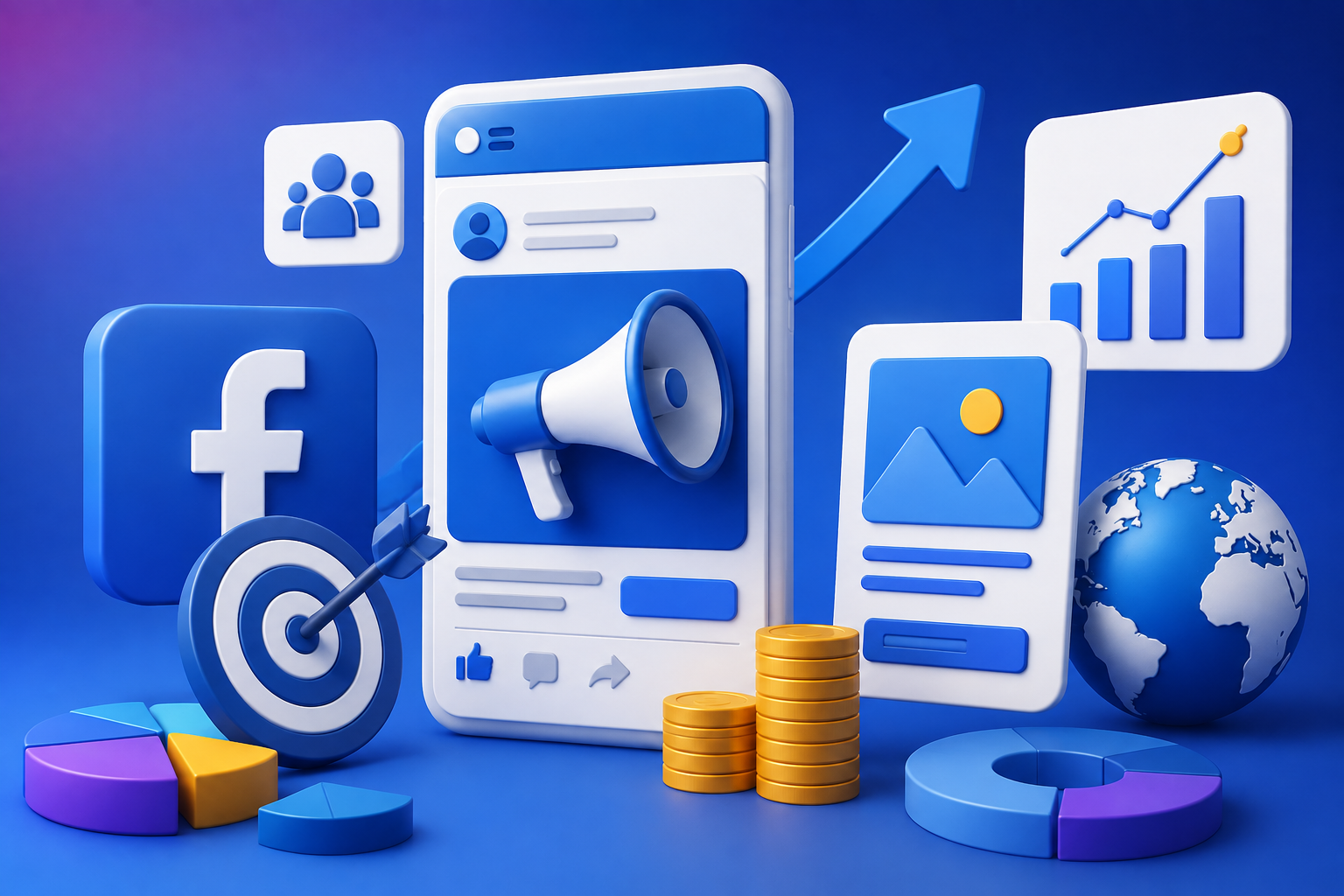


Discover the ultimate guide to Facebook Ads in 2026. Learn advanced targeting, campaign optimization, retargeting strategies, ad creatives, conversion tracking, budgeting, and scaling techniques to maximize ROI and business growth.
Introduction
In the modern digital economy, Facebook Ads remain one of the most powerful advertising systems available for businesses of every size. Whether you run an eCommerce store, a local business, a SaaS platform, or a personal brand, Facebook’s advertising ecosystem gives you the ability to reach highly targeted audiences with precision and scale. The combination of detailed audience segmentation, advanced machine learning, and creative flexibility makes Facebook advertising one of the most profitable marketing channels available today.
Businesses that invest strategically in paid social advertising often experience significant increases in traffic, lead generation, sales, and brand awareness. However, running profitable campaigns is no longer about simply boosting a post or selecting random interests. Today’s advertising environment demands a deep understanding of campaign objectives, audience psychology, creative testing, analytics, and optimization frameworks.
At My Blog Poster, businesses increasingly seek advanced digital advertising strategies that align with Google-quality content standards and sustainable business growth. This comprehensive guide explores the latest Facebook Ads strategies, best practices, optimization methods, and conversion-focused frameworks designed for modern marketers in 2026.
Understanding How Facebook Ads Work
Facebook Ads operate through Meta’s sophisticated advertising platform, which includes placements across Facebook, Instagram, Messenger, and the Audience Network. Advertisers can create campaigns tailored to specific objectives such as traffic generation, lead collection, video views, engagement, app installs, and conversions.
The Facebook advertising system uses machine learning to determine which users are most likely to complete the desired action. This means advertisers are not simply paying for impressions; they are leveraging predictive behavioral algorithms designed to maximize campaign efficiency. Understanding how this system functions is critical for long-term success.
One of the platform’s biggest strengths is its audience targeting capability. Businesses can target users based on demographics, interests, online behavior, purchase intent, geographic location, and custom audience data. Advanced advertisers also use lookalike audiences to find users similar to their existing customers. This allows campaigns to scale efficiently while maintaining relevance.
Another important factor is the Facebook Ads auction system. Ads compete for placements based on bid strategy, relevance, estimated action rates, and overall ad quality. This means the advertiser with the highest budget does not always win. Highly engaging and relevant ads often outperform expensive campaigns with poor targeting or weak creative assets.
To better understand how Meta structures campaigns, advertisers should review the official Meta Ads Manager Guide and the Meta Advertising Standards to ensure compliance and optimization alignment.
Why Facebook Ads Are Essential for Modern Businesses
Facebook Ads continue to dominate the paid social advertising landscape because of their scalability, targeting depth, and cross-platform integration. Businesses can reach millions of users while maintaining exceptional control over budgets and campaign objectives.
One of the primary reasons companies rely on Facebook Ads is audience accessibility. Billions of users interact daily across Meta-owned platforms, creating a massive opportunity for businesses to engage consumers at every stage of the buyer journey. Whether the goal is awareness, lead generation, or direct sales, Facebook provides customizable campaign solutions for virtually every industry.
Another major advantage is cost efficiency. Compared to traditional advertising channels such as television, radio, or print media, Facebook Ads allow advertisers to start with relatively small budgets while still collecting valuable performance data. Small businesses can compete with larger brands through strategic targeting and creative optimization.
Facebook Ads also excel because of detailed analytics and measurable performance metrics. Advertisers can monitor click-through rates, conversion rates, customer acquisition costs, engagement levels, and return on ad spend in real time. This data-driven approach enables businesses to optimize campaigns continuously and reduce wasted ad spend.
For businesses focused on performance marketing, integrating campaigns with tools like Meta Pixel and Google Analytics provides deeper visibility into customer behavior and conversion attribution.
Setting Clear Facebook Advertising Goals
Every successful Facebook advertising campaign begins with clearly defined goals. Without a strategic objective, advertisers often waste budgets on campaigns that generate vanity metrics instead of meaningful business outcomes.
The first step is understanding the marketing funnel. Awareness campaigns focus on visibility and reach, while consideration campaigns emphasize engagement, traffic, and lead generation. Conversion campaigns prioritize measurable actions such as purchases, bookings, or sign-ups. Each campaign type requires different messaging, creative assets, and optimization settings.
Businesses should also establish measurable KPIs before launching campaigns. These may include cost per acquisition, return on ad spend, click-through rates, conversion rates, or customer lifetime value. Defining success metrics early ensures that optimization decisions remain aligned with business objectives rather than emotional assumptions.
Another essential factor is aligning campaign goals with audience intent. Cold audiences require educational and trust-building content, while warm audiences respond better to social proof, testimonials, offers, and urgency-driven messaging. Matching the correct objective with audience awareness significantly improves campaign efficiency.
Advertisers should review Meta Campaign Objectives Documentation to better understand how each objective affects ad delivery and optimization behavior.
Audience Targeting Strategies That Improve ROI
Audience targeting remains one of the most important factors influencing Facebook Ads performance. Even highly polished creatives fail when shown to irrelevant audiences. Strategic targeting ensures ads reach users most likely to engage and convert.
Core audiences allow advertisers to target users based on interests, demographics, behaviors, education levels, job titles, and online activities. This method works particularly well for awareness campaigns and niche targeting. Businesses often combine multiple interest categories to narrow audience relevance and improve engagement quality.
Custom audiences are another powerful targeting option. These audiences are built using website visitors, email subscribers, previous customers, app users, or social media engagers. Since these users already interacted with the brand, conversion rates are typically much higher than cold traffic campaigns.
Lookalike audiences enable advertisers to scale campaigns efficiently. Meta analyzes existing customer data and identifies users with similar characteristics and behaviors. High-quality source audiences generally produce stronger lookalike performance and better return on ad spend.
Advanced advertisers increasingly combine first-party data strategies with privacy-compliant tracking systems. Reviewing resources such as Meta Business Help Center and Google Privacy Best Practices helps ensure compliance while maintaining campaign effectiveness.
Creating High-Converting Facebook Ad Creatives
Creative quality is often the defining factor between profitable campaigns and wasted budgets. Modern users are exposed to thousands of ads daily, making attention-grabbing visuals and compelling messaging more important than ever.
Successful Facebook ad creatives usually focus on emotional triggers, clarity, and immediate value communication. Users scroll quickly through social feeds, meaning advertisers only have seconds to capture attention. Strong hooks, engaging visuals, and concise copy improve stopping power and engagement rates.
Video ads continue to outperform static formats in many industries because they allow brands to demonstrate products, tell stories, and build emotional connections. Short-form vertical videos optimized for mobile consumption often produce superior results on Facebook and Instagram placements.
Equally important is the relationship between visuals and copywriting. High-performing ads align imagery, headlines, descriptions, and calls to action into a unified message. Inconsistent creative elements often reduce trust and lower conversions.
Businesses should also continuously test multiple variations of headlines, visuals, ad formats, and CTA buttons. This process, commonly called creative testing, helps advertisers identify winning combinations and improve long-term campaign efficiency.
For design recommendations and platform specifications, advertisers should consult Meta Creative Best Practices and Google Page Experience Guidelines.
The Importance of Facebook Pixel and Conversion Tracking
Conversion tracking is essential for campaign optimization, audience building, and accurate performance measurement. Without reliable tracking systems, advertisers struggle to understand which campaigns generate actual business results.
The Meta Pixel is a tracking code installed on websites to monitor user actions such as page views, purchases, registrations, add-to-cart events, and lead submissions. This data enables Facebook’s machine learning system to optimize ad delivery toward users most likely to convert.
Accurate event tracking also improves remarketing capabilities. Businesses can create custom audiences based on user behavior, such as abandoned carts, product viewers, or incomplete lead forms. These audiences are highly valuable because they target users already familiar with the brand.
Server-side tracking and the Conversion API have become increasingly important due to browser privacy changes and cookie limitations. These technologies improve data reliability and help advertisers maintain optimization accuracy even in privacy-focused digital environments.
Campaign attribution is another critical area. Many businesses incorrectly evaluate performance because they fail to understand attribution windows, assisted conversions, or cross-device interactions. Combining Meta analytics with tools like Google Tag Manager and Google Analytics 4 provides more comprehensive reporting visibility.
Facebook Ad Copywriting Techniques That Drive Action
Ad copywriting directly influences click-through rates, engagement, and conversions. Even visually impressive campaigns can underperform if the messaging lacks clarity, emotional relevance, or persuasive structure.
Effective Facebook ad copy starts with a strong opening hook. The first sentence must immediately capture attention and communicate value. Questions, surprising statistics, pain points, and emotionally charged statements often perform well when aligned with audience intent.
Successful copy also focuses heavily on benefits rather than features. Users care more about outcomes than technical specifications. Instead of describing product functions, advertisers should explain how the offer improves convenience, saves time, increases revenue, or solves specific problems.
Social proof significantly improves credibility. Testimonials, case studies, customer reviews, and trust indicators reduce skepticism and encourage action. Including measurable results can further strengthen campaign performance and conversion rates.
Calls to action should remain clear and direct. Weak CTAs create uncertainty, while strong CTAs guide users toward the next step. Phrases such as “Book Your Free Consultation,” “Get Started Today,” or “Claim Your Offer” often outperform vague messaging.
Advertisers seeking better content quality alignment should review Google Helpful Content Guidelines for deeper insight into user-focused communication strategies.
Budgeting and Bidding Strategies for Facebook Ads
Budget management plays a critical role in campaign profitability. Many advertisers overspend because they scale too quickly, ignore performance data, or use ineffective bidding strategies.
Facebook Ads allow businesses to choose between daily budgets and lifetime budgets. Daily budgets provide steady spending control, while lifetime budgets offer more delivery flexibility over a scheduled period. The right choice depends on campaign objectives and testing requirements.
Bid strategies also influence campaign outcomes. Lowest-cost bidding is commonly used for broad optimization, while cost-cap and bid-cap strategies provide more control over acquisition costs. Advanced advertisers frequently experiment with different bidding methods depending on scaling goals and competitive market conditions.
Testing budgets should remain realistic. Launching campaigns with extremely small budgets often limits Facebook’s ability to gather meaningful optimization data. At the same time, aggressive scaling before validating performance can rapidly increase acquisition costs.
Smart advertisers monitor frequency scores, CPM trends, and audience saturation levels to avoid ad fatigue. Refreshing creatives and rotating audience segments helps maintain campaign efficiency over time.
Understanding cost structures and optimization techniques through Meta Ads Cost Controls can significantly improve long-term advertising performance.
Retargeting Strategies That Increase Conversions
Retargeting is one of the most profitable Facebook advertising strategies because it focuses on users already familiar with the brand. These audiences often convert at significantly higher rates than cold traffic campaigns.
Website visitor retargeting allows businesses to reconnect with users who previously engaged with products or services but did not complete a conversion. Advertisers can segment audiences based on behavior such as product page visits, time on site, or cart abandonment.
Dynamic retargeting campaigns are especially effective for eCommerce brands. These campaigns automatically display previously viewed products to users across Facebook and Instagram, increasing purchase intent and conversion probability.
Video engagement retargeting is another powerful approach. Users who watched a significant portion of a video ad demonstrate higher interest levels and can be moved into conversion-focused campaigns with stronger offers or direct-response messaging.
Sequential retargeting strategies further improve efficiency. Instead of repeatedly showing the same ad, advertisers can guide users through a structured journey involving awareness content, testimonials, product demonstrations, and conversion offers.
To maximize remarketing performance while respecting privacy regulations, businesses should follow guidance from Google Consent Mode Documentation and Meta Data Policy.
Advanced Facebook Ads Scaling Strategies
Scaling Facebook Ads successfully requires more than simply increasing budgets. Many campaigns collapse during scaling because advertisers ignore audience fatigue, creative decay, and unstable optimization signals. Sustainable growth depends on structured scaling frameworks that preserve profitability while expanding reach.
Vertical scaling involves gradually increasing campaign budgets while monitoring performance stability. Most experienced advertisers increase budgets incrementally rather than doubling spend overnight. Sudden budget spikes can disrupt Meta’s learning phase and increase acquisition costs dramatically. Controlled scaling allows algorithms to adapt gradually while maintaining optimization efficiency.
Horizontal scaling focuses on expanding campaign reach through new audience segments, placements, and creative variations. Advertisers often duplicate winning ad sets and target broader interests, additional lookalike percentages, or alternative geographic regions. This method reduces dependency on a single audience pool and creates more stable long-term growth opportunities.
Creative diversification is equally important during scaling. Audiences exposed repeatedly to identical ads eventually experience fatigue, causing declining click-through rates and rising CPMs. Successful advertisers continuously introduce fresh creatives, new messaging angles, and updated offers to maintain engagement. Scaling without creative evolution usually leads to diminishing returns over time.
Businesses looking to scale campaigns effectively should study Meta Advantage+ Campaigns and performance optimization recommendations from Google Marketing Platform.
A/B Testing Frameworks for Better Performance
A/B testing is one of the most powerful methods for improving Facebook Ads profitability. Instead of relying on assumptions, advertisers can use controlled experiments to identify which variables produce superior performance.
The most effective testing strategies isolate one variable at a time. This may include headlines, ad creatives, CTA buttons, audience targeting, landing pages, or campaign objectives. Testing too many variables simultaneously creates confusion and makes it difficult to identify the true cause of performance differences.
Creative testing is often the highest-impact area. Different images, video formats, opening hooks, and messaging angles can produce dramatically different results even when targeting the same audience. Successful advertisers maintain ongoing creative testing pipelines to consistently discover new winning combinations.
Landing page testing also plays a critical role in campaign optimization. Even highly effective ads can fail if the landing page creates friction or lacks clarity. Testing page layouts, forms, headlines, testimonials, and mobile responsiveness can significantly improve conversion rates and lower customer acquisition costs.
Data interpretation matters just as much as testing itself. Advertisers should avoid making decisions based on limited sample sizes or emotional reactions. Statistical significance and trend consistency are essential for reliable optimization.
Businesses can improve testing accuracy by reviewing Google Optimize Best Practices and Meta Experiments Tool documentation.
Mobile Optimization for Facebook Advertising Success
Mobile-first advertising has become essential because the majority of Facebook and Instagram users engage with content on smartphones. Campaigns that are not optimized for mobile experiences often suffer from poor engagement and low conversion rates.
Successful mobile creatives prioritize vertical formats, fast-loading visuals, and concise messaging. Mobile users scroll rapidly, meaning advertisers must communicate value immediately. Long intros, cluttered graphics, or excessive text often reduce effectiveness.
Landing page performance is another major factor. Slow-loading websites create frustration and increase bounce rates. Research consistently shows that users abandon pages that take too long to load, especially on mobile devices. Optimizing images, reducing unnecessary scripts, and improving hosting infrastructure can dramatically improve user experience.
Thumb-friendly design also improves conversion rates. Buttons, forms, and navigation elements should remain easy to interact with on smaller screens. Confusing layouts or difficult checkout experiences often lead to abandoned conversions.
Advertisers should also consider mobile-specific placements such as Instagram Stories, Facebook Reels, and in-feed vertical video formats. These placements frequently outperform traditional desktop-focused creatives because they align naturally with user behavior.
To improve mobile experience quality, advertisers should review Google PageSpeed Insights and Core Web Vitals Documentation.
Facebook Ads for eCommerce Businesses
eCommerce brands rely heavily on Facebook Ads because of the platform’s ability to drive product discovery, remarketing, and direct-response sales. With the right strategy, businesses can build highly scalable revenue systems using Meta’s advertising ecosystem.
Product-focused creatives often perform exceptionally well in eCommerce campaigns. Demonstration videos, user-generated content, before-and-after examples, and customer testimonials help increase trust and showcase product value effectively. Authenticity generally outperforms overly polished advertising in modern social environments.
Dynamic Product Ads are particularly valuable for online stores. These campaigns automatically display products users previously viewed or interacted with on a website. Since the products remain highly relevant to the viewer, conversion rates are often significantly higher than standard cold traffic campaigns.
Offer structuring also influences campaign success. Limited-time discounts, bundled packages, free shipping offers, and loyalty incentives can improve purchase intent and increase average order value. However, businesses should avoid excessive discount dependency because it can damage long-term brand perception.
Customer retention strategies are equally important. Many profitable eCommerce brands focus not only on acquiring customers but also on increasing repeat purchases through retargeting campaigns, upselling, and personalized offers.
Store owners seeking better shopping experiences should study Google Merchant Center Guidelines and Meta Commerce Manager resources.
Lead Generation Strategies Using Facebook Ads
Facebook lead generation campaigns provide businesses with opportunities to collect customer information directly within the platform. These campaigns are widely used in industries such as real estate, healthcare, consulting, education, finance, and home services.
Lead forms simplify the conversion process by reducing friction. Since Facebook can auto-fill user information, form completion rates are often higher than traditional landing pages. However, advertisers must balance convenience with lead quality by asking strategic qualifying questions.
Trust-building is essential in lead generation advertising. Users are more likely to submit personal information when businesses demonstrate authority, credibility, and transparency. Testimonials, certifications, client success stories, and clear value propositions improve conversion performance.
Follow-up speed significantly impacts lead conversion rates. Businesses that respond quickly to new inquiries often outperform competitors with delayed responses. Integrating Facebook leads into CRM systems and automation workflows can dramatically improve sales efficiency.
Educational lead magnets also perform well. Free consultations, downloadable guides, webinars, audits, and strategy sessions encourage users to exchange contact information for valuable insights. The perceived value of the offer directly affects lead quality and campaign profitability.
Advertisers can improve compliance and data collection practices by reviewing Meta Lead Ads Terms and Google Data Privacy Guidance.
Using AI and Automation in Facebook Advertising
Artificial intelligence has transformed digital advertising by improving audience targeting, bidding optimization, creative personalization, and predictive analytics. Facebook’s advertising system increasingly relies on machine learning to determine which users are most likely to engage or convert.
Automated bidding strategies help advertisers optimize campaigns based on specific goals such as purchases, leads, or app installs. Rather than manually adjusting bids constantly, advertisers can leverage Meta’s AI-driven optimization systems to improve efficiency at scale.
AI-assisted creative testing is also becoming more common. Businesses now use machine learning tools to analyze engagement patterns, identify winning creative elements, and predict performance trends. This reduces manual workload while accelerating optimization processes.
Automation workflows further improve operational efficiency. CRM integrations, chatbot automation, email follow-up sequences, and lead qualification systems help businesses manage campaigns and customer interactions more effectively.
However, advertisers should avoid overdependence on automation. Human oversight remains essential for strategic planning, creative direction, audience psychology, and brand positioning. AI enhances decision-making, but it does not replace marketing expertise or customer understanding.
Businesses exploring advanced automation should review Meta Advantage Suite and Google AI Essentials.
Common Facebook Ads Mistakes Businesses Should Avoid
Many advertisers fail to achieve profitable results because of preventable strategic mistakes. Understanding these common errors can save businesses significant time and advertising budgets.
One of the biggest mistakes is targeting audiences that are too broad or completely irrelevant. Without proper audience refinement, campaigns often attract low-quality traffic that rarely converts. Effective targeting requires continuous audience analysis and segmentation.
Another frequent issue is poor creative quality. Ads with weak visuals, unclear messaging, or generic offers struggle to capture attention in highly competitive social feeds. Businesses that neglect creative testing usually experience declining performance over time.
Many advertisers also ignore tracking accuracy. Incomplete event tracking, broken pixels, or incorrect attribution settings create misleading performance data. This often results in poor optimization decisions and wasted ad spend.
Scaling too aggressively is another common problem. Increasing budgets rapidly before campaigns stabilize can disrupt learning phases and increase acquisition costs. Sustainable growth requires gradual optimization and consistent monitoring.
Finally, many businesses focus solely on clicks rather than actual business outcomes. High engagement metrics may appear impressive, but profitability depends on meaningful conversions, customer quality, and long-term revenue generation.
For policy compliance and campaign quality improvements, advertisers should regularly review Meta Advertising Policies and Google Search Essentials.
Best Practices for Long-Term Facebook Ads Success
Long-term Facebook advertising success requires consistency, adaptability, and strategic discipline. Businesses that approach advertising as an ongoing optimization process generally outperform brands looking for quick wins.
One essential best practice is maintaining strong creative pipelines. Regularly refreshing visuals, messaging angles, and offers prevents ad fatigue and keeps campaigns engaging. Advertisers should continuously test new concepts even when current campaigns perform well.
Data-driven decision-making is equally important. Successful marketers rely on analytics, conversion tracking, and testing frameworks rather than assumptions or emotional reactions. Monitoring metrics consistently allows advertisers to identify opportunities and correct problems early.
Audience quality should always remain a priority. Building strong first-party data systems, customer lists, and retargeting audiences improves campaign efficiency while reducing dependency on third-party targeting methods.
Businesses should also focus heavily on landing page experience and customer journey optimization. Strong ads alone are not enough. The post-click experience must remain fast, trustworthy, and conversion-focused to maximize ROI.
Finally, staying updated with platform changes is critical. Facebook’s advertising ecosystem evolves constantly due to privacy updates, AI enhancements, and changing user behavior. Ongoing education helps businesses remain competitive in dynamic digital markets.
FAQs
What is the ideal budget for Facebook Ads?
The ideal budget depends on industry competition, campaign goals, and audience size. Many businesses start with small testing budgets and gradually scale successful campaigns based on performance data.
Are Facebook Ads still effective in 2026?
Yes. Facebook Ads remain highly effective because of Meta’s advanced targeting systems, AI optimization capabilities, and massive audience reach across Facebook and Instagram.
How long does it take for Facebook Ads to work?
Some campaigns generate results within days, while others require several weeks of optimization and testing. Campaign performance improves as Meta’s algorithm gathers more conversion data.
Which Facebook ad format performs best?
Video ads, carousel ads, and user-generated content often perform exceptionally well. However, the best format depends on audience behavior, campaign objectives, and industry type.
Why are my Facebook Ads expensive?
High costs can result from poor targeting, weak creatives, low-quality landing pages, audience saturation, or increased competition in specific industries.
Is retargeting important for Facebook Ads?
Yes. Retargeting campaigns typically generate higher conversion rates because they focus on users already familiar with the brand or products.
Can small businesses succeed with Facebook Ads?
Absolutely. Small businesses often compete successfully through strategic targeting, compelling creatives, and efficient budget management.
What is the biggest factor affecting ad performance?
Creative quality is often the most influential factor because it directly affects engagement, relevance, and conversion behavior.
Best Practices Summary
- Focus on audience relevance instead of broad targeting
- Continuously test creatives and copy variations
- Use accurate tracking systems and conversion events
- Optimize landing page speed and mobile usability
- Scale campaigns gradually using performance data
- Leverage retargeting for higher conversion efficiency
- Monitor campaign metrics consistently
- Align offers with audience intent and customer journey stages
- Refresh ad creatives regularly to avoid fatigue
- Combine AI automation with human strategic oversight
Conclusion
Facebook Ads continue to provide businesses with exceptional opportunities for growth, lead generation, brand awareness, and revenue expansion. The platform’s advanced targeting systems, AI optimization capabilities, and scalable advertising infrastructure make it one of the most powerful digital marketing channels available today.
However, long-term success requires more than launching random campaigns. Businesses must understand audience psychology, creative strategy, data analysis, optimization frameworks, and customer journey alignment. The advertisers who consistently test, adapt, and improve their systems are the ones most likely to achieve sustainable profitability.
At My Blog Poster, businesses can explore modern digital marketing strategies designed to improve visibility, conversions, and long-term online growth through high-quality, user-focused content and advertising solutions.
Want to Implement This Easily?
Prompt Text:
You are an expert consultant. Based on the blog post titled “Facebook Ads”, provide a step-by-step, practical implementation guide. Include tools, best practices, common mistakes to avoid, and advanced tips. Assume the reader wants to implement everything discussed in this article effectively.
Call to Action:
Want our help implementing this? Just reach out to us via our website contact form:
Contact Us